Tag Archives: esol

The wonder of wait time!

  How would you like it if your students:
  
– Gave longer answers?
  – Answered more often?
  – Gave more confident answers?
  – Weren’t afraid to challenge or add to   o
ther students’ answers?  – Were willing to discuss and offer alternative answers?
For all these benefits, why not try new and improved
‘Wait Time’TM?

Actually, I doubt any teacher would need a heavy sales technique to be persuaded to ‘buy’ this idea. These are the benefits which Rowe (1974) found to increasing the amount of time teachers wait after asking the class a question. Typically, she found, teachers wait no more than 1.5 seconds after asking a question before they jump in and rephrase it, or even answer it themselves. By waiting at least 3 seconds, she concluded, all the above benefits ensued.
Her research wasn’t in a language classroom, but Nunan (1991) came to similar conclusions, as did Scott Thornbury in 1996.

Of course, the questions asked need to be those which warrant giving the extra time to think. In other words, more open and higher level questions, rather than very closed or display questions. This is important, because when teachers lengthened wait time when asking lower level questions (Riley 1986), student achievement and motivation actually went down. No doubt they just thought the teacher was half asleep!

But, there is also evidence (Swift & Gooding, 1983; Tobin 1986) that when teachers started consciously giving more wait time, their own skills improved. They tend to ask fewer questions, but make them higher quality- asking for more thought and higher level thinking skills.

As well as wait time after asking a question, there have also been found to be benefits in pausing briefly after a student offers an answer. This gives them time to add any further thoughts, or even for another student to add something or contradict.

And why stop there? As Stahl (1990) points out, there are plenty of other moment in the classroom when silence can be golden. He refers to ‘think time’ rather than ‘wait time’, as he feels this better describes the purpose of such times (for both teacher and students) Stahl lists eight categories of periods of silence:

1 Post teacher question wait time (this is discussed above)
2 Within students’ response pause time (not jumping in when a student hesitates- and/or not allowing other students to do so)
3 Post students’ response wait time (allowing a few seconds when a student has finished giving an answer will enable them to add something if they want to, and allow other students the chance to consider what has been said and respond to it.)
4 and 5 Student and teacher pause time (that there should generally be a culture where it is acceptable to stop for a moment and consider what you are going to say)
6 Within teacher presentation pause time (That while a teacher is presenting some information, they stop for a short time, just to let the information sink in and give time for students to absorb it).
7 Student task completion wait time (This seems obvious, but I have a tendency to ask students to work in pairs almost automatically. Here the suggestion is to set a specific amount of time for students to work in silence, individually)
8 Impact pause time (Using a short pause to grab attention; making students wait in anticipation for the next piece of information)

Of course, especially at first, it can feel really uncomfortable to leave any silence in the classroom. In my experience, however, it is worth a bit of initial discomfort to experiment with this idea.
Alternatively (or additionally), rather than simply waiting, you could of course, give students something concrete to do with the wait time:

• Try getting students to write down an answer first. If it’s a closed question, they could write the answer on a miniwhiteboard (or piece of paper) and hold it up when they time has finished. You could then nominate a learner to explain the reasons for their answer.

• Let the students discuss the answer in pairs before nominating a student (or pair) to give their answer to the class.

• Before carrying out a feedback slot on, say, a reading comprehension task, allocate different questions to different students and ask them to spend a little time thinking about why they chose the answer that they did, so that they are ready to explain their reasoning to the class.

At different times in my teaching life, I have been recorded teaching. While it has never failed to be a gruesome experience watching (or even listening to) myself, it has to be said that there is no better way of really examining what is actually happening in your classroom. Why not try it, and see what kind of wait time you are giving and the impact of it when you do give more?

References
Nunan, D (1991) Language Teaching Methodology. Prentice Hall

Rowe, M.B. (1974). Wait-time and rewards as instructional variables, their influence on language, logic and fate control: Parts I and II. Journal of Research in Science Teaching, 11, 81-84 and 291-308.

Stahl, R. J. (1994). Using ‘Think-time’ and ‘Wait-time’ Skilfully in the Classroom. ERIC Abstracts, report number EDO-SO-94-3

Swift, J. N., & Gooding, C. T. (1983). Interaction of wait time feedback and questioning
instruction on middle school science teaching. Journal of Research in Science Teaching,
20(8), 721-730.

Thornbury, S (1996) Teachers research teacher talk. ELT J, 50 (4): 279-289.

Tobin, K. (1987) The Role of Wait Time in Higher Cognitive Level Learning. Review of Educational Research, 57 (1), 69-95.
5 Comments

Filed under Teaching methodology

Getting students to notice language in reading texts

To start with, why not try this little awareness test:

How successful were you in noticing? Whatever we are doing, we don’t tend to notice everything- and we can miss some quite important elements!

We tend to notice things which are either frequent or salient. So, when I first went to live in Portual, I quickly noticed the word ‘puxe’, which was written on a lot of doors. It was something I saw frequently. It was also salient, or meaningful for me because the pronunciation is ‘push’..but it means ‘pull’!

Schmidt, who first coined the term ‘noticing’(I think), carried out a study of his own language learning in Brazil (where they use ’empurre’ rather than ‘puxe’ btw). He concluded that he was more likely to actually use language himself when his attention had been drawn to it in some way.

Or as Scott Thornbury puts it:

‘1. Learners must attend to linguistic features of the input that they are exposed to, without which input cannot become ‘intake’.

2. Learners must ‘notice the gap’, i.e. make comparisons between the current state of their developing linguistic system, as realised in their output, and the target language system, available as input.’

(Thornbury 1996)

A reading text is full of language that we can draw students’ attention to in this way, and thus, hopefully, help them in the process of acquiring this language into their ‘store’.

Before we can start to focus on language though, it is important to focus on the actual text as a whole (see previous blog posts), and then we have to consider which aspects of language to focus on or we risk not seeing the wood for the trees (or the monkey for the basketball players).

Activities which help students to ‘notice’ vocabulary

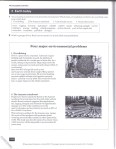
Many texts will have a clear topic, so this is a good place to start (especially if the topic is one which is relevant to students’ needs and interests- and if it isn’t why are you using it? 😉 ). You can simply ask the students to find words and phrases in the text connected with the topic of X, or ask them to categorise the words and phrases they find into subsections of the topic (example here from IELTS Foundation 2nd ed-click to enlarge).

You can help to expand students’ vocabulary by asking them to find synonyms of words you give them, in the text. This is particularly useful for those taking exams, where questions are usually paraphrased.

You can help students to see how texts are put together by asking them to find lexical links and chains in the text (example here from IELTS Foundation 2nd ed-click to enlarge)

Students can also develop their awareness of chunks and collocation by asking them to find chunks of words that go together, or asking them to search the text to find what collocates with a list of words from the text which you have given them.

Activities which help students to notice grammar or discourse

The most obvious task is to ask students to look at the examples of the language focus in the text and use them to complete rules about its use. Or they could try writing their own rules and then comparing them with a grammar reference.

An alternative is to remove those examples (or parts of them) and get students to complete the text, comparing their versions with the original. This is something which works very well for articles and for discourse markers.

Or you could give students another version of the text with deliberate errors, and ask them to find a ccertain numbers of mistakes and correct them- before, again, checking against the original.

Try a dictogloss (read a short section aloud, which contains the language you are focusing on) and ask students to write down as much as they can before reconstructing the text together. This works well for structures which are very frequent, such as reference links or articles.

Having thus drawn the students’ attention to language, I believe that it is important to give them some opportunity to use the language. Opinion varies as to whether practising the language per se helps students to acquire it, but at the very least it is another opportunity to notice it, which does seem to help with acquisition.

5 Comments

Filed under Exploiting authentic reading materials, IELTS, Teaching methodology

Creating effective reading tasks

In my previous post, I looked at the whole idea of reading tasks and the arguments for and against using them. One conclusion I came to is that, ideally, tasks should bear some relation to the kinds of processes we would use when reading in real life contexts.

There are some quite simple task types which will work for a lot of texts. For example, setting up the topic (using pictures perhaps, or the title) and then asking students think of questions that they would like answered about the topic. Alternatively, ask them to write down what they expect to learn and then read to check their ideas.  This kind of approach has the obvious advantage of no preparation, and is very close to what we would do in the real world.

Similarly, with different kinds of texts, particularly factual ones, we can set tasks which require students to scan and find particular bits of information. Classic examples are small ads, tv listings etc.

More typical comprehension questions,such as we see in EL exams, tend to test what the question setter sees as the main points of the text. Of course, in real life, we are able to decide for ourselves what the main points are, which means that pre-set questions are intrinsically somewhat inauthentic. The format of typical question types can also be rather inauthentic, of course. While at IATEFL this year, I saw John Field, talking about listening, and he made the very valid point that when carrying out multiple choice questions, we are asking students to do something much more complex than simply listen for information. As well as listening for the information we require, they also have to pick up on the distractors and discount them, a sophisticated process.

Some traditional question types are closer to real world reading than others. For example, multiple matching, which is becoming a very popular exam type question. This is a task type which can work very well with short texts. In a comment on my last post, ESL Notes, asked about a possible reading task for these very short tasks (death by twitter). I think multiple matching is ideal for these kinds of texts. For example, for theseparticular texts, you could ask ‘Which text is about a fuel related tragedy?’ ‘Which text tells us about a possible miracle?’ (maybe a rather depressing lesson though? 😉 )

Form completion, note completion and summary completion can also be quite realistic, depending on the students’ context. Form completion is important in an ESOL context, note and summary completion are skills needed by students studying in the English medium.

Other tasks are not necesssarily realistic, but do have a definite value in terms of the skills they teach. For example, matching headings or summaries to paragraphs, which encourages students to read in such a way as to grasp the main point of each paragraph. Incidentally, although it isn’t foolproof, it is worth pointing out to students that the main point is often in the first sentence of the paragraph (the topic sentence).

I am also quite keen on tasks where students have to put in missing sentences or even paragraphs, as these really help develop awareness of how texts are constructed. However, they are quite difficult to construct as you have to make sure that there are very clear clues which guide them to the right answer.

This is the first part (there is more text and more gaps) of an example from Real Life Advanced, an Upper Secondary book, published by Macmillan. The original article is here.

Mark Boyle, 31, gave up using money in November 2008. He lives in a caravan that he got from Freecycle, an organisation which matches people who have things they want to get rid of with people who can use them, and so keeps usable items out of landfills. His caravan is parked at an organic farm near Bristol, where Boyle volunteers three days a week. He grows his own food, has a wood-burning stove and produces electricity from a solar panel (it cost £360 before the experiment started). He has a mobile phone for incoming calls only and a solar-powered laptop. Boyle, who has been vegan for six years, set up the Freeconomy in 2007, an online network that encourages people to share skills or possessions and now has 17,000 members. His book, The Moneyless Man: A Year of Freeconomic Living, is out now.

 1_______________My friend and I were talking about all the problems in the world, such as sweatshops, global warming, factory farms, animal testing, wars over resources. I realised they were all, in their own way, connected to money.

2_______________I sold my houseboat in Bristol and gave up my job at an organic food company. I made a list of everything I bought and tried to figure out which I could get in another way. For toothpaste I use a mixture of cuttlefish bone and wild fennel seeds. Things like iPods you just have to knock off the list, but birds in the trees around my kitchen have become my new iPod.

Everything takes more time and effort in a moneyless world. Handwashing my clothes in a sink of cold water, using laundry liquid made by boiling up nuts on my rocket stove, can take two hours, instead of half an hour using a washing machine.

It was meant to be just for a year but I enjoy the lifestyle so much that I’m just going to keep living like this. 3________________

I had a very normal childhood. I think at first my parents wondered what on earth I was doing. But now they totally support me and they say that they may even try it themselves.

A I’ve never been happier or fitter.

B Just being a vegan cuts down the number of women I’m compatible with, never mind being moneyless.

C It all started in a pub

D My girlfriend isn’t that keen on my lifestyle though.

E Sometimes it is frustrating trying to socialise with no money

F I decided to give up cash.

The answer to the first gap is ‘C’. This is clear if you understand how narratives work- that we start by giving the background- where he was, what he was doing. The second gap is ‘F’- this relates back to his conversation- it was the result- and to the fact that he realised that the problems were all caused by money (relates to cash). It relates forward to the impact of his decision. The third gap is ‘A’ and relates back to what he says about enjoying his lifestyle. (‘D’ might also be possible here, but it is clear from the rest of the text that he doesn’t have a girlfriend).

Multiple choice and true/false are perhaps the most artificial task types. True/false also has the disadvantage of being pretty easy to guess. However, they are also the most common in exams, which many of our students will need to take, so it is perhaps worth giving them practice in these task types for that reason alone. Some tips for writing these types of questions:

True/false

  • Don’t use the exact language in the text- paraphrase.
  • Make sure there is only one idea in each statement, so that students aren’t likely to think it is partially true. For this reason, keep statements short.
  • Make sure there is roughly an equal numbe of T/F answers, and be careful not to create a pattern (e.g. T then F then T)

Multiple Choice

  • Paraphrase as above.
  • Make sure all the choices are plausible and can’t be guessed or answered through general knowledge (for example, a well known piece of ESOL material which asked largely Muslim students about what Ramadan is)
  • Don’t make the distractors (the wrong answers) too complex. You are testing what’s in the stem (the first part of the question).
  • Make all the choices a similar length if possible, and don’t make the correct answer the longest or shortest.
  • Make sure the answer isn’t always ‘C’ etc.

Whatever task type you use, in the spirit of demand high teaching, I think it’s always a good idea to devote some time to exploring why students have chosen particular answers. What in the text led them to that conclusion? This will not only prevent guessing, but will, I think, actually go some way towards developing their ability to tackle texts.

2 Comments

Filed under Exploiting authentic reading materials

What kind of reading tasks might be worthwhile?

In my first reading related post, I looked at things you might consider when selecting authentic reading texts. There’s quite a lot to consider, I think, and I can sometimes spend several hours searching for the right text. As Ray Williams said, back in 1986 (ELTJ 40(1)), ‘in the absence of interesting texts, very little is possible.’

Having spent all that time, the last thing you want is to only end up with a 20 minute activity in class, so I think it’s really worth considering how you can maximise what students get out of the text . Clearly, a major reason for using texts in class is in order to provide students with the opportunity to ‘notice’ language in context. However, can texts also be used to develop students’ actual ability to read effectively and efficiently?

Some of the reading skills which teachers and materials commonly aim to develop include:

  • Skimming
  • Scanning
  • Reading for gist
  • Predicting content
  • Identifying point of view and tone
  • Identifying main points
  • Guessing meaning from context
  • Recognising the organisation of a text

In recent years there has been some debate about the whole idea of developing  students’ reading skills. Walter and Swan point out  that there is perhaps an assumption that the learner does not already have these skills and that, if they do have them, that they are unable to transfer them into their first language. Thornbury  gives the example of how he was able to apply his L1 reading skills to reading in Spanish, and how, as his Spanish improved, so did his reading. I think these are both very valid points. However, I do slightly wonder if Thornbury should consider himself typical of a language learner, as he was clearly very aware of his own language learning process. In my experience, many learners do not always have good reading skills in their first language and many do not seem able to automatically transfer them.

I certainly agree that it can be patronising to make students jump through hoops of skimming and scanning and I also agree with Swan and Walter that guessing meaning from context activities are too often impossible. That said, that if we reduce reading texts to no more than vehicles for useful language, we are selling our students short. What about the information and/or pleasure that can be gained from a text? We don’t read in our daily lives in order to notice language.

Of course, we don’t usually set ourselves a task either!

But we do need to give our students a reason to read, and a well designed task can provide that, as well as the opportunity to develop reading skills if they need to be developed. In order to be able to use a text as a source for language, the text needs to have been understood first and a task can also help to ensure this.

The question, perhaps, is not so much whether we should be setting reading tasks, but what kind of tasks we should be setting. Ideally, I think that the task should bear some resemblance to the way we might naturally read that genre of text. So, if you want students to read a set of food labels, there is not much point in setting a gist task! If it’s a carefully argued article, on the other hand, you might want to set a task which helps learners to identify these arguments and how they link together

Research has found (Carrell 1984, 1985), that understanding how different types of texts are organised is a key factor in understanding a text. This is something which is often focused on in EAP, but, I think, much less so in General English. Obviously this is partly because academic writing tends to have more clearly defined text types (cause and effect, problem-solution etc). However, I think all students can benefit from being able to recognise the organisation and development of a text. Here are a few prediction type activities which might help with this:

1 Get students to look at the visual clues- how the text is laid out, any pictures, any headings or sub-headings. Where do they think the text came from?

2 For a newspaper article, try getting students to read the title and the first paragraph. This is often a summary of the rest of the article, so students could predict what will be found in the rest of the article.

3 Ask students to read just the first sentence of each paragraph. This is often the topic sentence (sentence with the main idea), so this can give a good overview of the content of the text, and its organisation.

4 If the text already has comprehension questions (i.e. an exam practice text), give out the questions before the text and ask them to use the questions to predict the content of the text. Exam questions should go in the same order as the text, so it should be possible to make some predictions about the organisation of the text as well.

In my next post, I’d like to look more carefully at some different types of tasks and questions, the aim behind them, and some tips for creating them. If you want to receive this through your email, the button is on the right.

12 Comments

Filed under Exploiting authentic reading materials

‘Pushing’ student output: one way to Demand High Teaching?

Having taken part in the ELTChat discussion last week on Demand High Teaching (see Jim Scrivener and Adrian Underhill’s slides from their IATEFL talk here), I was reminded of a session I taught for in-service teachers on the Output Hypothesis. Back in 1985, Merrill Swain studied children learning French in an immersion context in Canada and discovered that while their comprehension was good, their productive skills were not very strong. They had been given lots of what Krashen calls ‘comprehensible input’, but, she concluded, they had not been given enough opportunity to use the language themselves. Output is important because:

  1. While attempting to produce the target language, learners may notice their linguistic short-comings, ‘notice the gap’
  2. Output is a way of trying out language and testing hypotheses that are forming.
  3. Speech (and writing) can offer a way of reflecting on language itself in interaction with other students, helping to clarify ideas and iron out problems.

 Swain also came up with the idea of ‘push’ (see here for Thornbury’s excellent blog post on the idea of ‘push’), saying:

‘Comprehensible output refers to the need for a learner to be pushed toward the delivery of a message that is not only conveyed but that is conveyed precisely, coherently and appropriately.’

Just how helpful this ‘push’ can be is illustrated in the following example from a piece of research by Alison Mackey (2002). She recorded ESL learners interacting with other learners, teachers and native speakers and then asked them to watch the videos and reflect on what had been happening for them at the time.

This is a transcript of one of these interactions:

NNS: And hand- in hand have a bigger glass to see.

NS: It’s errr. You mean something in his hand?

NNS: Like spectacle. For older person.

NS: Mmm. Sorry, I don’t follow. It’s what?

NNS: In hand have- he have- has- a glass for looking through for make the print bigger to see, to see the print, for magnify.

NS: He has some glasses?

NNS: Magnify glasses. He has magnifying glass.

NS: Oh, aha, I see, a magnifying glass. Right, that’s a good one. Ok.

And this is what the student said about the interaction:

In this example I see I have to manage my err err expression because he does not understand me and I cannot think of exact word right then. I am thinking, thinking, it is nearly in my mind, thinking bigger and magnificate and eventually magnify. I know I see this word before but he is forcing me to think harder, think harder for the correct word to give him so he can understand and so I was trying. I carry on talking until finally I get it and when I say it then he understand it, me.

So, we can see that being ‘unhelpful’ to a learner can actually lead to much more learning than jumping in and giving them the word they’re looking for straightaway.

Image


3 Comments

Filed under Teaching methodology

Should we pre-teach vocabulary before reading- and, if so, how?

Photo Credit: Chris JL via Compfight cc

Photo Credit: Chris JL via Compfight cc

Pre-teaching vocabulary is something that many of us were taught to do on our CELTAs or other pre-service course. I hold my hand up to having trained other teachers to do it- and to having, as a result, sat through an excruciating 20 minutes plus while trainee teachers laboriously explained word after word until the students had lost the will to live, never mind the will to read the text.

Another argument against pre-teaching is that it doesn’t train students for real-life encounters with language; that we’re spoon feeding them rather than teaching them the skills to deal with unknown words.

I am sure this is true, and I would certainly not recommend pre-teaching as a way of explaining all the words in a text that students are unlikely to know. However, done sparingly, I think it can have some value both in terms of practicality (making sure they can actually do the task you set, and that you don’t have twenty people all asking the same question, one after another) and in terms of helping to raise interest and motivation.

The questions you need to ask yourself are, I think:

–          Do the students actually need to know this word/phrase to do the task?

–          Could they guess it from context?

–          Can this word or phrase be used productively within this lesson?

Selecting what vocabulary to pre-teach

1. Look at what vocabulary the students will need to know to do the task you set, rather than what they probably won’t know in the text.

2. Look at vocabulary which is directly related to the topic of the text, so that it can be used to activate schema.

To illustrate what I mean, here is a scan of three pages from IELTS Foundation 2nd edition Macmillan 2012, with a set of activities around a reading text. Looking at the tasks set on the third page, there are certain words which the students will need to know to carry out these tasks. I would suggest:

current    reluctant    short term effects   essential   reduce   prevent   tend to  encourage   efficient

congestion charge  higher parking charges  public transport  pay per mile

The first set of words could be looked at, as necessary, when the teacher is setting the tasks. Many of them are very typical of IELTS questions and so might well be already known. If not, a matching activity with synonyms might work well with these words, especially with synonyms in the text (most IELTS questions will use a synonym rather than the words in the text itself)

The second set of words however are all linked to the topic, so provide scope to act as a lead in to the text as well as a pre-teaching activity. If you look at the first page of the extract, you can see that these and other related words from the text are given to students to categorise into traffic problems and possible solutions. The students then use the words in a personalised way, to talk about problems in their city before reading the text and comparing with their ideas and opinions.

One of the major problems with pre-teaching vocabulary is dealing with a set of seemingly disconnected words, with no context. Choosing words which relate to the topic of the text is a good way round this issue, and the words can also be used productively.

Ideas for pre-teaching vocabulary

1 Categorising is often a good approach, as it should get the learners to engage with the meaning of the words. If the words aren’t related in terms of meaning you could always get them to categorise into ‘words I know’, ‘words I am not sure about ‘and ‘words I don’t know’. Done in pairs, this should lead to peer teaching and you can monitor and then help with any still causing difficulties.

2 Connecting words: ask students to choose two or more words and phrases  from those you want to pre-teach and write a sentence using them. This will only really work if the words are at least half known though.

3 Predicting: Ask students to make predictions about the text using the words given. Depending on the words and the students this could range from guessing the topic, to guessing the attitude of the writer, to guessing the answers to the questions they are going to answer.

4 Using the context of the text: Pull out some sentences which contain the words you want to pre-teach and put them up on the board with gaps. Get the students to decide which words go in which gaps.

5 If appropriate, matching the vocabulary you want to pre-teach with pictures. Relatively easy these days, pictures are a great way of providing the context which would otherwise be missing.

If you do decide to pre-teach (and there are, as we have seen, arguments against it), make sure that the words and phrases are useful and contextualised and that the time spent pre-teaching is worth it for what the students will get out of the process.

Please see the previous post on selecting authentic reading materials if this is an area which interests you, or the next one on reading tasks.

If you are currently taking CELTA, can I suggest my e-book, The CELTA Teaching Compendium, available from Amazon and Smashwords, containing everything you need to know for CELTA teaching practice.

celta compendium cover

27 Comments

Filed under Different ways to use a coursebook, Exploiting authentic reading materials

Tips on selecting effective authentic reading materials

Many teachers like to use authentic materials in class, and they can obviously be a wonderful source of language. Over the next few weeks, I’d like to offer some thoughts and tips on how you might go about selecting and exploiting these materials, to maximise their benefit to students.

Nunan (1988) defines authentic materials as those ‘which have been produced for purposes other than to teach language’, so that might mean emails, blogs, statistics, timetables, advertisements, instructions, labels, menus etc as well as articles from newspapers and magazines.

Relevance and interest

Have you ever done any research into the literacy practices  of your students? In other words, what they actually read (and write) in their daily lives, in their first language as well as in English. Ask students to keep a note of everything they read, including cereal packets etc, for a couple of days. You may be surprised, and it will probably give you some new ideas of where to look for material.

Similarly, the more you can find out about the kinds of topics your students are interested in, the more successful your texts are likely to be. Obviously, if the students are preparing for an exam, you will also need materials and topics which reflect the exam they are taking.

Cultural appropriateness

This is a HUGE area, but I think there are three main points:

  1. Being careful about materials which may offend political, social or religious mores. If you know the context you are teaching in, this should be fairly easy to avoid. Or, if you are confident about your class, you may be able to touch on subjects which published material would have to avoid. I once taught a fabulous class about dangerous sports, which was fabulous not because of anything I did, but because one of the students suddenly started telling us all about the time he played Russian Roulette. Everyone was, unsurprisingly, fascinated and completely involved in communicating with one another.
  2. Being careful about materials which your students simply can’t relate to. This is a criticism aimed, not unfairly, at a lot of published ELT materials. ESOL learners in Birmingham are unlikely to want to read about skiing holidays, for example. However, just because something is outside the students’ experience, does not necessarily mean that it is uninteresting. It’s a judgement call.
  3. Consider visual literacy as well. The way the text is laid out may cause confusion. This is particularly an issue for students with low levels of literacy in their first language, but can also cause problems if the norms aren’t transferable.

For example, look at this leaflet:

The bullet points in the top right hand corner are used to give reasons why you should join- but this is only implied through the visual convention and might well not be obvious to a student.

The speech marks on the left indicate that what is inside them is a quote- but you need to know what the speech marks mean.

The asterisk in the bottom left-hand corner indicates some ‘small print’ information (in itself another convention!)

Students need to know a lot about the conventions of this type of text to be able to make sense of it. Other examples would be speech bubbles which always go from left to right, italics to indicate direct speech and bold or capitals to indicate that something is particularly important.

Linguistic and cognitive demands of the text                                                                                                    

To a certain extent, the question isn’t so much about how difficult the text is, but about what you expect learners to do with it (the task). However, realistically, if a text is syntactically very complex and contains a great deal of unknown vocabulary, it is unlikely to be very motivating!

As teachers, we generally have a good sense of the ‘level’ of a text. However, if you aren’t sure, you could try running it through a programme which will assess the difficulty of the vocabulary, such as  the Oxford 3000 profiler. According to this tool, if 100% of the words in your text are in the Oxford 3000, it is at a low intermediate level, if 90-95%, it’s upper intermediate and 70-90%, it’s advanced. This obviously won’t help with assessing the complexity of the syntax though, or other factors such as the level of background knowledge or maturity required.

Another factor is how clearly the text is organised. This can be a real headache with newspaper texts, which often have very short paragraphs, not necessarily linked clearly to the surrounding text. I remember an activity in the first edition of Headway Intermediate where the students had to order the paragraphs of a newspaper article. It was virtually impossible, because the links weren’t clear enough- and because the students weren’t made aware that the first paragraph of a newspaper article usually sums up the whole story.

It is also worth thinking about whether you want to use the text as a model for writing and, if so, whether, for example, a newspaper article is a type of discourse that students might actually want or need to write in real life (unless they are budding journalists of course)

Practical considerations

  • Length (if it’s too long, you could edit it, but would need to be very careful about removing some of the features which make the text authentic or making it difficult to follow the links which make it cohesive)
  • Font size and style (may be too small or difficult for learners not yet familiar with different ways of reproducing the Roman alphabet)

In my next post, I’ll look at some ideas for exploiting texts once you’ve found them. If you want to get the next post automatically, just hit the ‘Follow blog via email’ button on the right.


14 Comments

Filed under Exploiting authentic reading materials

Listen up and take notice:using (semi) authentic listening resources productively

More and more authentic (or semi authentic) listening texts are appearing in published materials. In this session we will look at the reasons for this and at how these materials can be exploited fully to provide not just more realistic listening practice but also a rich resource for developing learners’ own language and speaking skills.

This post is the substance of my presentation at IATEFL Glasgow on 20/3/12, title and abstract above. It can be read without reference to the slides, but the slides can be found on the Glasgow Online website at:

http://iatefl.britishcouncil.org/2012/sessions/2012-03-20/listen-and-take-notice-using-semi-authentic-listening-resources-productively

What makes a listening text authentic? The difference between a listening text which has been scripted and a piece of authentic dialogue is very obvious once it has been transcribed. In real life speech is full of :

  • Repetition
  • False starts, rephrasing and clarification
  • Hesitation and fillers
  • Simpler sentences or even ‘ ungrammatical’  language
  • Paralinguistic features
  • Backchannelling
  • Ellipsis

If the only practice we give our students is with material that does not have these features, how can we really be preparing them to listen in the real world?

On the other hand, fully authentic material, material which was never intended to be used for learning purposes, may be a little too authentic.

In their book,  Conversation: from description to pedagogy, Scott Thornbury and  Diana Slade make the following observation:

‘Conversations are notoriously hard to capture on tape and even harder to listen to. In the interests of intelligibility…speakers should be recorded talking about a topic without being told exactly what to say in advance.  This way there is more likelihood of capturing naturally occurring features of conversation such as hesitations, fillers, false starts, overlaps etc.’

This is what is known as a semi authentic listening. I recently wrote the new edition of Total English Intermediate. This book, and the other levels in the series, contain at least one and often two of these semi authentic recordings per unit, using a variety of native speakers and non native speakers.

When we listened to the recordings, we discovered that, as well as providing good listening practice, the scripts were also full of examples of natural English use, which learners could learn from.

But how to get them to notice and use this language, or these features? One simple, but very useful framework comes from Thornbury and Slade. They argue that there are three key things we need to be giving our learners:

Exposure, Instruction and Practice

Exposure, or giving opportunities to hear language being used, is the one we tend to be quite good at (though I would argue that we need a lot more. Many coursebooks only have one ‘listening’ per unit.)

It is however, not really enough. Learners will either fail to notice salient points, or take a very very long time to notice them.

So we also need instruction- or occasions when their attention is drawn to these salient points of language.

And, of course, we also need practice. Instinctively, we all know that to learn any practical skills- and that’s what language is- requires practice.

So,  let’s take an example of an unscripted anecdote about a childhood memory.  This appears in Unit 10 of New Total English Intermediate, but you could use any recording which follows the structure of a narrative or anecdote.

The aim is to help students become aware of the discourse structure of an anecdote, following Labov’s Standard Western Narrative:

Abstract Announces that a story is about to start (optional)
Orientation Provides background information
Complication Introduces a problem or a turning point into the main sequence of events
Evaluation Show the speaker’s attitude to the events (may be spread throughout the story)
Resolution What finally happened
Coda Returns listeners to the present (optional)

Obviously the way this is phrased is quite complex, but it can easily be simplified for students. An awareness of this discourse structure is extremely useful because we use it all the time. In job interviews for example, when you’re giving an example of a success you had, when you’re giving an excuse and so on.

So, learners are  exposed to the discourse structure by being asked to put the main events in order as well as any other comprehension tasks. Next they are instructed in the sequence of narratives and finally they tell their own similar anecdote or story, practising the structure.

Alternatively, they could retell the story from the point of view of a different protagonist. This might be useful in an ESOL context, for example, where talking about childhood memories might be inappropriate.

But exposure, instruction, practice isn’t the only way the triangle can work. Alternatively, we could have:

Instruction-Exposure-Practice

 Let’s look at an example which focuses on vocabulary this time. The recording I used featured two short monologues in which people talked about problems in the cities where they lived (Madrid and Edinburgh). A lot of useful vocabulary came out of these recordings, for example;

building work, construction, drilling, exhaust fumes, heatwave, roads being blocked,  horns honking rush hour, terribly cold, tower blocks.

We started by asking the students to categorise these words and phrases into Noise, Types of buildings, Weather, Pollution and Congestion. This was the instruction part of the triangle.

Next the students listened to the monologues and made notes in each category. In this way they were exposed to the language in context. Finally, they carried out a parallel task describing their own town or city.

Thirdly, the triangle could, of course, also be practice-exposure-instruction (and then maybe more practice)

This works well with a recording in which students listen to mote proficient speakers carrying out the same task as themselves, a technique from task-based learning. In my example, learners are asked to use a leaflet to plan a day trip to London.

To follow the practice- exposure-instruction triangle, learners could be asked to first carry out the task themselves. That’s the practice. Then they could listen to the recording, which is of two native speakers and one very proficient non native speaker doing the same task and find out what they decide to do. That’s the exposure.

Finally, they can look at the transcript and underline the language the speakers use to make suggestions and respond to ideas. And that’s the instruction.

While I wouldn’t suggest looking at the transcripts while listening for the first time, they can be a very useful resource. Sound disappears, the transcript captures it so that students can look again and notice the features of natural spoken English.

In this case, what they will find is a good number of useful adjacency pairs for making and responding to suggestions. E.g.

‘Are you guys Ok with paying for that?’ ‘Yes,  I think so’

Incidentally, I noticed a lot of use of the phrase ‘you guys’, despite the fact that all three speakers were female. Probably not something I’d ever have thought of writing in a scripted dialogue.

Transcripts can also be a wonderful resource for developing pronunciation and fluency through automaticity.

I’m using this term as Scott Thornbury uses it, to mean memorising chunks of language that can then be pulled whole out of your store. He talks about creative automaticity. These exercises are not creative in themselves, but will lead to the learners using the language, or having it available to use (as we aren’t mandating it), in a creative way as they carry out the final task themselves.

Firstly, select just a small part of the recording, perhaps some phrases that you expect the learners may want to use themselves in the parallel task, ask the learners to listen again and mark the stressed syllables on the transcript. Ask them what happens to the unstressed syllables- they are weakened or reduced, and use the recording as a model for drilling.

Alternatively, students could read aloud at the same time as listening, trying to make their speed and intonation as close as possible to what they hear. This is a very old fashioned technique, and I wouldn’t advise overdoing it, but actually it can really help with being able to deliver chunks in a confident and fluent manner.

And finally, students can read the dialogue aloud to each other. I would suggest, however, that to make this a bit more fun, as well as more testing, you set the activity up so that they can look at the dialogue, but only when they are NOT speaking or listening. When they speak or listen, they have to look at their partner. This means that they have to memorise the chunk, in a similar way to a running dictation.

While I obviously hope that you’ll take a look at the material in New Total English, all of the ideas could be used with any authentic or semi authentic recording- and there are more and more available.

Useful reading

Conversation: from description to pedagogy- Scott Thornbury and Diana Slade- CUP

Listening Myths: applying second language research to classroom teaching- Steven Brown-Michigan ELT- 2011

How to Teach Listening- JJ Wilson- Pearson

Listening in the Language Classroom- John Field- CUP

Teaching and Researching: Listening- Michael Rost- Longman

2 Comments

Filed under Different ways to use a coursebook, Exploiting authentic recordings and videos

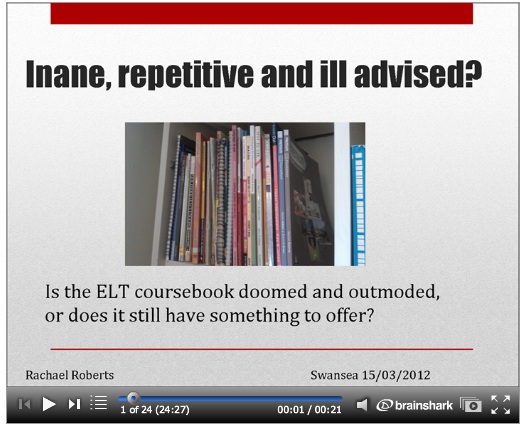
Inane, repetitive and illadvised? Is the ELT coursebook doomed and outmoded, or does it still have something to offer?

Inane-repetitive-and-ill-advised-Is-the-ELT-coursebook-outmoded-or-does-it-still-have-something-to-o-883693503

This is a version of a talk I gave at Swansea University in March 2012. It’s about 25 minutes, plus time to read some of the slides, so get a cup of coffee first!

Some of the questions I try to answer:

  • How is the methodology behind a coursebook decided on?
  • Are we now in an era of ‘textbook defined practice’?
  • Should we be using coursebooks at all, and if so how should we be using them?

9 Comments

Filed under Different ways to use a coursebook, Teaching methodology

#ELTChat summary on Multiple Intelligences 07/03/12

This is a summary of the first ELT Chat on Wednesday 7th March 2012 about Multiple Intelligences.
#ELTChat takes place on Twitter every Wednesday at 12pm and 9pm BST www.eltchat.com
Shaun Wilden kicked off by giving us a link to the Wikipedia page on Multiple Intelligences. The link is below, but basically, it’s a theory proposed by Howard Gardner in the 1980s, which says that rather than there being just one kind of intelligence, there are different kinds of intelligence:
• Spatial
• Linguistic
• Logical-mathematical
• Bodily-kinesthetic
• Musical
• Interpersonal
• Intrapersonal
• Naturalistic
• Existential
(The last two were added at a later date)
The first part of the discussion mostly centred around whether MI theory had now been discredited, to what extent people believed in it and to what extent it was practised.
The overall view seemed to be that people were little sceptical about the scientific basis, but agreed that it was important to recognise that people learn in different ways, and to provide a variety of activities:

@louisealix68: think it’s good as T to know we all learn diff.(I’m visual) in order 2 help kids with learning strats best 2 them
@rliberni: yes agreed I think the idea of varying activities etc is imp and MI would help to highlight that
@breathyvowel: Yup but for me the varying comes first, and the relevance to MI is more or less incidental

@esolcourses also suggested that it might be impractical or unnecessary to devote too much time to individual differences when students actually had a lot in common. And other people suggested some drawbacks to focusing on MI:

@OUPELTGlobal: I think tchers should be careful of labelling their sts – different sts can use
different ints at different times.
@michaelegriffin: Just sort of the cultiness of MI puts me off. I am with @Marisa_C about
much of it just being sensible
@kevchanwow: agree that a wide range of activities is necessary to keep students involved. But does MI offer the right framework?

Several people felt that, irrespective of whether the science actually stood up, there was a benefit in discussing multiple intelligences with students so that they would be aware of different ways of learning and able to ‘play to their strengths’ (@OUPELTGlobal)

@kevchanwow: MI as a means for students to discuss how they learn. An exercise in empathy and to realize that there are many ways to learn and that it is OK to be (learn) different
@samshep: we cn be interested in how ss learn w/out labelling them. Also shd encourage thm to try diff things & expand capabilities
@kevchanwow recognizing what brings our students joy and how where they excel is key for rapport. But does MI help us do that?

There was also seen to be a benefit in teachers at least considering MI, so that they would not assume that all learners learnt the same way (or the same way the teachers did)

It was questioned whether MIs needed to be formally assessed, but @Marisa_C suggested a possible test for anyone who wanted to do so, the Barsch Learning Styles Inventory, available online. @worldteacher also provided a short MI quiz (see below)
@ louisealix68 mentioned Thomas Armstrong (link below) as a good place to go for more information on MI.

People started to discuss other systems of learning styles:
@samshep surely multiple intelligences is just learning styles dressed in different clothes w same pitfalls and questions.
@shaunwilden: @samshep I agree and there are far too many learning styles models out there, can get very confusing 🙂
@teflerinha asked whether people felt that multisensory learning (link below), which has some crossover with MI, was particularly suitable for YLs. It was generally agreed that it was, though the point was made by @worldteacher that it could also apply to adults.
@louisealix68 raised the question of whether males had different learning styles to females. @breathyvowel commented: I definitely find that the atmosphere changes with gender balance, so perhaps unconsciously yes and @teflerinha commented: Thnk gender cn affct way class interacts. Once had all male CELTA & all activities finished superfast.

A little later there was also discussion of naturalist and existential intelligences and how these might be accommodated. @teflerinha made the point that existential or spiritual intelligence was becoming a big thing in coaching and business training(essentially about connecting with your inner wisdom and with others) and @leoselivan suggested that naturalist intelligence lent itself well to categorising and ordering tasks.

@cherrymp commented that perhaps Emotional Intelligence was more important to cultivate than MI (“the ability to identify, assess, and control the emotions of oneself, of others, and of groups”.)

@Marisa_C asked for examples of MI based activities which had been used successfully:
@teflerinha: Extended project type work tends to be good for MI I think as there are a variety of tasks
@louisealix68: e.g. use running dictation for kinsaesthetic. Dictogloss = linguistic/math
@esolcourses: Online drag and drop picture quizzes on my website 4 spacial intel. – work well as ind. or group activities. http://t.co/DwwK3BTV
@louisealix68: learn vocab=rote (music); organise alphabetically – math; read/cover = ling
@rliberni: used to do dictation in teams with paper up on wall 1st grp to complete with all correct won
@teflerinha: And giving ss the opportunity to work alone as well as in pairs or groups- for intrapersonal learners
@michaelegriffin: Drawin’, movin’, clappin’ actin’, connectin’, solvin’ (puzzles),
@OUPELTGlobal : Asking sts whon learn visually to find their own images for texts, adds to their understanding/learning of the text

There was a questions from @SueAnnan as to whether MI meant more planning. Some comments:
@leoselivan: no but it does require thinking on your feet sometimes. I think if a T is aware u
don’t need to spend MORE time planning
@teflerinha: Not so much a lot of prep as bearing it in mind when choosing activity types I
think
@shaunwilden: No cos it is everyday teaching anyway 🙂
@OUPELTGlobal: I don’t think so. Once I was aware of them, and my sts too, we sort of
helped each other. Awareness is very important!
But @SueAnnan made the point that, while she agreed to an extent, she had seen ss turned off by non traditional activities. @michaelegriffin agreed, ‘I think that is a very good point and quite common… Like “why are we drawing in English class???!?!” “Give me verbs!”’
@SophiaKhan4suggested that it was ‘sometimes hard to go out of your own comfort zone when choosing activities tho’ and @NikkiFortova agreed ‘@SophiaKhan4 so so true, but if we don;t go out of our comfort zone from time to time, we don’ t learn @shaunWilden said that ‘thats only natural isn’t it, if we have a class we need to cater to all which might mean some are happy when others aren’t.’

Perhaps a good conclusion would be @shiftparadigm’s comment,’ In practice, might a good place to start be recognizing and accommodating a student’s strengths?’

List of useful links (please let me know if any don’t work)

Link to Wikipedia page on MI http://en.wikipedia.org/wiki/Theory_of_multiple_intelligences (@ShaunWilden)
Link to Thomas Armstrong’s webpage http://www.thomasarmstrong.com/multiple_intelligences.php
Link to Barsch Learning styles inventory http://t.co/2W7ckOep (@Marisa_C)
Link to MI Quiz http://t.co/zqOgEMKN (@worldteacher)
Link to Howard Gardner’s book on Googlebooks http://t.co/0TagR8U6 (@Marisa_C)
Link to info on multisensory learning (VAK) http://tlp.excellencegateway.org.uk/tlp/pedagogy/assets/documents/qs_multi_sensory_learning.pdf (@teflerinha)
Link to VARK learning styles http://t.co/ct36VJSi @rliberni)
Link to Bonnie Tsai, interesting speaker on MI http://t.co/ly1oLHQb (louisealix68)
Whole set of links on MI http://cybraryman.com/multipleintel.html (@cybraryman1)
Googlebooks link to Multiple Intelligences in the Classroom http://t.co/oBKyBZlc (@marisa_C)
Link to page on Multiple Intelligences http://t.co/AcfXd99B (@cherrymp)
Link to Multiple Intelligences lesson plans http://t.co/CKyTfbx7 (@cherrymp)
Link to a whole list of learning styles resources, diigo by @carldowse http://www.diigo.com/list/carldowse/learning-styles (@SueAnnan)
Link to article on Integrating MI in ESL/EFL classrooms http://t.co/vrtkdLon (@worldteacher)
Link to MI lesson plan http://t.co/ae3xEz66 (@shaunWilden)
Link to Howard Gardner, Multiple Intelligences and Education http://t.co/tpleDJxb (@cherrymp)
Link to an interactive version of Blooms Taxonomy, revised for 21st Century http://t.co/q2IApHij (@nikkiFortova)

2 Comments

Filed under Differentiation, ELT Chat summaries