Tag Archives: ESL

Creating effective reading tasks

In my previous post, I looked at the whole idea of reading tasks and the arguments for and against using them. One conclusion I came to is that, ideally, tasks should bear some relation to the kinds of processes we would use when reading in real life contexts.

There are some quite simple task types which will work for a lot of texts. For example, setting up the topic (using pictures perhaps, or the title) and then asking students think of questions that they would like answered about the topic. Alternatively, ask them to write down what they expect to learn and then read to check their ideas.  This kind of approach has the obvious advantage of no preparation, and is very close to what we would do in the real world.

Similarly, with different kinds of texts, particularly factual ones, we can set tasks which require students to scan and find particular bits of information. Classic examples are small ads, tv listings etc.

More typical comprehension questions,such as we see in EL exams, tend to test what the question setter sees as the main points of the text. Of course, in real life, we are able to decide for ourselves what the main points are, which means that pre-set questions are intrinsically somewhat inauthentic. The format of typical question types can also be rather inauthentic, of course. While at IATEFL this year, I saw John Field, talking about listening, and he made the very valid point that when carrying out multiple choice questions, we are asking students to do something much more complex than simply listen for information. As well as listening for the information we require, they also have to pick up on the distractors and discount them, a sophisticated process.

Some traditional question types are closer to real world reading than others. For example, multiple matching, which is becoming a very popular exam type question. This is a task type which can work very well with short texts. In a comment on my last post, ESL Notes, asked about a possible reading task for these very short tasks (death by twitter). I think multiple matching is ideal for these kinds of texts. For example, for theseparticular texts, you could ask ‘Which text is about a fuel related tragedy?’ ‘Which text tells us about a possible miracle?’ (maybe a rather depressing lesson though? 😉 )

Form completion, note completion and summary completion can also be quite realistic, depending on the students’ context. Form completion is important in an ESOL context, note and summary completion are skills needed by students studying in the English medium.

Other tasks are not necesssarily realistic, but do have a definite value in terms of the skills they teach. For example, matching headings or summaries to paragraphs, which encourages students to read in such a way as to grasp the main point of each paragraph. Incidentally, although it isn’t foolproof, it is worth pointing out to students that the main point is often in the first sentence of the paragraph (the topic sentence).

I am also quite keen on tasks where students have to put in missing sentences or even paragraphs, as these really help develop awareness of how texts are constructed. However, they are quite difficult to construct as you have to make sure that there are very clear clues which guide them to the right answer.

This is the first part (there is more text and more gaps) of an example from Real Life Advanced, an Upper Secondary book, published by Macmillan. The original article is here.

Mark Boyle, 31, gave up using money in November 2008. He lives in a caravan that he got from Freecycle, an organisation which matches people who have things they want to get rid of with people who can use them, and so keeps usable items out of landfills. His caravan is parked at an organic farm near Bristol, where Boyle volunteers three days a week. He grows his own food, has a wood-burning stove and produces electricity from a solar panel (it cost £360 before the experiment started). He has a mobile phone for incoming calls only and a solar-powered laptop. Boyle, who has been vegan for six years, set up the Freeconomy in 2007, an online network that encourages people to share skills or possessions and now has 17,000 members. His book, The Moneyless Man: A Year of Freeconomic Living, is out now.

 1_______________My friend and I were talking about all the problems in the world, such as sweatshops, global warming, factory farms, animal testing, wars over resources. I realised they were all, in their own way, connected to money.

2_______________I sold my houseboat in Bristol and gave up my job at an organic food company. I made a list of everything I bought and tried to figure out which I could get in another way. For toothpaste I use a mixture of cuttlefish bone and wild fennel seeds. Things like iPods you just have to knock off the list, but birds in the trees around my kitchen have become my new iPod.

Everything takes more time and effort in a moneyless world. Handwashing my clothes in a sink of cold water, using laundry liquid made by boiling up nuts on my rocket stove, can take two hours, instead of half an hour using a washing machine.

It was meant to be just for a year but I enjoy the lifestyle so much that I’m just going to keep living like this. 3________________

I had a very normal childhood. I think at first my parents wondered what on earth I was doing. But now they totally support me and they say that they may even try it themselves.

A I’ve never been happier or fitter.

B Just being a vegan cuts down the number of women I’m compatible with, never mind being moneyless.

C It all started in a pub

D My girlfriend isn’t that keen on my lifestyle though.

E Sometimes it is frustrating trying to socialise with no money

F I decided to give up cash.

The answer to the first gap is ‘C’. This is clear if you understand how narratives work- that we start by giving the background- where he was, what he was doing. The second gap is ‘F’- this relates back to his conversation- it was the result- and to the fact that he realised that the problems were all caused by money (relates to cash). It relates forward to the impact of his decision. The third gap is ‘A’ and relates back to what he says about enjoying his lifestyle. (‘D’ might also be possible here, but it is clear from the rest of the text that he doesn’t have a girlfriend).

Multiple choice and true/false are perhaps the most artificial task types. True/false also has the disadvantage of being pretty easy to guess. However, they are also the most common in exams, which many of our students will need to take, so it is perhaps worth giving them practice in these task types for that reason alone. Some tips for writing these types of questions:

True/false

  • Don’t use the exact language in the text- paraphrase.
  • Make sure there is only one idea in each statement, so that students aren’t likely to think it is partially true. For this reason, keep statements short.
  • Make sure there is roughly an equal numbe of T/F answers, and be careful not to create a pattern (e.g. T then F then T)

Multiple Choice

  • Paraphrase as above.
  • Make sure all the choices are plausible and can’t be guessed or answered through general knowledge (for example, a well known piece of ESOL material which asked largely Muslim students about what Ramadan is)
  • Don’t make the distractors (the wrong answers) too complex. You are testing what’s in the stem (the first part of the question).
  • Make all the choices a similar length if possible, and don’t make the correct answer the longest or shortest.
  • Make sure the answer isn’t always ‘C’ etc.

Whatever task type you use, in the spirit of demand high teaching, I think it’s always a good idea to devote some time to exploring why students have chosen particular answers. What in the text led them to that conclusion? This will not only prevent guessing, but will, I think, actually go some way towards developing their ability to tackle texts.

2 Comments

Filed under Exploiting authentic reading materials

What kind of reading tasks might be worthwhile?

In my first reading related post, I looked at things you might consider when selecting authentic reading texts. There’s quite a lot to consider, I think, and I can sometimes spend several hours searching for the right text. As Ray Williams said, back in 1986 (ELTJ 40(1)), ‘in the absence of interesting texts, very little is possible.’

Having spent all that time, the last thing you want is to only end up with a 20 minute activity in class, so I think it’s really worth considering how you can maximise what students get out of the text . Clearly, a major reason for using texts in class is in order to provide students with the opportunity to ‘notice’ language in context. However, can texts also be used to develop students’ actual ability to read effectively and efficiently?

Some of the reading skills which teachers and materials commonly aim to develop include:

  • Skimming
  • Scanning
  • Reading for gist
  • Predicting content
  • Identifying point of view and tone
  • Identifying main points
  • Guessing meaning from context
  • Recognising the organisation of a text

In recent years there has been some debate about the whole idea of developing  students’ reading skills. Walter and Swan point out  that there is perhaps an assumption that the learner does not already have these skills and that, if they do have them, that they are unable to transfer them into their first language. Thornbury  gives the example of how he was able to apply his L1 reading skills to reading in Spanish, and how, as his Spanish improved, so did his reading. I think these are both very valid points. However, I do slightly wonder if Thornbury should consider himself typical of a language learner, as he was clearly very aware of his own language learning process. In my experience, many learners do not always have good reading skills in their first language and many do not seem able to automatically transfer them.

I certainly agree that it can be patronising to make students jump through hoops of skimming and scanning and I also agree with Swan and Walter that guessing meaning from context activities are too often impossible. That said, that if we reduce reading texts to no more than vehicles for useful language, we are selling our students short. What about the information and/or pleasure that can be gained from a text? We don’t read in our daily lives in order to notice language.

Of course, we don’t usually set ourselves a task either!

But we do need to give our students a reason to read, and a well designed task can provide that, as well as the opportunity to develop reading skills if they need to be developed. In order to be able to use a text as a source for language, the text needs to have been understood first and a task can also help to ensure this.

The question, perhaps, is not so much whether we should be setting reading tasks, but what kind of tasks we should be setting. Ideally, I think that the task should bear some resemblance to the way we might naturally read that genre of text. So, if you want students to read a set of food labels, there is not much point in setting a gist task! If it’s a carefully argued article, on the other hand, you might want to set a task which helps learners to identify these arguments and how they link together

Research has found (Carrell 1984, 1985), that understanding how different types of texts are organised is a key factor in understanding a text. This is something which is often focused on in EAP, but, I think, much less so in General English. Obviously this is partly because academic writing tends to have more clearly defined text types (cause and effect, problem-solution etc). However, I think all students can benefit from being able to recognise the organisation and development of a text. Here are a few prediction type activities which might help with this:

1 Get students to look at the visual clues- how the text is laid out, any pictures, any headings or sub-headings. Where do they think the text came from?

2 For a newspaper article, try getting students to read the title and the first paragraph. This is often a summary of the rest of the article, so students could predict what will be found in the rest of the article.

3 Ask students to read just the first sentence of each paragraph. This is often the topic sentence (sentence with the main idea), so this can give a good overview of the content of the text, and its organisation.

4 If the text already has comprehension questions (i.e. an exam practice text), give out the questions before the text and ask them to use the questions to predict the content of the text. Exam questions should go in the same order as the text, so it should be possible to make some predictions about the organisation of the text as well.

In my next post, I’d like to look more carefully at some different types of tasks and questions, the aim behind them, and some tips for creating them. If you want to receive this through your email, the button is on the right.

12 Comments

Filed under Exploiting authentic reading materials

‘Pushing’ student output: one way to Demand High Teaching?

Having taken part in the ELTChat discussion last week on Demand High Teaching (see Jim Scrivener and Adrian Underhill’s slides from their IATEFL talk here), I was reminded of a session I taught for in-service teachers on the Output Hypothesis. Back in 1985, Merrill Swain studied children learning French in an immersion context in Canada and discovered that while their comprehension was good, their productive skills were not very strong. They had been given lots of what Krashen calls ‘comprehensible input’, but, she concluded, they had not been given enough opportunity to use the language themselves. Output is important because:

  1. While attempting to produce the target language, learners may notice their linguistic short-comings, ‘notice the gap’
  2. Output is a way of trying out language and testing hypotheses that are forming.
  3. Speech (and writing) can offer a way of reflecting on language itself in interaction with other students, helping to clarify ideas and iron out problems.

 Swain also came up with the idea of ‘push’ (see here for Thornbury’s excellent blog post on the idea of ‘push’), saying:

‘Comprehensible output refers to the need for a learner to be pushed toward the delivery of a message that is not only conveyed but that is conveyed precisely, coherently and appropriately.’

Just how helpful this ‘push’ can be is illustrated in the following example from a piece of research by Alison Mackey (2002). She recorded ESL learners interacting with other learners, teachers and native speakers and then asked them to watch the videos and reflect on what had been happening for them at the time.

This is a transcript of one of these interactions:

NNS: And hand- in hand have a bigger glass to see.

NS: It’s errr. You mean something in his hand?

NNS: Like spectacle. For older person.

NS: Mmm. Sorry, I don’t follow. It’s what?

NNS: In hand have- he have- has- a glass for looking through for make the print bigger to see, to see the print, for magnify.

NS: He has some glasses?

NNS: Magnify glasses. He has magnifying glass.

NS: Oh, aha, I see, a magnifying glass. Right, that’s a good one. Ok.

And this is what the student said about the interaction:

In this example I see I have to manage my err err expression because he does not understand me and I cannot think of exact word right then. I am thinking, thinking, it is nearly in my mind, thinking bigger and magnificate and eventually magnify. I know I see this word before but he is forcing me to think harder, think harder for the correct word to give him so he can understand and so I was trying. I carry on talking until finally I get it and when I say it then he understand it, me.

So, we can see that being ‘unhelpful’ to a learner can actually lead to much more learning than jumping in and giving them the word they’re looking for straightaway.

Image


3 Comments

Filed under Teaching methodology

Should we pre-teach vocabulary before reading- and, if so, how?

Photo Credit: Chris JL via Compfight cc

Photo Credit: Chris JL via Compfight cc

Pre-teaching vocabulary is something that many of us were taught to do on our CELTAs or other pre-service course. I hold my hand up to having trained other teachers to do it- and to having, as a result, sat through an excruciating 20 minutes plus while trainee teachers laboriously explained word after word until the students had lost the will to live, never mind the will to read the text.

Another argument against pre-teaching is that it doesn’t train students for real-life encounters with language; that we’re spoon feeding them rather than teaching them the skills to deal with unknown words.

I am sure this is true, and I would certainly not recommend pre-teaching as a way of explaining all the words in a text that students are unlikely to know. However, done sparingly, I think it can have some value both in terms of practicality (making sure they can actually do the task you set, and that you don’t have twenty people all asking the same question, one after another) and in terms of helping to raise interest and motivation.

The questions you need to ask yourself are, I think:

–          Do the students actually need to know this word/phrase to do the task?

–          Could they guess it from context?

–          Can this word or phrase be used productively within this lesson?

Selecting what vocabulary to pre-teach

1. Look at what vocabulary the students will need to know to do the task you set, rather than what they probably won’t know in the text.

2. Look at vocabulary which is directly related to the topic of the text, so that it can be used to activate schema.

To illustrate what I mean, here is a scan of three pages from IELTS Foundation 2nd edition Macmillan 2012, with a set of activities around a reading text. Looking at the tasks set on the third page, there are certain words which the students will need to know to carry out these tasks. I would suggest:

current    reluctant    short term effects   essential   reduce   prevent   tend to  encourage   efficient

congestion charge  higher parking charges  public transport  pay per mile

The first set of words could be looked at, as necessary, when the teacher is setting the tasks. Many of them are very typical of IELTS questions and so might well be already known. If not, a matching activity with synonyms might work well with these words, especially with synonyms in the text (most IELTS questions will use a synonym rather than the words in the text itself)

The second set of words however are all linked to the topic, so provide scope to act as a lead in to the text as well as a pre-teaching activity. If you look at the first page of the extract, you can see that these and other related words from the text are given to students to categorise into traffic problems and possible solutions. The students then use the words in a personalised way, to talk about problems in their city before reading the text and comparing with their ideas and opinions.

One of the major problems with pre-teaching vocabulary is dealing with a set of seemingly disconnected words, with no context. Choosing words which relate to the topic of the text is a good way round this issue, and the words can also be used productively.

Ideas for pre-teaching vocabulary

1 Categorising is often a good approach, as it should get the learners to engage with the meaning of the words. If the words aren’t related in terms of meaning you could always get them to categorise into ‘words I know’, ‘words I am not sure about ‘and ‘words I don’t know’. Done in pairs, this should lead to peer teaching and you can monitor and then help with any still causing difficulties.

2 Connecting words: ask students to choose two or more words and phrases  from those you want to pre-teach and write a sentence using them. This will only really work if the words are at least half known though.

3 Predicting: Ask students to make predictions about the text using the words given. Depending on the words and the students this could range from guessing the topic, to guessing the attitude of the writer, to guessing the answers to the questions they are going to answer.

4 Using the context of the text: Pull out some sentences which contain the words you want to pre-teach and put them up on the board with gaps. Get the students to decide which words go in which gaps.

5 If appropriate, matching the vocabulary you want to pre-teach with pictures. Relatively easy these days, pictures are a great way of providing the context which would otherwise be missing.

If you do decide to pre-teach (and there are, as we have seen, arguments against it), make sure that the words and phrases are useful and contextualised and that the time spent pre-teaching is worth it for what the students will get out of the process.

Please see the previous post on selecting authentic reading materials if this is an area which interests you, or the next one on reading tasks.

If you are currently taking CELTA, can I suggest my e-book, The CELTA Teaching Compendium, available from Amazon and Smashwords, containing everything you need to know for CELTA teaching practice.

celta compendium cover

27 Comments

Filed under Different ways to use a coursebook, Exploiting authentic reading materials

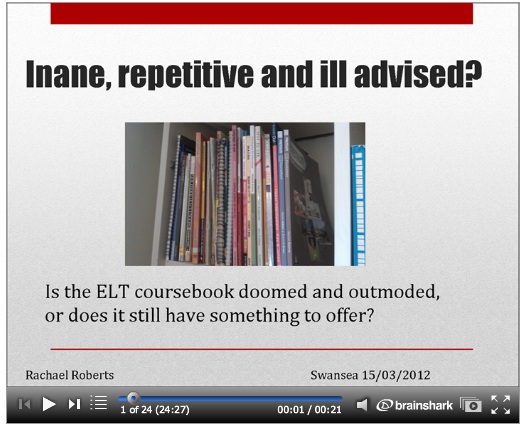
Inane, repetitive and illadvised? Is the ELT coursebook doomed and outmoded, or does it still have something to offer?

Inane-repetitive-and-ill-advised-Is-the-ELT-coursebook-outmoded-or-does-it-still-have-something-to-o-883693503

This is a version of a talk I gave at Swansea University in March 2012. It’s about 25 minutes, plus time to read some of the slides, so get a cup of coffee first!

Some of the questions I try to answer:

  • How is the methodology behind a coursebook decided on?
  • Are we now in an era of ‘textbook defined practice’?
  • Should we be using coursebooks at all, and if so how should we be using them?

9 Comments

Filed under Different ways to use a coursebook, Teaching methodology