Tag Archives: elt

The Science of Smiling: free downloadable lesson

A free downloadable lesson about why smiling, even when we don’t feel much like it, can actually make us happier. The lesson starts with a short video, demonstrating the impact of smiling on the ‘miserable’ people of Edinburgh. After some brief discussion, the students go on to read a text about the various scientific findings about the emotional impact of smiling. The text and task would be suitable for students preparing for IELTS, especially at a lower level, but is suitable for a General English class as well. Finally, the lesson looks at a lexical set of idioms to describe emotions, and the students are asked to discuss how different situations might make them feel.

Download PDF here: ELT Resourceful – The Science of Smiling

30 Comments

Filed under Downloadable lesson materials, Exploiting authentic reading materials, IELTS, Listening, Speaking, Vocabulary

Taking a genre approach towards IELTS writing (Part 1)

Photo Credit: AlaskaTeacher via Compfight cc

Photo Credit: AlaskaTeacher via Compfight cc

In a previous post, I looked at how a genre approach could help students who need to produce a specific type of writing. IELTS is a perfect example of this, and in this post, and the next one, I want to look in more detail at ideas for helping students to become familiar with the genres required for the IELTS Writing Test.

At first, the IELTS Writing Test (whether as a teacher or student) can seem rather intimidating. Many people are not particularly familiar with the kinds of texts required, and students are penalised for not producing exactly the right kind of text.

However, as a teacher of General English we ask our students to produce many different genres. For example:

  • Thank you letter
  • Letter of complaint
  • Narrative
  • Description
  • Biography
  • Form filling
  • Short message
  • Email to a friend
  • Postcard
  • Letter of application
  • Instructions
  • Report
  • Summary
  • Poem
  • Anecdote
  • Magazine article
  • Newsletter
  • Essay

In contrast, IELTS requires much less:

Part 1: Describing data

  • Graphs and charts
  • Process
  • Map

Part 2: Essay

  • Argument
  • Balanced opinion
  • Problem-solution

In addition, although I have separated out the different kinds of tasks in each part of the Writing Test, they do in fact have a lot in common. Learning what the features are of these different genres is quite manageable and, while it won’t solve problems like not having an opinion on the topic in Part 2, it will go a long way towards helping students produce a decent answer.

The features of a particular genre can be grouped under the following headings:

Content or communicative purpose

Layout 

Organisation

Grammatical structures

Lexis/formulae

So, looking at the most typical IELTS Task, describing a graph, chart or table, we could say:

Communicative purpose

  • Summarise information  (not to give your opinion about it)

Layout

  • Should use paragraphs
  • About 150 words

Organisation

  • Introduction which rewords the rubric to summarise what is shown.
  • Clear overview
  • Identifying key features- not every little detail
  • Logical grouping of information

Grammatical structures

  • Comparing and contrasting
  • Describing changes over time

Lexis/formulae

  • Rise, fall, plummet etc.

Once you’ve identified the key features, you can start to devise activities to work on each of them.

Rewording the rubric

This comes under organisation, so we aren’t starting at the top,  but it is the first thing the student needs to be able to do.  Students who ‘lift’ phrases from the rubric will be penalised, so it needs to become second nature to paraphrase.

You can start by doing this together on the board, eliciting different words and phrases for the underlined sections. For example:

‘The table below gives information about changes in modes of travel in England between 1985 and 2000

Don’t forget that you can change the sentence structure too, so ‘changes’ could become ‘how…have changed’. This is particularly useful if students can’t think of a synonym. Once students have got the idea, and a few useful phrases up their sleeves, this can become a regular warmer, with a competition to see how many appropriate paraphrases they can produce in a time limit. E.g.

The table illustrates how methods of transport in England changed between 1985 and 2000.

In this table we can see the changes in how people in England travelled between the years 1985 and 2000.

This table shows changes in modes of transport in England over a 15 year period, from 1985- 2000.

Summarising information/identifying key features

This is probably the biggest challenge of Part 1, and it takes lots of practice.  Depending on their educational background, students may not be very used to interpreting graphs and charts, so you need to try and familiarise them with how they work. A good way to do this is to start off by getting students to make their own, based on information about themselves or the class. In this way they will really understand the data, making it easier for them to identify the most important features.

Next, you could try giving students model answers without the graph or table, and ask them to draw it based on the answer. They can then compare it with the original.

There is usually some kind of contrast in these types of questions-e.g. some sales fell while others grew, so train your students to look for similarities and differences, and any particularly striking contrasts.

One way to practise this is to take a kind of jigsaw approach. Divide students into pairs and ask A to look for similarities between the pieces of data and B to look for differences. They can then share information and decide together on the most relevant pieces of information to include.

Giving a clear overview

This is related to identifying key information, but requires students to summarise the main point(s). It is really important that they are able to do this, though it doesn’t really matter if they give the overview at the beginning, as part of the introduction, or at the end, as a conclusion.

Show students a chart of graph with three possible overviews and ask them to decide which one is best, and why. As they become more familiar with this task, they can write their own choice of three and swap with other students to decide on the best overviews.

Using paragraphs/logical grouping

Once students have identified the key features, they need to decide how to group them.  There are different ways of doing this, depending on the information. For example, they might choose to organise it from smallest to biggest (though still not describing every little detail), or first look at similarities and then differences.

Again, model answers can be very helpful. Try asking students to decide how they would organise their answer to a question, and then compare their ideas with the model answer.

Language focus

Students are very often asked to compare and contrast in these tasks, so a good grasp of the kind of language they need to do this is really helpful. ( Incidentally, it’s also really useful for the other IELTS tests, especially Speaking) This can be achieved through work on formulae (e.g. In contrast, we can see that..) , comparative and superlative structures and linkers such as whereas, while, however.

They might also be used to describe changes over time, which also involves comparing and contrasting, but will need more complex use of tenses (not just present simple).

An excellent resource for typical language can be found on Alex Case’s website

Try using model answers for students to find examples of comparing and contrasting (or any other suitable language focus). Then ask them to look back at a Part 1 task they have written and ask them to improve it by adding similar language.

Essentially, this approach involves breaking down the component parts of the IELTS genres and practising them separately, rather than simply writing practice paper after practice paper. Of course, you can then put it all together and do some practice papers as well.

In my next post, I’ll look at some more ideas for developing familiarity with the features of Part 2 type writing tasks.


21 Comments

Filed under IELTS, Writing

The Icing on the Cake- free downloadable lesson

A free downloadable lesson based around another wonderful animated true story from http://www.storycorps.com. The conversation between a mother and daughter looks back on the family’s struggles as poor immigrants to the US, and how the daughter was inspired by her mother’s determination.

The lesson is  suitable from Pre-Intermediate +/A2+, particularly because the animation helps with comprehension. After watching and listening, there is a focus on impersonal pronouns/adverbs (something, anything, everyone.nowhere etc) and a discussion task which brings in more vocabulary to describe qualities we’d like to pass onto our children. Again, this could be adapted to lower and higher levels through the choice of vocabulary.

Download PDF here: ELT Resourceful – The Icing on the Cake

6 Comments

Filed under Differentiation, Downloadable lesson materials, Exploiting authentic recordings and videos, Grammar, Listening, Speaking, Vocabulary

The chicken nugget experiment- a free downloadable lesson

A free downloadable lesson based around a video of British chef, Jamie Oliver, demonstrating exactly what does go into cheap chicken nuggets to a group of American children. It’s pretty revolting, but the children reckon it’s ‘awesome’..and there’s a surprise at the end.

The lesson is at two levels, Lower Intermediate (A2+) and  Upper Intermediate (B2+). Both versions introduce a set of vocabulary for talking about junk food, and both have a variety of discussion tasks and questions. The lower level version also introduces some functional language for giving opinions and agreeing and disagreeing, while the higher level version looks at how to use contrast markers, although, even though, despite etc.

Download PDF here: ELT Resourceful-The Chicken Nugget Experiment-LowerInt

Download PDF here: ELT Resourceful-The Chicken Nugget Experiment-UpperInt

7 Comments

Filed under Downloadable lesson materials, Exploiting authentic recordings and videos, Grammar, Speaking, Vocabulary

To R.P. Salazar with love – free downloadable lesson

For all incurable romantics, a free downloadable lesson about Rachel P Salazar in Thailand and Ruben P Salazar in the US, who found love when an email was delivered to the wrong RP Salazar by mistake. Suitable from Intermediate level (B1) upwards, the lesson uses an authentic recording from http://www.storycorps.com, which has also been animated. The lesson focuses on vocabulary (uses of like) and grammar (would and used to) from the recording, and asks students to think about the role of luck or fate in our lives, and whether there really is someone for everyone. The lesson finishes with a speaking activity where students can tell the tale of how they and their partner (or a couple they know) met.

And if you want to celebrate Random Acts of Kindness Week instead (or as well), there’s another lesson here.

Click here for the PDF ELT Resourceful – To R P Salazar with love

6 Comments

Filed under Downloadable lesson materials, Exploiting authentic recordings and videos, Grammar, Vocabulary

Responding to students’ writing

Photo Credit: cabbit via Compfight cc

Photo Credit: cabbit via Compfight cc

I have called this post responding to writing, rather than error correction on writing, as I believe that there is a lot more to responding to written work than simply correcting errors.

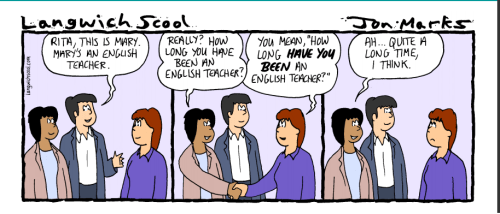
To begin with, it is very important to respond to the content of the writing as well as the form. Otherwise we risk being like this teacher:

By Jon Marks, as featured in ETp

By Jon Marks, as featured in ETp

When we assess a piece of writing there are various questions we could ask:

  • Is the content interesting and/or appropriate to the task?
  • Is there a clear sense of audience (who the writer is writing to or for) and is this reflected in the language chosen?
  • Are the ideas well organised? Is there a sense of ‘flow’?
  • Does the writer use paragraphs and connectives well to help get their message across?
  • Does the writer use a good range of vocabulary in an appropriate and flexible way?
  • Can the writer structure sentences accurately, and with variety and flexibility?
  • Is spelling and punctuation accurate, adding to clarity?

It is, I think, important that we look at the questions further up the list, as well as picking out discrete errors with word choice, agreement, spelling and so on. Equally, it is important that learners are thinking about all of these areas as they write and rewrite.

Yet most feedback from teachers still tends to focus on error correction. Why? Could it be that it is actually a lot easier for teachers to give feedback in this way?

When students give peer feedback on each other’s work there is also a strong tendency to concentrate on discrete items, such as grammar and spelling, rather than looking at the whole. I suspect that this is both because it is easier, and because this is what has been modelled time and time again by teachers.

In fact, some would argue that focusing on these discrete items (by teachers or students) is not only just part of the whole picture, but may even be pretty much a waste of time. Truscott famously argued that ‘grammar correction has no place in writing courses and should be abandoned’

Of course, other academics, such as   Ferris (2006)  disagree, but it is true to say that no-one (as far as I know) has yet come up with any hard evidence that grammar correction makes any dramatic difference. This post by Jeff McQuillan, on The Backseat Linguist reviews several studies which purported to show the positive impact of correction and concludes that, considering the huge amount of time and effort expended, the difference made was not really very significant. McQuillan also cites a study showing (no surprise here) that extensive reading had a much more noticeable beneficial effect.

Personally, I don’t think there is anything wrong with using a correction code to mark work from time to time. It can be a helpful way of focusing on accuracy, and perhaps has the added benefit of encouraging learners to proof-read their work more carefully.

However, I also think it shouldn’t become the default position when responding to students’ work.

In some very interesting comments on my post about process writing, Simon Marshall and Brian Morrison (@ButeBob) make alternative suggestions:

  • Using the Microsoft comments function to rewrite a small section of the text in a more fluent and/or appropriate way.
  • Focusing on what is successful about the writing- such as more complex or sophisticated language.
  • Pushing/encouraging students to try and make ‘safe’ language a little more sophisticated.

To these I would add:

  • Where possible, conferencing with students about their writing, rather than (or as well as) giving written feedback. This makes it easier (and actually less time consuming) to explain why something is wrong and what could be used instead.
  • If conferencing isn’t possible, try using the comments function not to reformulate, but to provide metalinguistic comments- explaining as you would face to face. You are unlikely to have time to do this in detail for all your students,  but even selecting a few key aspects to comment on could be very helpful.
  • Reformulating (as Simon suggests), rather than correcting. As well as using the comments box, you could reformulate a certain section of each essay, such as the introduction in an IELTS Part 1 essay. Or you could choose an essay (perhaps from a previous group, and anonymous) and rewrite the whole thing, asking students to then make comparisons between the two versions.
  • Deciding (perhaps with the students) whether to focus on paragraphing, linking, vocabulary, grammar, accuracy, range etc,  rather than trying to cover everything.
  • Correcting grammar mistakes or using a correction code, but choosing to focus on just ONE area (such as articles). This should help to make the point more salient, and thus students should notice and retain more.
  • Using models to help students learn about the different features of different genres, so that they can start to use them themselves (this fits in with McQuillan’s point about extensive reading)

And finally, bear in mind that in all likelihood, different approaches and methods will suit different learners, so it may be a good idea to provide a variety of ways of responding and correcting.

24 Comments

Filed under Writing

Living without money: free downloadable lesson

A free downloadable lesson about Heidemarie Schwermer, who lives without using money. Suitable from Upper Intermediate (B2) upwards, the lesson uses an authentic newspaper article, and focuses on reading, vocabulary and discussion. Note that the video below, which is in German, with English subtitles, is a lead-in, with the main focus on the authentic reading text to follow.

Click here for the PDF : ELT Resourceful-Living without Money

After the lead-in, students work on vocabulary from the authentic text, related to money and different roles in life. They then look in detail at the reading text before being invited to consider their opinions about Heidemarie’s lifestyle, and the bigger question of whether society is too materialistic and whether (and how) it should change.

6 Comments

Filed under Downloadable lesson materials, Exploiting authentic reading materials, Exploiting authentic recordings and videos, Speaking, Vocabulary

Just write: short, inspiring activities to get students writing

Photo Credit: Camdiluv ♥ via Compfight cc


In recent blog posts I have looked at some different aspects of writing in class. Common to all of them has been the point that good preparation is key to producing a successful piece of writing.

However, there is also a lot to be said for writing completely unprepared; short, fun activities where, instead of thinking and planning carefully, students just get on with it and write. These sorts of activities can be used as a warmer, or slotted into your lesson to change the focus and pace. They encourage students to see writing as fun and help to develop creativity and confidence.

In many cases the activities can also be used as a starting point for longer writing activities, but that’s up to you.

Soundtracks

Play students a series of short extracts of classical music, with very different moods. If you don’t have your own collection, a good way of doing this is to use the free samples you can play when deciding whether to purchase a download. Tell students each one is part of the soundtrack to a film, and ask them to write down what they imagine as they listen. Where is the film set, what characters are in the scene, what are they doing..

Similarly, play students a short part of a film (perhaps from YouTube), but only let them listen to it (not see it). Again, ask them to write down what they think is taking place and what the scene looks like. They can then see the original and make comparisons.

With both these activities, students could then go on to use their snippets of writing as the basis for a story or film-script.

Visuals

Give students a selection of pictures of people. Ask them to choose one each and write a brief description of the person (perhaps as much information as they can put down in 5 minutes). Then put them in pairs and ask them to imagine their two characters meet on a train (or anywhere else you like). They have a further 5-10 minutes to write a conversation between the two. Then take in the pairs of pictures and the dialogues and put them up on the wall, so that the pairs of people are together but the dialogues are separate. Number the dialogues and then ask the students to read them and guess which pair of pictures each dialogue refers to.

Similarly, you could use pictures of places and ask students to write a description, or what happened before and will happen next. There are some great pictures taken from Google Earth at http://www.guardian.co.uk/artanddesign/gallery/2012/feb/20/google-street-view-nine-eyes-in-pictures but BE SELECTIVE before the lesson as you might not want some of the pictures flashing up in class!

Or show students a photo of a friend of yours or a member of your family and ask them to write about who they think the person is, what they think their personality is like, how you met them etc. Then tell them the truth.

Realia

Bring in a bag with a selection of unconnected objects. Ask students to pick one out each and either and describe it in as much detail as possible (this is a great mindfulness activity), or put the students into 2s or 3s and ask them to each write a short story which involves all the objects in their group, before comparing their stories for similarities and differences.

Ask students to look around the classroom and choose any object they can see (clock, handbag, board pen). Students then write what from the viewpoint of the object. What can it see? What does it think is happening in the classroom? What else does it see during the day, or at night? What does it do all day? You could also ask students not to mention the name of the object, which then allows them to read each other’s and guess which object is being described.

Other

Give out small 5 slips of paper to each student and ask them to write down words which they have recently learnt and want to recycle on each slip. Then put the slips into a bag and ask each student to pull out 3-5 slips (if any words are the same, one should be put back.) They then have a time-limit, say ten minutes to write a (very) short story, which uses all the words. These stories can then be read aloud (perhaps in small groups) and the others can guess what the 3-5 words were.

Tell students to write a short note to anyone in the class. Once the note is received, students read it and reply. It’s fine if some students are replying to more than one person. You have to be a bit careful about the kind of class you do this with, as you can’t possibly see what’s being written, but it can be a great warm-up for a class.

Reading and writing: Give students 5 minutes to open up the coursebook and read the first text or dialogue they see (it doesn’t matter if they only read part of it). They then have 5 minutes to write about what they read.

Show a picture of a Genie (or dress up if it takes your fancy !) and elicit what a genie does- gives three wishes. Ask students to write down their three wishes, saying why they would choose those things and how their lives would change as a result.

In all these activities, the focus is very much on fluency, rather than accuracy. Just as in a speaking activity, you could, of course, incorporate feedback in a number of ways. You could have a feedback slot at the end, where together you correct some errors you have noticed while monitoring. Or you could use the free writing as a first draft, and take a process approach. Getting students to repeat the writing task later, or on another day, would also be likely to improve accuracy.

However, the main point of these activities is really to have some fun with writing and to get students into feeling happy to just write freely.

18 Comments

Filed under Different ways to use a coursebook, Writing

Pay it forward: free downloadable lesson

A new free downloadable lesson about the concept of ‘pay it forward’, incorporating reading, speaking, video, grammar and writing.

ELT Resourceful – Pay it Forward-Pre-Int level

ELT Resourceful – Pay it Forward-Intermediate

ELT Resourceful – Pay it Forward-Upper Int level

This lesson starts with a short reading text about a recent event at a coffee shop in Canada, where some-one’s kindness in paying for the person behind them led to 288 people passing on the favour to the next in line. The lesson then uses the video above (no words, just music) to extend the idea, before focusing on defining relative clauses. There are three different versions, so that you can either choose the most appropriate for your students, or use all  three with mixed level classes. The lesson rounds off by asking students to complete a story, imagining their own chain of events.

23 Comments

Filed under Downloadable lesson materials, Exploiting authentic recordings and videos, Grammar, Speaking

The Secret Millionaire: free downloadable lesson

As a new addition to the ELT-Resourceful site, I am now adding free downloadable materials, on PDFs. Just click on the link below each picture. All comments very welcome.

3906454739_6b727ab59a

ELT Resourceful Materials- The Secret Millionaire

With a reading text about a real-life Secret Millionaire, who wanted to give something back, this lesson introduces a range of idioms to talk about wealth and poverty and gets students thinking about the gap between rich and poor, the responsibilities of those who are better off, and what it means to have someone who believes in you. There is a focus on strategies for skim reading and the lesson finishes with a writing activity where students write to someone who made a difference in their lives.

2 Comments

Filed under Downloadable lesson materials