Tag Archives: efl

Mindfulness for teachers

What mindfulness is (and is not)

Mindfulness is a term that is becoming increasingly familiar to many people, but it is still not that clear to many, I think, what exactly it means. Mindfulness isn’t about drifting off into your inner world; it’s more about being fully conscious, really aware of what we’re doing and feeling, right now.

Most of us spend most of our time only dimly aware of what’s happening for us right now. We are usually too busy making future plans, worrying about stuff, remembering things and reacting to situations based on what we think we’ve learnt in the past.  Our mind is crowded out with all sorts of stuff.

However, mindfulness isn’t about having an empty mind; it’s about being focused.

Why mindfulness for teachers?

For many people, myself included, one of the great attractions of teaching is that it can be so absorbing that I often find myself in a state of what Csikszentmihalyi calls ‘flow’. When we are totally present in the classroom (or anywhere else), time goes very quickly and we are really in a state of heightened awareness, feeling alert and alive. Communication flows easily between us and others and everyone seems to be really focused on the experience of learning. This is a very enjoyable form of mindfulness, and it can be encouraged by developing our own mindfulness practice outside the classroom.

Mindfulness , flow, feeling connected  is not so much something that we have to acquire, as something which is always there, but that we tend to be very good at blocking out through anxiety, fear, anger, mind-chatter, judgements and so on.

The more we practice mindfulness, the easier it is to connect to that peaceful place when we’re under pressure, students are playing up, the lesson plan isn’t working and so on.

Mindfulness helps us to be able to respond to a difficult situation calmly, rather than a knee-jerk reaction of feeling angry with ourselves or the students, or feeling that we’re not good enough or whatever our particular ‘favourite’ reaction might be.

Rather than feeling exhausted and drained at the end of a class, we’ll feel energised and alive (and so will the students).

Techniques to develop mindfulness

A key personal discovery is how important it is to start the day right. That doesn’t mean you can’t get things back on track, but it seems to really help to start by getting into the right frame of mind. How you do this is a matter of individual choice, of course: meditation, a brisk walk taking full notice of nature around you or simply setting your intention for the day- reminding yourself to stay in touch with what’s actually happening, take proper breaks, eat well, or to be kinder to yourself etc.

Whenever you remember (and don’t beat yourself up for forgetting, because you will most of the time), check in with what’s actually happening, and how you are feeling. When those feelings are negative, don’t deny or suppress them- just notice them and accept them (rather than telling yourself you shouldn’t feel that way), and most of the time they’ll just fade away. When they don’t, you can put them to one side until later and then try a bit of pillow bashing, talking stuff through, writing it all down and so on. But remember that your thoughts aren’t necessarily true- they’re just thoughts. This may help you not to get too caught up in the drama of it all.

Every so often (decide when in advance), take a few minutes to just breathe and become aware. I like to go for a short walk outside.

There are several excellent books on developing mindfulness which I would recommend for developing your own practice:

Mindful teaching and teaching mindfulness – Deborah R. Schoeberlein

Mindfulness: a practical guide -Mark Williams and Danny Penman

Mindfulness for beginners: Jon Kabat-Zinn

Any of these books will guide you through exercises designed to help build your inner resilience, dissipate stress, help you to be in the ‘flow’, help you deal with difficult situations and students and generally greatly improve your quality of life.

In my next post, I’d like to look at how you can encourage mindfulness from your students- in ways that won’t feel too different from what you already do, but that may make a difference to the quality of learning.

Other blog posts on mindfulness related topics:

http://tpstefltravels.blogspot.co.uk/2012/10/mindfulness-elt-chat-summary.html

http://itdi.pro/blog/2012/05/14/working-with-difficult-students-chuck-sandy/

http://malingual.blogspot.co.uk/2012/10/a-note-on-mindfulness.html

If you’re interested in mindfulness, check out my new website, www.life-resourceful.com

7 Comments

Filed under Teaching methodology, Working with groups

Task repetition: helping students to improve accuracy,repertoire and fluency

I am very far from being a fluent Polish speaker. In fact, after four years of hard study and living in the country, I was still probably only about B2 level. However, if you happened to hear me chatting to a taxi driver in Polish, you’d probably conclude I was pretty fluent.

I was very good indeed at the basic chitchat of where are you from, how long have you been in Poland, what do you think about Poland and so on. And the reason I became so fluent (in this context)? ….I caught a lot of taxis.

In other words, I had plenty of opportunity for task repetition. In language learning terms, task repetition is a term most often related to task-based learning. Perhaps one of the key articles about this is Martin Bygate’s Effects of task repetition: appraising the developing language of learners. In this article, Bygate suggests several benefits to getting learners to repeat a task:

  •  More fluency in terms of pausing and speed (less need to plan as we speak)
  • Fewer false starts and self corrections
  • Fewer errors

These reasons seem fairly self-evident, and you could say exactly the same things about drilling a dialogue. However, while I also think there are benefits in simply repeating or drilling, task repetition is about more than this. Bygate suggests that once the speaker is more familiar with the content, this frees them up to not simply make fewer errors or speak more quickly, but to actually pay more attention to how they formulate their meaning.

In this article, Bygate demonstrated (admittedly with a small sample), that repeating a simple speaking task (in this case describing a film), without any input or feedback, still led to the learner producing more appropriate and more complex language. They improved in terms of accuracy, repertoire and fluency.

Since then, further research has confirmed that task repetition does indeed have a positive effect on complexity and fluency, though some feel that learners may also need feedback on the first task (instinctively, I would tend to agree with this).

So, how can we start to build in more task repetition without boring students? The first thing to say, perhaps, is that I think the idea that repeating a task is boring, may well be a projection from the teacher. If a student is really engaged in a task, and struggling (in a good way) with getting meaning across, it won’t be boring, but satisfying. See this article  for a piece of research which set out to prove this.

In repeating speaking activities, I would suggest:

–      Play about with giving feedback in between repetitions. Sometimes you could give immediate feedback, with examples you have noted while monitoring. Sometimes you could make notes then use these notes to plan a short teaching session in another lesson, before a task is repeated. Sometimes the feedback could be self-evaluation (especially if students are able to record themselves) or peer feedback.

–      Try repeating the task at different time intervals (immediately, next lesson, next week, next month) and see what difference it makes. Again, recording both versions can be very helpful so that students themselves can be helped to notice improvements.

–      Change the audience for the task. This could just be telling the story again to a new partner (which makes it more genuinely communicative), or it could be moving from 1-2-1 to speaking to a larger group, or from speaking to a live group to recording the talk (using Vocaroo or just a mobile phone).

–      Change the task slightly. Choose a new task which has enough parallels in terms of structure and likely language for students to benefit from repetition, but enough difference to keep up the interest. For example, asking students to retell a narrative from the point of view of a different person involved in the story (same events, different perspective)

And, of course, task repetition does not always have to be about speaking. All the above points could equally well apply to writing. We have more time available to process when writing, so combining writing and speaking can work very well too. First students tell and then they write- or vice versa.

And it can even apply to receptive skills work. See this post, for example, on repeated reading.

Please feel free to add other task repetition ideas- I’m sure the possibilities are endless.


20 Comments

Filed under Different ways to use a coursebook, Speaking, Teaching methodology, Vocabulary

To read better, improve your pronunciation?

To read better, improve your pronunciation….

This statement jumped out at me recently, from an excellent post by Robin Walker on Pronunciation for YLs. He was reporting from a talk by Catherine Walter at IATEFL 2008, and reading this (perhaps surprising) statement sent me off to find her original research.

In her article Phonology in second language reading: not an optional extra, Walter questions the idea that the skill of reading is something which needs to be taught to second language learners. She argues that successful L1 readers already possess the cognitive skills needed to build a mental structure or representation, which is, in fact, what we mean by ‘comprehension.’ According to Walter, comprehension isn’t actually a linguistic skill, so it’s fruitless to talk about transferring it from L1 to L2.

So why are some learners competent at reading in L1, but struggle with reading in L2? Obviously, lack of linguistic knowledge plays a part. Fascinatingly, though, Walter cites a study (Robertson et al 2000)* which used MRI scanning to show that sentence comprehension and comprehension of a text as a whole take place on different sides of the brain.

Walter doesn’t mention this, but, of course, there has been a lot of speculation about left brain and right brain thinking. Interestingly, sentence level comprehension, or decoding, used the left frontal lobe (associated with analytical, logical processing) and text comprehension uses the right frontal lobe (associated with intuition).

So a learner may have effective (non-linguistic) comprehension skills, and even be able to decode L2 sentences, but still struggle. Why?

According to Walter, it may be to do with how we use our working memories. Part of the working memory is something called the phonological loop:

‘a short-term memory mechanism that stores information in phonological form and automatically rehearses that information by unconscious sub- vocalisation.’ (Walter 2008)

In other words, as we listen, we automatically ‘record’ the last two seconds of what we hear in the memory, like a little Dictaphone. It’s why we can repeat back what we have just heard, even if we weren’t really listening properly to the speaker.

There is also evidence that we do exactly the same thing as we read- that we also sub-vocalise and record the sound of what we are reading. We don’t see it, we hear it.  At least, this is true for those of us with L1s that are alphabetic (there is some evidence that learners with non-alphabetic L1s, may use more visual representations).

However, if our phonological representations of what we have just read are unreliable, we may find it difficult to associate these sounds with meanings, and thus find it difficult to keep meaning in our short term memory. This, in turn, will make it harder for us to carry out meaning building processes on the text as a whole.

Walter’s research in this paper concludes that unless learners are also poor at comprehension in L1, we would be better off teaching them to improve how they ‘mentally represent spoken language’ than teaching comprehension skills.

Some suggestions:

As much exposure as possible to the spoken language- so lots of listening and watching videos in English.

Listening while reading – hearing the spoken version while reading a text. This could mean using sub-titles, or following a transcript while listening, or listening to an audio version of a written text while reading. I would suggest that these don’t have to be instead of our usual listening or reading activities (I’m not quite ready to throw out more traditional reading and listening procedures), but as a follow up.

And finally, explicit focus on features of pronunciation, such as minimal pairs work , and focus on word stress and on how words change in the stream of speech . This kind of work will help learners to develop a more reliable repertoire of L2 sounds, which, Walter suggests, could also help them to hold what they are reading more efficiently in their short term memory, which in turn will greatly help with building up the meaning of the text.

And even if this isn’t the case, it will certainly help with developing fluency in speaking and confidence in listening, so what have we got to lose?


 * Robertson, D. A., Gernsbacher, M. A., Guidotti, S. J., Robertson, R. R. W., Irwin, W.,Mock, B. J., et al. (2000). Functional neuroanatomy of the cognitive process of mapping during discourse comprehension.

Psychological Science, 11, 255–260


9 Comments

Filed under Different ways to use a coursebook, Pronunciation, Teaching methodology

How to activate the ‘Useful Language’ box in your coursebook.

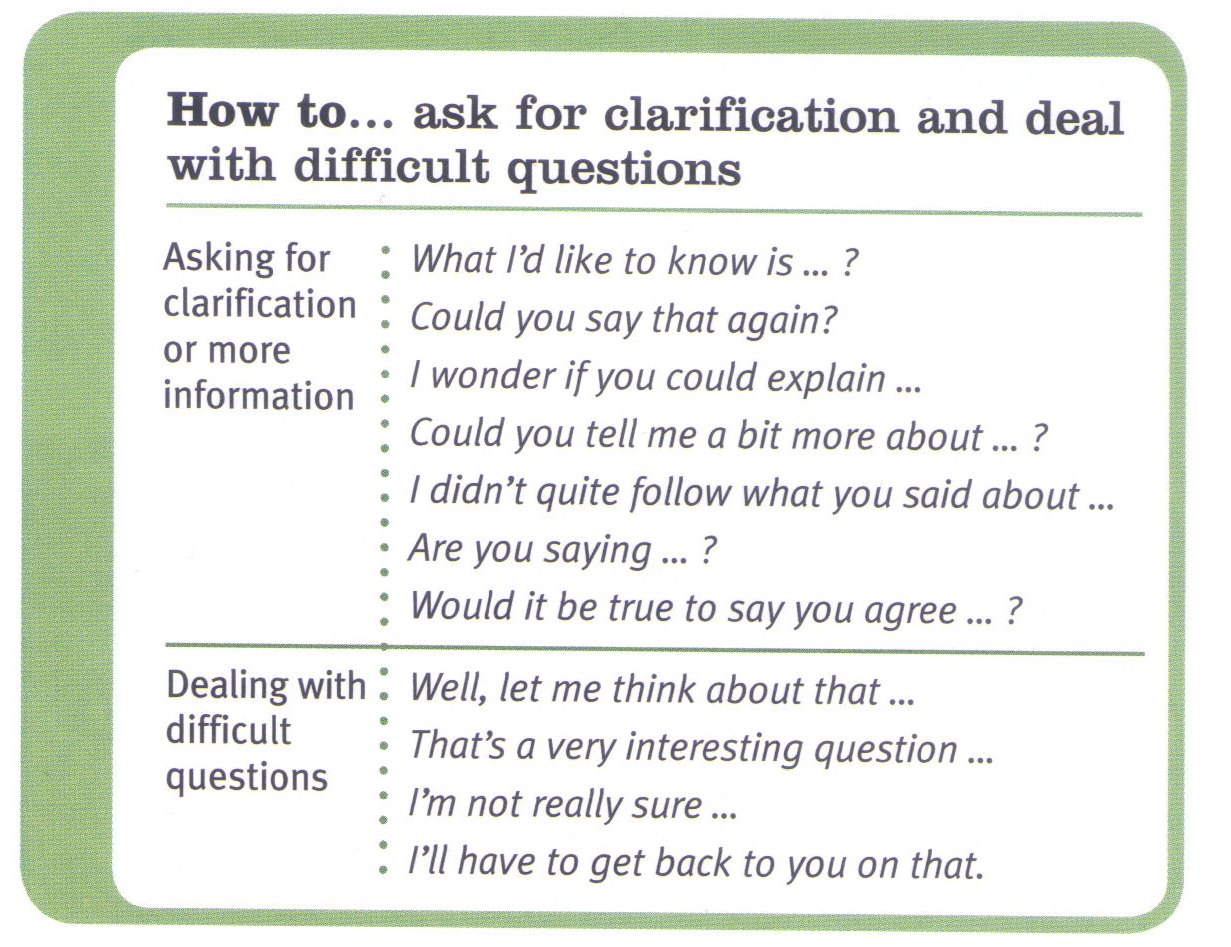
From New Total English Intermediate- Pearson 2011

A common feature in many coursebooks is the ‘Useful Language’ box. This is usually a collection of phrases which the authors consider may be useful for an upcoming speaking activity. A ‘useful language’ box is potentially a great idea because the tendency in speaking activities can be for students to simply stay safe and just use what they already know. Providing this language gives us the opportunity to scaffold their learning and encourage the learners to stretch themselves a bit.

However, in practice, there are two recurring problems.

  1. What do you actually do with the Useful Language box? Just getting students to read through it certainly isn’t enough to get them using the language.
  2. There seems for many students to be a reluctance or inability to use the language straightaway (see this recent conversation on Pearson ELT Community). And if they don’t use it straightaway, what are the chances of them locating and using it at a later date?

I think most people would agree that for students to use new language:

– They need to process the language in some way, work with it, not just be shown it.

– They need to know exactly how to use it in and in what context.

– They need to need to use it.

A good place to start with ‘useful language’ is by having it come out of a recording, rather than just being on the page. With the example above, from New Total English Intermediate, students have been listening to a short presentation, with follow up questions, and, after carrying out other comprehension based tasks, they listen again and tick the phrases they hear being used. They then prepare and give their own mini-presentations.

This approach works in terms of providing context, and it also means that there is a model for pronunciation, which is often very important with functional language (more later). However, there is still, I feel, something missing between identifying the phrases and being expected to use them.

Contextualisation

If the ‘useful language’ came from a recording, students will already have some idea of how they can be used in context. If not, you will, I think, need to provide some. Live listening can be good way of doing this (see my previous post for details). Essentially, you provide the model, ideally recording yourself so that it can be replayed. With the example of useful language given here, you might ask a confident student to give a short presentation on a very familiar and unthreatening topic and warn them that you will ask lots of questions! You can then play the recording back and start to work with the language, as discussed below.

Other ideas for processing the language

Categorisation

Exactly how you do this obviously depends on the language, but, for example, with the language box above, you could ask students to divide the first section into phrases to use when you don’t understand, and phrases to use when you want more information. If the categories aren’t clear-cut, so much the better as this will force students to discuss why they have chosen to put a phrase in that category- and thus create more processing.

Phrase completion

Useful language boxes often have phrases with elllipses (…….), so that students can complete them however they choose. Fine, if they have the faintest idea how to complete them! So, one task could be to give them a context, and ask them to write a completion for each phrase. For example, with this useful language box, you could give a short talk yourself, or use the recording, or use a short video and ask students to prepare questions using the stems. This will also help you to see whether they are able to use them grammatically. As an example, I think many students might struggle with completing ‘What I’d like to know is…’ because of the emphatic structure used.

Dictation

Rather than showing them the useful language box, try closing the book and dictating the phrases. You could add some challenge by mixing up the phrases and asking them to decide where in the box they belong (in this example, in ‘Asking for clarification or more information, or in dealing with difficult questions)

You should make sure that you dictate the phrases in a natural way, as complete phrases, with appropriate intonation, and normal features of connected speech. This will then have the added bonuses of providing a further model of how to say the phrase, and raising awareness of connected speech. For example, some students may well write down ‘What I like to know is..’, rather than ‘What I’d like to know is..’, giving the opportunity to focus on the ’ ‘d’ they didn’t hear.

Writing dialogues

You may have noticed that the activities so far are more focused on writing than speaking, which may seem odd when these phrases are provided for a speaking activity. However, writing can be a good way of bridging the gap between new language and speaking. In ‘How to teach Speaking’, Scott Thornbury points out, ‘Inevitably, because of the constraints placed on mental processing by the demands of real-time speaking, learners tend to rely on a very narrow repertoire of memorized expressions in face-to-face interaction…it may sometimes help to reduce the processing demands on them..one way of slowing down processing is to turn the speaking task into a writing one.’

The following two ideas both come from this book:

–          Paper conversations. Learners have a conversation, but, instead of speaking, they write the conversation on paper. The teacher can then easily monitor and make suggestions for improvement.

–          Rewriting. Students can be given a simple dialogue and asked to rewrite or modify it to use the new language.

Work on pronunciation

As mentioned above, pronunciation is particularly important in using functional-type phrases. They need to be delivered fluently, as a chunk, or they are likely to sound a bit odd and artificial. Intonation is also often extremely important. Think about the phrase, ‘Are you saying…?’  This needs to be delivered with the right intonation, or it could sound pretty aggressive!

So students need a good model- either a recording, or the teacher- and they need to practise drilling the phrases, getting their tongues round the connected speech and using the right intonation.

A fun way of working on intonation is to ‘say’ the phrases using just ‘Mmmm, mmmm’. Students have to guess which phrase you are saying. As they become more confident, they can do this themselves in pairs.

Using the ‘useful language’ in a speaking activity

After time spent processing and preparing, students should be much more likely to use the language in a follow-up speaking activity anyway. However, there are a few ways to encourage this further.

– As described by Antonia Clare in the Pearson ELT discussion I mentioned earlier, you can write phrases on cards and hand out a few to each student. They need to try to put ‘their’ phrases into the conversation as naturally as possible. If the other students feel it wasn’t natural, they could have to take the card back.

– A certain amount of pressure, such as recording the conversation or giving a presentation to the class can encourage students to focus more on using the new language.

– Similarly having an observer in the group, whose job it is to notice when people use the ‘useful language’ can help to focus the mind.

– Depending on the language and the teaching context, students can be asked to go away and ‘notice’ any of the phrases being used in conversation over the next week (on TV, eavesdropping at the bus-stop etc).

10 Comments

Filed under Different ways to use a coursebook, Speaking, Vocabulary

Do something different with the coursebook listening

When teachers talk about ‘doing a listening’, what they usually mean is that they will set the scene, pre-teach as (and if ) necessary, then set some questions before pressing play.

This kind of teaching routine can work very well, and I’ve certainly written plenty of listening sections following that kind of format.

However, in the spirit of John Fanselow, I also believe that it is always a good idea to question such routines, and consider how we could do things differently.

Listening from the middle

In this article (thank you to Frances Eales for drawing it to my attention), John Madden explains how, rather than playing a recording from the beginning, students can benefit from starting in the middle. In real life we often start listening in the middle of a conversation, or when we turn on the radio or TV in the middle of a programme. Starting in the middle helps learners to develop the confidence and skills to deal with this.

Madden starts by discussing times when learners have ‘started in the middle’ in real life and then plays a section from the middle of the recording. Learners tune in as best they can, then discuss with a partner what they understood, and what they think might have been said before they started listening. They can then listen to the entire recording to check their predictions.

Pausing and predicting

Rather than always beginning by asking students to predict the content of a recording, another way of encouraging prediction might be to pause the recording while playing and ask for predictions.

There are several ways I can think of to do this:

1. If the recording is a dialogue, stop the recording after each utterance by person A, and ask students to either say, or write down what they think person B might say. They can then continue listening to check their ideas.

2. Stop the recording about halfway through, and ask students to either continue the conversation they have been listening to, or, if a monologue, to write down what they think the person will say in the rest of the talk.  This could work very well with a well-signposted monologue of the kind found in more academic English

Pausing and focusing on language

These activities would work better after using the comprehension activities in the coursebook, as a way of encouraging students to notice certain aspects of language. For more on this kind of bottom up activity, you might like to read John Field, and my article on Decoding Skills

1. Having previously picked out some useful expressions from the listening, pause the recording halfway through the expression, and ask students try and complete it from memory.

E.g. I had to learn the poem……by heart.

2. Using only a short part of the recording, pause at the end of each sentence or longer phrase, and ask students to write down what they hear. This can work really well for identifying students’ difficulties in decoding connected speech.

3. Pause the recording after referring expressions and ask students to identify what they refer to.

E.g. Albert Einstein is widely considered to be a genius. However, his education did not start off so well (pause-who does his refer to?). He didn’t learn to speak fluently until six or seven and one of his teacher wrote on his school report (pause-who does his refer to?) ‘He will never amount to anything.’, meaning he would never be successful. How wrong he was! (pause- who does he refer to?)

[extract taken from New Total English Intermediate]

Focusing on strategies

Rather than providing a follow-up related to the content of the text, you could carry out a protocol activity. After carrying out your comprehension activity, play the recording again and ask students to write down (in L1 if lower level students), as far as they can remember, what they were thinking at each point of the listening. What exactly did they understand or not understand, what strategies did they use, did they switch off (when and why?). This can then become the basis of a fruitful class discussion about how to listen.

To finish, you might like to watch this short (7 minute) TED talk by Julian Treasure, on How to listen better. It isn’t specifically about ELT listening, but it’s an inspiring reminder of how doing things differently can indeed lead to something exceptional.

16 Comments

Filed under Different ways to use a coursebook, Exploiting authentic recordings and videos, Listening, Teaching methodology

Fresh and inspiring sources for your teaching: an #ELTChat summary

How do you make sure your classes stay fresh and inspiring and what sources and influences outside ELT do you use to find subjects for your lessons?

This is the summary of the ELTChat held on Twitter at 12pm Wednesday 18th July 2012. The topic was suggested by @theteacherjames and inspired, he told us, by the following quote:

‘Success depends on sufficient knowledge of the special subject and a variety of extraneous knowledge to produce new and original combinations of ideas.’ Rosamund E.M. Harding

@theteacherjames  kicked off by pointing out that ‘ELT is the subject without a subject, meaning we can basically use any topic we want for our classes’ So, ‘. How do we find ideas?’  The focus was particularly on ideas and topics not from ELT sources.

News stories

News stories were obviously a popular source. Many people used local newspapers, so that the stories would be very topical, but some useful websites were also suggested:

@cybraryman1 gave us the link to a whole page full of links to news sites: http://cybraryman.com/news.html

@teflerinha gave the link to weird news stories from Metro (a free newspaper) http://www.metro.co.uk/weird/

@esolcourses recommended Newsy, for short news videos http://www.newsy.com/

And Ken Wilson’s blog has a nice article on using the Yahoo home page: http://kenwilsonelt.wordpress.com/2010/11/07/the-yahoo-home-page-dull-scary-or-engaging/

Other articles and bits and pieces

@theteacherjames gave us a link to  http://www.brainpickings.org/ , an ‘interestingness digest.’

And his list of interesting’ sciency ‘people on Twitter https://twitter.com/#!/thejamesabroad/interesting/members

@theteacherjames recommended the Guardian Family section and gave a link to his blog where he highlights some of what can be done with it. http://theteacherjames.blogspot.be/search/label/The%20Guardian

@theteacherjames suggested ‘For fun facts and trivia, follow @qikipedia and @UberFacts.’

Films and clips

@leoselivan mentioned using films, and said that he used whole films in segments throughout the semester. @sharonzspace said she encouraged students to find suitable films, and there was a brief discussion about finding out what students are interested in rather than imposing our own favourites  on them, balanced with choosing films which are suitable and have linguistic benefits.

@esolcourses mentioned youtube and gave an example of a clip used on her blog at at http://esolcourses.blogspot.com/

@leoselivan gave us the following link to the ESL Learner Movie Guide  http://www.eslnotes.com/

@cliltoclimb Gave us this link to an interview with Kieran Donaghy on using films http://iasku.wordpress.com/2012/07/12/kieran-donaghy/

@sharonzspace gave us a link to the TED page http://www.ted.com/

@worldteacher’s students still love Mr Bean! @theteacherjames gave us a link to his blog with some examples of different silent movies. http://theteacherjames.blogspot.be/search/label/silentmovies and @esolcourses gave us a clip of oktopodi  http://esolcourses.blogspot.com/2009/09/learn-english-twitter-esl-writing.html

@teflerinha mentioned clip from youtube, which @designerlessons has turned into a lesson for advanced students. It’s from a series of videos 50 people, 1 question. This one interviews people in Denver about ‘What would make you happy?’  : http://designerlessons.org/2012/02/20/esl-lesson-plan-happiness-one-question-generating-discussions/

 Podcasts and other audio resources

 @worldteacher commented, ‘One of my favourite resources with higher level sts – From Our Own Correspondent podcast from BBC – 5 x 5-min stories each edition.’ @BobK99 agreed ‘Very good for looking at different accents (as there’s often a vox pop in the reports).’

 @teflerinha somewhat sheepishly added BBC Women’s Hour as a favourite source- and other fans came out of the closet too!

And @jamestheteacher said he often used  4 thought http://www.bbc.co.uk/programmes/b010q0n0 with business students.

@worldteacher also mentioned BBC Desert Island Discs

@jeaneoakes made the point that ‘ if students make podcasts they hear how they improve oral langauge skill. Use a rubric to score and set goals.’

Pictures and visual content

@Sharonzspace mentioned Facebook for visual content, and @worldteacher suggested that it pays to follow the British Council, as they post great links.

Technology

 @nancyteach pointed out that there are lots of free webinars and walkthroughs which can help teachers learn how to do many Edtech tasks.

 @Sharonzspace uses a closed group on Facebook with her students and @worldteacher’s students are motivated by using Edmodo (a secure social learning network for learners and teachers- good if Facebook is blocked)


Other

@DanielaArghir told us about a routine she has with YLs where she starts each lesson with a ten minute slot on what is being celebrated that day (e.g. International Women’s Day, or something sillier like Chewing gum Day- can even make them up if necessary)

@cybraryman1 gave us a link to national holidays etc on  http://cybraryman.com/calendar.html

@worldteacher suggested that  ‘Taking students outside of the classroom whenever possible helps to keep things fresh.’

@esolcourses suggested using Googlemaps for virtual trips.

@BobK99 said ‘I use mats based on a free tourist h/o (maps, time, buying tickets, etc) but after the lesson give out up-to-date education.’ And @teflerinha agreed that realia can be really motivating- even simple things like brining in a real book to read aloud from rather than reading it off the coursebook page.

@teflerinha suggested lessons where students make things, such as origami, can be good for a change and involve a lot of language use. @DanielaArghir gave an example of a recent class where her 11 year olds made windmills for Global Wind Day. And @worldteacher talked about her cookery sessions with adult students (lucky, her some of them own restaurants!)

@DanielaArghir gave us a link to a site about creative ideas for working with children. http://www.childcareexchange.com/

@SueAnnan had used a foreign language music CD, which generated lots of language.

And, intriguingly, @jeanneoakes mentioned using a ‘culture bag’ but we never found out what that was?!

To conclude, @Shaunwilden reminded everyone that materials are not the only thing which makes a lesson fresh and inspiring. @teflerinha agreed that trying out different ways of doing things was also important, and @worldteacher mentioned CPD. @Cybraryman1 added ‘Important to start each lesson with something that will engage your students & is relevant. Vary your teaching approach too.’ And, finally, @MizLadyCaz pointed out that ‘The right scaffolding can allow for success with any resource.’

3 Comments

Filed under ELT Chat summaries

Getting students to notice language in reading texts

To start with, why not try this little awareness test:

How successful were you in noticing? Whatever we are doing, we don’t tend to notice everything- and we can miss some quite important elements!

We tend to notice things which are either frequent or salient. So, when I first went to live in Portual, I quickly noticed the word ‘puxe’, which was written on a lot of doors. It was something I saw frequently. It was also salient, or meaningful for me because the pronunciation is ‘push’..but it means ‘pull’!

Schmidt, who first coined the term ‘noticing’(I think), carried out a study of his own language learning in Brazil (where they use ’empurre’ rather than ‘puxe’ btw). He concluded that he was more likely to actually use language himself when his attention had been drawn to it in some way.

Or as Scott Thornbury puts it:

‘1. Learners must attend to linguistic features of the input that they are exposed to, without which input cannot become ‘intake’.

2. Learners must ‘notice the gap’, i.e. make comparisons between the current state of their developing linguistic system, as realised in their output, and the target language system, available as input.’

(Thornbury 1996)

A reading text is full of language that we can draw students’ attention to in this way, and thus, hopefully, help them in the process of acquiring this language into their ‘store’.

Before we can start to focus on language though, it is important to focus on the actual text as a whole (see previous blog posts), and then we have to consider which aspects of language to focus on or we risk not seeing the wood for the trees (or the monkey for the basketball players).

Activities which help students to ‘notice’ vocabulary

Many texts will have a clear topic, so this is a good place to start (especially if the topic is one which is relevant to students’ needs and interests- and if it isn’t why are you using it? 😉 ). You can simply ask the students to find words and phrases in the text connected with the topic of X, or ask them to categorise the words and phrases they find into subsections of the topic (example here from IELTS Foundation 2nd ed-click to enlarge).

You can help to expand students’ vocabulary by asking them to find synonyms of words you give them, in the text. This is particularly useful for those taking exams, where questions are usually paraphrased.

You can help students to see how texts are put together by asking them to find lexical links and chains in the text (example here from IELTS Foundation 2nd ed-click to enlarge)

Students can also develop their awareness of chunks and collocation by asking them to find chunks of words that go together, or asking them to search the text to find what collocates with a list of words from the text which you have given them.

Activities which help students to notice grammar or discourse

The most obvious task is to ask students to look at the examples of the language focus in the text and use them to complete rules about its use. Or they could try writing their own rules and then comparing them with a grammar reference.

An alternative is to remove those examples (or parts of them) and get students to complete the text, comparing their versions with the original. This is something which works very well for articles and for discourse markers.

Or you could give students another version of the text with deliberate errors, and ask them to find a ccertain numbers of mistakes and correct them- before, again, checking against the original.

Try a dictogloss (read a short section aloud, which contains the language you are focusing on) and ask students to write down as much as they can before reconstructing the text together. This works well for structures which are very frequent, such as reference links or articles.

Having thus drawn the students’ attention to language, I believe that it is important to give them some opportunity to use the language. Opinion varies as to whether practising the language per se helps students to acquire it, but at the very least it is another opportunity to notice it, which does seem to help with acquisition.

5 Comments

Filed under Exploiting authentic reading materials, IELTS, Teaching methodology

Creating effective reading tasks

In my previous post, I looked at the whole idea of reading tasks and the arguments for and against using them. One conclusion I came to is that, ideally, tasks should bear some relation to the kinds of processes we would use when reading in real life contexts.

There are some quite simple task types which will work for a lot of texts. For example, setting up the topic (using pictures perhaps, or the title) and then asking students think of questions that they would like answered about the topic. Alternatively, ask them to write down what they expect to learn and then read to check their ideas.  This kind of approach has the obvious advantage of no preparation, and is very close to what we would do in the real world.

Similarly, with different kinds of texts, particularly factual ones, we can set tasks which require students to scan and find particular bits of information. Classic examples are small ads, tv listings etc.

More typical comprehension questions,such as we see in EL exams, tend to test what the question setter sees as the main points of the text. Of course, in real life, we are able to decide for ourselves what the main points are, which means that pre-set questions are intrinsically somewhat inauthentic. The format of typical question types can also be rather inauthentic, of course. While at IATEFL this year, I saw John Field, talking about listening, and he made the very valid point that when carrying out multiple choice questions, we are asking students to do something much more complex than simply listen for information. As well as listening for the information we require, they also have to pick up on the distractors and discount them, a sophisticated process.

Some traditional question types are closer to real world reading than others. For example, multiple matching, which is becoming a very popular exam type question. This is a task type which can work very well with short texts. In a comment on my last post, ESL Notes, asked about a possible reading task for these very short tasks (death by twitter). I think multiple matching is ideal for these kinds of texts. For example, for theseparticular texts, you could ask ‘Which text is about a fuel related tragedy?’ ‘Which text tells us about a possible miracle?’ (maybe a rather depressing lesson though? 😉 )

Form completion, note completion and summary completion can also be quite realistic, depending on the students’ context. Form completion is important in an ESOL context, note and summary completion are skills needed by students studying in the English medium.

Other tasks are not necesssarily realistic, but do have a definite value in terms of the skills they teach. For example, matching headings or summaries to paragraphs, which encourages students to read in such a way as to grasp the main point of each paragraph. Incidentally, although it isn’t foolproof, it is worth pointing out to students that the main point is often in the first sentence of the paragraph (the topic sentence).

I am also quite keen on tasks where students have to put in missing sentences or even paragraphs, as these really help develop awareness of how texts are constructed. However, they are quite difficult to construct as you have to make sure that there are very clear clues which guide them to the right answer.

This is the first part (there is more text and more gaps) of an example from Real Life Advanced, an Upper Secondary book, published by Macmillan. The original article is here.

Mark Boyle, 31, gave up using money in November 2008. He lives in a caravan that he got from Freecycle, an organisation which matches people who have things they want to get rid of with people who can use them, and so keeps usable items out of landfills. His caravan is parked at an organic farm near Bristol, where Boyle volunteers three days a week. He grows his own food, has a wood-burning stove and produces electricity from a solar panel (it cost £360 before the experiment started). He has a mobile phone for incoming calls only and a solar-powered laptop. Boyle, who has been vegan for six years, set up the Freeconomy in 2007, an online network that encourages people to share skills or possessions and now has 17,000 members. His book, The Moneyless Man: A Year of Freeconomic Living, is out now.

 1_______________My friend and I were talking about all the problems in the world, such as sweatshops, global warming, factory farms, animal testing, wars over resources. I realised they were all, in their own way, connected to money.

2_______________I sold my houseboat in Bristol and gave up my job at an organic food company. I made a list of everything I bought and tried to figure out which I could get in another way. For toothpaste I use a mixture of cuttlefish bone and wild fennel seeds. Things like iPods you just have to knock off the list, but birds in the trees around my kitchen have become my new iPod.

Everything takes more time and effort in a moneyless world. Handwashing my clothes in a sink of cold water, using laundry liquid made by boiling up nuts on my rocket stove, can take two hours, instead of half an hour using a washing machine.

It was meant to be just for a year but I enjoy the lifestyle so much that I’m just going to keep living like this. 3________________

I had a very normal childhood. I think at first my parents wondered what on earth I was doing. But now they totally support me and they say that they may even try it themselves.

A I’ve never been happier or fitter.

B Just being a vegan cuts down the number of women I’m compatible with, never mind being moneyless.

C It all started in a pub

D My girlfriend isn’t that keen on my lifestyle though.

E Sometimes it is frustrating trying to socialise with no money

F I decided to give up cash.

The answer to the first gap is ‘C’. This is clear if you understand how narratives work- that we start by giving the background- where he was, what he was doing. The second gap is ‘F’- this relates back to his conversation- it was the result- and to the fact that he realised that the problems were all caused by money (relates to cash). It relates forward to the impact of his decision. The third gap is ‘A’ and relates back to what he says about enjoying his lifestyle. (‘D’ might also be possible here, but it is clear from the rest of the text that he doesn’t have a girlfriend).

Multiple choice and true/false are perhaps the most artificial task types. True/false also has the disadvantage of being pretty easy to guess. However, they are also the most common in exams, which many of our students will need to take, so it is perhaps worth giving them practice in these task types for that reason alone. Some tips for writing these types of questions:

True/false

  • Don’t use the exact language in the text- paraphrase.
  • Make sure there is only one idea in each statement, so that students aren’t likely to think it is partially true. For this reason, keep statements short.
  • Make sure there is roughly an equal numbe of T/F answers, and be careful not to create a pattern (e.g. T then F then T)

Multiple Choice

  • Paraphrase as above.
  • Make sure all the choices are plausible and can’t be guessed or answered through general knowledge (for example, a well known piece of ESOL material which asked largely Muslim students about what Ramadan is)
  • Don’t make the distractors (the wrong answers) too complex. You are testing what’s in the stem (the first part of the question).
  • Make all the choices a similar length if possible, and don’t make the correct answer the longest or shortest.
  • Make sure the answer isn’t always ‘C’ etc.

Whatever task type you use, in the spirit of demand high teaching, I think it’s always a good idea to devote some time to exploring why students have chosen particular answers. What in the text led them to that conclusion? This will not only prevent guessing, but will, I think, actually go some way towards developing their ability to tackle texts.

2 Comments

Filed under Exploiting authentic reading materials

What kind of reading tasks might be worthwhile?

In my first reading related post, I looked at things you might consider when selecting authentic reading texts. There’s quite a lot to consider, I think, and I can sometimes spend several hours searching for the right text. As Ray Williams said, back in 1986 (ELTJ 40(1)), ‘in the absence of interesting texts, very little is possible.’

Having spent all that time, the last thing you want is to only end up with a 20 minute activity in class, so I think it’s really worth considering how you can maximise what students get out of the text . Clearly, a major reason for using texts in class is in order to provide students with the opportunity to ‘notice’ language in context. However, can texts also be used to develop students’ actual ability to read effectively and efficiently?

Some of the reading skills which teachers and materials commonly aim to develop include:

  • Skimming
  • Scanning
  • Reading for gist
  • Predicting content
  • Identifying point of view and tone
  • Identifying main points
  • Guessing meaning from context
  • Recognising the organisation of a text

In recent years there has been some debate about the whole idea of developing  students’ reading skills. Walter and Swan point out  that there is perhaps an assumption that the learner does not already have these skills and that, if they do have them, that they are unable to transfer them into their first language. Thornbury  gives the example of how he was able to apply his L1 reading skills to reading in Spanish, and how, as his Spanish improved, so did his reading. I think these are both very valid points. However, I do slightly wonder if Thornbury should consider himself typical of a language learner, as he was clearly very aware of his own language learning process. In my experience, many learners do not always have good reading skills in their first language and many do not seem able to automatically transfer them.

I certainly agree that it can be patronising to make students jump through hoops of skimming and scanning and I also agree with Swan and Walter that guessing meaning from context activities are too often impossible. That said, that if we reduce reading texts to no more than vehicles for useful language, we are selling our students short. What about the information and/or pleasure that can be gained from a text? We don’t read in our daily lives in order to notice language.

Of course, we don’t usually set ourselves a task either!

But we do need to give our students a reason to read, and a well designed task can provide that, as well as the opportunity to develop reading skills if they need to be developed. In order to be able to use a text as a source for language, the text needs to have been understood first and a task can also help to ensure this.

The question, perhaps, is not so much whether we should be setting reading tasks, but what kind of tasks we should be setting. Ideally, I think that the task should bear some resemblance to the way we might naturally read that genre of text. So, if you want students to read a set of food labels, there is not much point in setting a gist task! If it’s a carefully argued article, on the other hand, you might want to set a task which helps learners to identify these arguments and how they link together

Research has found (Carrell 1984, 1985), that understanding how different types of texts are organised is a key factor in understanding a text. This is something which is often focused on in EAP, but, I think, much less so in General English. Obviously this is partly because academic writing tends to have more clearly defined text types (cause and effect, problem-solution etc). However, I think all students can benefit from being able to recognise the organisation and development of a text. Here are a few prediction type activities which might help with this:

1 Get students to look at the visual clues- how the text is laid out, any pictures, any headings or sub-headings. Where do they think the text came from?

2 For a newspaper article, try getting students to read the title and the first paragraph. This is often a summary of the rest of the article, so students could predict what will be found in the rest of the article.

3 Ask students to read just the first sentence of each paragraph. This is often the topic sentence (sentence with the main idea), so this can give a good overview of the content of the text, and its organisation.

4 If the text already has comprehension questions (i.e. an exam practice text), give out the questions before the text and ask them to use the questions to predict the content of the text. Exam questions should go in the same order as the text, so it should be possible to make some predictions about the organisation of the text as well.

In my next post, I’d like to look more carefully at some different types of tasks and questions, the aim behind them, and some tips for creating them. If you want to receive this through your email, the button is on the right.

12 Comments

Filed under Exploiting authentic reading materials

‘Pushing’ student output: one way to Demand High Teaching?

Having taken part in the ELTChat discussion last week on Demand High Teaching (see Jim Scrivener and Adrian Underhill’s slides from their IATEFL talk here), I was reminded of a session I taught for in-service teachers on the Output Hypothesis. Back in 1985, Merrill Swain studied children learning French in an immersion context in Canada and discovered that while their comprehension was good, their productive skills were not very strong. They had been given lots of what Krashen calls ‘comprehensible input’, but, she concluded, they had not been given enough opportunity to use the language themselves. Output is important because:

  1. While attempting to produce the target language, learners may notice their linguistic short-comings, ‘notice the gap’
  2. Output is a way of trying out language and testing hypotheses that are forming.
  3. Speech (and writing) can offer a way of reflecting on language itself in interaction with other students, helping to clarify ideas and iron out problems.

 Swain also came up with the idea of ‘push’ (see here for Thornbury’s excellent blog post on the idea of ‘push’), saying:

‘Comprehensible output refers to the need for a learner to be pushed toward the delivery of a message that is not only conveyed but that is conveyed precisely, coherently and appropriately.’

Just how helpful this ‘push’ can be is illustrated in the following example from a piece of research by Alison Mackey (2002). She recorded ESL learners interacting with other learners, teachers and native speakers and then asked them to watch the videos and reflect on what had been happening for them at the time.

This is a transcript of one of these interactions:

NNS: And hand- in hand have a bigger glass to see.

NS: It’s errr. You mean something in his hand?

NNS: Like spectacle. For older person.

NS: Mmm. Sorry, I don’t follow. It’s what?

NNS: In hand have- he have- has- a glass for looking through for make the print bigger to see, to see the print, for magnify.

NS: He has some glasses?

NNS: Magnify glasses. He has magnifying glass.

NS: Oh, aha, I see, a magnifying glass. Right, that’s a good one. Ok.

And this is what the student said about the interaction:

In this example I see I have to manage my err err expression because he does not understand me and I cannot think of exact word right then. I am thinking, thinking, it is nearly in my mind, thinking bigger and magnificate and eventually magnify. I know I see this word before but he is forcing me to think harder, think harder for the correct word to give him so he can understand and so I was trying. I carry on talking until finally I get it and when I say it then he understand it, me.

So, we can see that being ‘unhelpful’ to a learner can actually lead to much more learning than jumping in and giving them the word they’re looking for straightaway.

Image


3 Comments

Filed under Teaching methodology