Tag Archives: elt

How to activate the ‘Useful Language’ box in your coursebook.

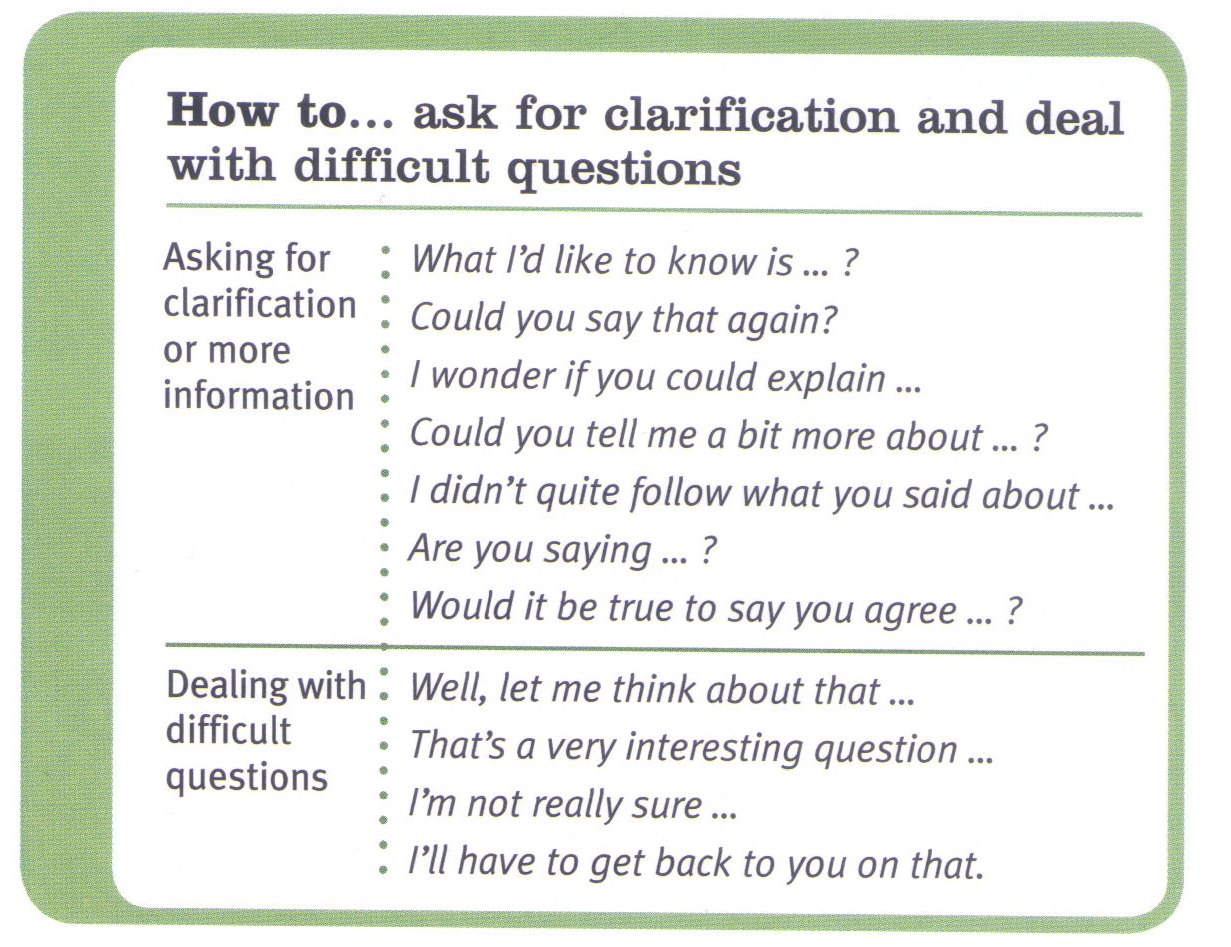
From New Total English Intermediate- Pearson 2011

A common feature in many coursebooks is the ‘Useful Language’ box. This is usually a collection of phrases which the authors consider may be useful for an upcoming speaking activity. A ‘useful language’ box is potentially a great idea because the tendency in speaking activities can be for students to simply stay safe and just use what they already know. Providing this language gives us the opportunity to scaffold their learning and encourage the learners to stretch themselves a bit.

However, in practice, there are two recurring problems.

  1. What do you actually do with the Useful Language box? Just getting students to read through it certainly isn’t enough to get them using the language.
  2. There seems for many students to be a reluctance or inability to use the language straightaway (see this recent conversation on Pearson ELT Community). And if they don’t use it straightaway, what are the chances of them locating and using it at a later date?

I think most people would agree that for students to use new language:

– They need to process the language in some way, work with it, not just be shown it.

– They need to know exactly how to use it in and in what context.

– They need to need to use it.

A good place to start with ‘useful language’ is by having it come out of a recording, rather than just being on the page. With the example above, from New Total English Intermediate, students have been listening to a short presentation, with follow up questions, and, after carrying out other comprehension based tasks, they listen again and tick the phrases they hear being used. They then prepare and give their own mini-presentations.

This approach works in terms of providing context, and it also means that there is a model for pronunciation, which is often very important with functional language (more later). However, there is still, I feel, something missing between identifying the phrases and being expected to use them.

Contextualisation

If the ‘useful language’ came from a recording, students will already have some idea of how they can be used in context. If not, you will, I think, need to provide some. Live listening can be good way of doing this (see my previous post for details). Essentially, you provide the model, ideally recording yourself so that it can be replayed. With the example of useful language given here, you might ask a confident student to give a short presentation on a very familiar and unthreatening topic and warn them that you will ask lots of questions! You can then play the recording back and start to work with the language, as discussed below.

Other ideas for processing the language

Categorisation

Exactly how you do this obviously depends on the language, but, for example, with the language box above, you could ask students to divide the first section into phrases to use when you don’t understand, and phrases to use when you want more information. If the categories aren’t clear-cut, so much the better as this will force students to discuss why they have chosen to put a phrase in that category- and thus create more processing.

Phrase completion

Useful language boxes often have phrases with elllipses (…….), so that students can complete them however they choose. Fine, if they have the faintest idea how to complete them! So, one task could be to give them a context, and ask them to write a completion for each phrase. For example, with this useful language box, you could give a short talk yourself, or use the recording, or use a short video and ask students to prepare questions using the stems. This will also help you to see whether they are able to use them grammatically. As an example, I think many students might struggle with completing ‘What I’d like to know is…’ because of the emphatic structure used.

Dictation

Rather than showing them the useful language box, try closing the book and dictating the phrases. You could add some challenge by mixing up the phrases and asking them to decide where in the box they belong (in this example, in ‘Asking for clarification or more information, or in dealing with difficult questions)

You should make sure that you dictate the phrases in a natural way, as complete phrases, with appropriate intonation, and normal features of connected speech. This will then have the added bonuses of providing a further model of how to say the phrase, and raising awareness of connected speech. For example, some students may well write down ‘What I like to know is..’, rather than ‘What I’d like to know is..’, giving the opportunity to focus on the ’ ‘d’ they didn’t hear.

Writing dialogues

You may have noticed that the activities so far are more focused on writing than speaking, which may seem odd when these phrases are provided for a speaking activity. However, writing can be a good way of bridging the gap between new language and speaking. In ‘How to teach Speaking’, Scott Thornbury points out, ‘Inevitably, because of the constraints placed on mental processing by the demands of real-time speaking, learners tend to rely on a very narrow repertoire of memorized expressions in face-to-face interaction…it may sometimes help to reduce the processing demands on them..one way of slowing down processing is to turn the speaking task into a writing one.’

The following two ideas both come from this book:

–          Paper conversations. Learners have a conversation, but, instead of speaking, they write the conversation on paper. The teacher can then easily monitor and make suggestions for improvement.

–          Rewriting. Students can be given a simple dialogue and asked to rewrite or modify it to use the new language.

Work on pronunciation

As mentioned above, pronunciation is particularly important in using functional-type phrases. They need to be delivered fluently, as a chunk, or they are likely to sound a bit odd and artificial. Intonation is also often extremely important. Think about the phrase, ‘Are you saying…?’  This needs to be delivered with the right intonation, or it could sound pretty aggressive!

So students need a good model- either a recording, or the teacher- and they need to practise drilling the phrases, getting their tongues round the connected speech and using the right intonation.

A fun way of working on intonation is to ‘say’ the phrases using just ‘Mmmm, mmmm’. Students have to guess which phrase you are saying. As they become more confident, they can do this themselves in pairs.

Using the ‘useful language’ in a speaking activity

After time spent processing and preparing, students should be much more likely to use the language in a follow-up speaking activity anyway. However, there are a few ways to encourage this further.

– As described by Antonia Clare in the Pearson ELT discussion I mentioned earlier, you can write phrases on cards and hand out a few to each student. They need to try to put ‘their’ phrases into the conversation as naturally as possible. If the other students feel it wasn’t natural, they could have to take the card back.

– A certain amount of pressure, such as recording the conversation or giving a presentation to the class can encourage students to focus more on using the new language.

– Similarly having an observer in the group, whose job it is to notice when people use the ‘useful language’ can help to focus the mind.

– Depending on the language and the teaching context, students can be asked to go away and ‘notice’ any of the phrases being used in conversation over the next week (on TV, eavesdropping at the bus-stop etc).


10 Comments

Filed under Different ways to use a coursebook, Speaking, Vocabulary

Do something different with the coursebook listening

When teachers talk about ‘doing a listening’, what they usually mean is that they will set the scene, pre-teach as (and if ) necessary, then set some questions before pressing play.

This kind of teaching routine can work very well, and I’ve certainly written plenty of listening sections following that kind of format.

However, in the spirit of John Fanselow, I also believe that it is always a good idea to question such routines, and consider how we could do things differently.

Listening from the middle

In this article (thank you to Frances Eales for drawing it to my attention), John Madden explains how, rather than playing a recording from the beginning, students can benefit from starting in the middle. In real life we often start listening in the middle of a conversation, or when we turn on the radio or TV in the middle of a programme. Starting in the middle helps learners to develop the confidence and skills to deal with this.

Madden starts by discussing times when learners have ‘started in the middle’ in real life and then plays a section from the middle of the recording. Learners tune in as best they can, then discuss with a partner what they understood, and what they think might have been said before they started listening. They can then listen to the entire recording to check their predictions.

Pausing and predicting

Rather than always beginning by asking students to predict the content of a recording, another way of encouraging prediction might be to pause the recording while playing and ask for predictions.

There are several ways I can think of to do this:

1. If the recording is a dialogue, stop the recording after each utterance by person A, and ask students to either say, or write down what they think person B might say. They can then continue listening to check their ideas.

2. Stop the recording about halfway through, and ask students to either continue the conversation they have been listening to, or, if a monologue, to write down what they think the person will say in the rest of the talk.  This could work very well with a well-signposted monologue of the kind found in more academic English

Pausing and focusing on language

These activities would work better after using the comprehension activities in the coursebook, as a way of encouraging students to notice certain aspects of language. For more on this kind of bottom up activity, you might like to read John Field, and my article on Decoding Skills

1. Having previously picked out some useful expressions from the listening, pause the recording halfway through the expression, and ask students try and complete it from memory.

E.g. I had to learn the poem……by heart.

2. Using only a short part of the recording, pause at the end of each sentence or longer phrase, and ask students to write down what they hear. This can work really well for identifying students’ difficulties in decoding connected speech.

3. Pause the recording after referring expressions and ask students to identify what they refer to.

E.g. Albert Einstein is widely considered to be a genius. However, his education did not start off so well (pause-who does his refer to?). He didn’t learn to speak fluently until six or seven and one of his teacher wrote on his school report (pause-who does his refer to?) ‘He will never amount to anything.’, meaning he would never be successful. How wrong he was! (pause- who does he refer to?)

[extract taken from New Total English Intermediate]

Focusing on strategies

Rather than providing a follow-up related to the content of the text, you could carry out a protocol activity. After carrying out your comprehension activity, play the recording again and ask students to write down (in L1 if lower level students), as far as they can remember, what they were thinking at each point of the listening. What exactly did they understand or not understand, what strategies did they use, did they switch off (when and why?). This can then become the basis of a fruitful class discussion about how to listen.

To finish, you might like to watch this short (7 minute) TED talk by Julian Treasure, on How to listen better. It isn’t specifically about ELT listening, but it’s an inspiring reminder of how doing things differently can indeed lead to something exceptional.

16 Comments

Filed under Different ways to use a coursebook, Exploiting authentic recordings and videos, Listening, Teaching methodology

How identifying the different roles we play can help groups work better together

Who are you?

This may seem an obvious question, but now try getting a pencil and writing down ten different responses to that question before you read on….

…If you look at your list, you might have listed your gender or ethnicity, and there may be some adjectives such as kind or artistic. You’re likely to see a set of roles that you play: teacher, manager, parent, son or daughter.

We all play different roles in different groups, and the classroom is no exception.

You are likely to take on different roles within your role of being a teacher: facilitator, critic, guide… But what about the roles your students take within the group?

Group theory (see, for example, Communicating in small groups: Beebe and Masterson) divides roles into three different types:

Task roles: roles that help a group carry out a task

Some examples

Initiator- contributor: proposes new or different ideas or approaches

Information seeker: asks for facts or clarification

Opinion seeker: Asks for values and opinions

Elaborator: provides examples

Orienter: attempts to summarise and keeps the group focused on the task

Maintenance roles: roles that help the group work smoothly together

Some examples

Encourager: Offers praise and acceptance

Harmoniser: mediates disagreements

Compromiser: attempts to resolve conflicts

Individual roles: these tend to be counter-productive to the group as a whole

Some examples

Aggressor: puts other people down

Blocker: negative, stubborn and difficult

Dominator: tries to take over the group

It is tempting to use these roles to start labelling your favourite (or least favourite students), but in fact, roles change all the time, and people can play many different roles. The point of exploring different roles is not to stereotype people or make them feel they should be carrying out a particular role, but to help the members of a group or class be aware of how they are all working together, and how that interaction could be improved.

Activities to raise awareness of group roles

The first two ideas are both ways for students to track interaction within a small group. This can be very useful for getting an overview of how the group is working.

  1. Put the students into groups of five or six. One person observes while the others carry out a speaking task. The observer draws circles on a piece of paper to represent each member of the group. They then listen and draw arrows each time someone speaks.  If one person speaks directly to another, draw an arrow between them. If someone speaks to the group as a whole draw an arrow away from the group. If someone is speaking for more than a few sentences at a time more than one arrow can be drawn.

At the end of the task, the observer should feedback to the group on what they observed, and the whole group can discuss the findings:

–          What do you notice about the lines of communication?

–          Were the lines of communication an effective way of carrying out the task? Why/why not?

–          Was everyone happy with the way they participated?

–          What things could the group change in the future?

This task is taken from Conversation: Nolasco and Arthur.

2 A similar, but perhaps more entertaining idea, comes from Classroom Dynamics: Jill Hadfield. Rather than having an observer, the group has a ball of wool or string. The person starting the speaking task holds the end, and then passes the ball to the next person to speak. This continues until the task has finished (I’d suggest quite a short task!). The pattern of interaction will be very clear at the end, demonstrated by the web of wool or string. Or possibly the students will actually start to change the pattern of interaction as they see that they are either taking over a bit too much, or not contributing very much.

After this kind of activity, you could go a step further and actually start to look at the different kind of roles students are taking. This needs to be done carefully though, to avoid singling people out for criticism.

Jill Hadfield suggests two activities which could both be handled sensitively:

1 Using a self-evaluation questionnaire. There is a photocopiable one in Classroom Dynamics, which includes questions such as:

–          Did you contribute any ideas?

–          Did you encourage anyone else to contribute any ideas?

–          Is there any way you could help the discussion to go better….by making a suggestion etc.

She suggests carrying out a speaking task, then asking students to complete the questionnaire individually and privately, then carrying out a second speaking task and finally discussing if and how the second speaking task was an improvement on the first one. (From personal experience I can tell you that this process can be completely transformational.)

2 Observing group roles. In this activity, students carry out a speaking task and are observed. The observer ticks how many times various things (such as contributing an idea, interrupting, evaluating someone else’s idea, not talking in English) happen- but does not note down who did these things.  The group then looks at the results and decides which things are happening too often, and which not often enough. There isn’t necessarily a value judgement to these things. Contributing ideas is something we want to see happen, but if that’s ALL that’s happening, the group will not be working very smoothly! They then choose three things they should do more often and three things they should do less often.

Incidentally, although the observer in these tasks is not taking part, this can be a useful role for certain students. Students who tend to be very dominant can benefit from having to sit back and listen, and students who struggle to get a word in can benefit from having a clear role and being asked to feedback on what they observed.

6 Comments

Filed under Differentiation, Speaking, Teaching methodology, Working with groups

A new class: building a learning environment together

Many of us are starting new terms and working with new groups. We probably already know what the learners are expected to achieve in their time with us, and the pressure is on.

It’s tempting to dive straight in, but any new group will need to work through interpersonal issues before they can function effectively as a group (and as individuals within the group). We can ignore these issues, but that won’t make them go away; we’re just more likely to get our feet tangled in them, like weeds under the surface of the water.

In a central work on group dynamics in the classroom, Schmuck and Schmuck [no, it isn’t just you that finds their names amusing  :)], observe:

‘ Our research has shown that classroom groups with supportive friendship patterns enhance academic learning, while more hostile classroom environments reduce learning…informal group processes in the classroom can, and do, make a difference in the accomplishment of the formal goals of the school.’

So, what can we do to encourage more supportive patterns?

Getting to know you activities

First of all, pay more than lip-service to the ‘getting to know you’ activities. Language learning is a high risk activity in terms of losing face and the student surrounded by unfamiliar faces is likely to either withdraw or ‘act-out’ as a way of controlling the environment.

Names

It seems obvious, but make sure that everyone knows everyone else’s names. Rather than putting pressure on them to learn them, try a discussion activity about names. Some possible questions:

–          How did you get your name? Were you named for someone else? Who/why?

–          Does your name have a meaning?

–          Do you have a nickname (you are willing to share)? How did you get it? Who uses it?

–          Do you or other people shorten your name in any way? How do you feel about either the shortened name or the full name? (Many people feel they are going to be told off when someone uses their full name)

–          Do you like your name? Why/why not?

–          What would you like to be called in class?

This can be done in small groups, which either swap around, or feedback to the main group.

It goes without saying that you need to learn your student’ names as quickly as possible. A few tips:

–          Write down the names in the same layout as the students are seated (i.e. in a horseshoe) and refer to it often in the first class or so.

–          Use their names as much as possible to begin with.

–          When students are working on something mentally go round and test yourself on the names. Ask anyone you can’t remember to remind you (better now than in a month’s time)

–          Make a note next to each name of a distinguishing feature (e.g. curly hair).But be careful with this one….don’t write anything you wouldn’t want the student to see!

Find someone who…

This is a very well-known activity in some circles, so apologies if it’s too obvious, but it does work brilliantly. This is a variation which doesn’t require you to know anything about the students prior to the class, and ensures that students are comfortable about what is revealed (which can sometimes be a problem when this activity is done on CELTA courses, based on application forms!)

Put students into small groups (3-4) and ask them to think of three things to tell the other group members about themselves, which they are pretty sure will be new information.  They should take it in turns to give a piece of information, and the others should comment on it. Model this if necessary. While they are carrying out the activity, monitor and note down one fact about each student that you overhear.

Then dictate the facts to the class. E.g. Find someone who…

…has just been to Sweden on holiday.

…used to live in another country

Students will already know some of these from their small group work, but they can then mingle and ask others in the class, ‘Have you just been to Sweden?’ etc.  (no pointing at the sheet allowed)

Guess who?

This works better with groups which have worked together a little before. Each group member writes 2-3 sentences about themselves (anything they want to share). These are collected in and read aloud (by you or the students) and everyone writes down who they think each one refers to before the answers are revealed at the end.

An alternative is for 1 of 3 pieces of information to be a lie. In this version, we don’t have to guess who, but guess which piece of information is untrue.

Creating a sense of group identity

As well as getting to know each other better, we can also focus on creating a positive group identity.

Class Yearbook or Photo Album

Over the course of the year, a scrapbook (or the digital equivalent) is gradually built up by members of the class. You could begin with photos and a short bio about each member, then add updates as often as you and the class wish. This could cover what has been learnt, any social activities or trips, creative writing or articles, whatever seems appropriate.

At the end of the year, contact details could be added for those that wish to keep in touch if the group is breaking up, and maybe include a letter from the teacher about the experience of teaching the group.

Class history

(this idea comes from the wonderful Classroom Dynamics- Jill Hadfield)

Exactly how you do this will depend on the age range of your students. The idea is for each student to research a different year or other short period of time in the past and find out what everyone in the class did or was doing at that time.

After a mingle activity where they interview each other, the information can be put together on a time–line.  This is a great activity for working together and getting to know each other (not to mention using past tenses)

In my next post I plan to look at some activities for developing the class’s awareness of how groups work together and how they, individually, are contributing to the group. Feel free to sign up to be sent this post by email- button on the right.


13 Comments

Filed under Differentiation, Teaching methodology

Using live listening to prepare for IELTS speaking

The extended monologue

In the second part of the IELTS test, candidates have to speak for 1-2 minutes on a given topic, having been given 1 minute to prepare. (Incidentally, I have mentioned IELTS in the title, because this is perhaps the best known example, but there are other speaking exams (e.g. Cambridge ESOL Skills for Life L1 and L2 ) where candidates have to carry out similar tasks).

Although Part 2 of IELTS is not actually as tough as Part 3, for many candidates, it is the part they dread the most. However, it is also the part where familiarity with the task and plenty of practice can really make a huge difference. As an IELTS examiner, I sometimes examine native speakers applying to emigrate to Australia, and even these perfectly fluent speakers can struggle with Part 2 if unprepared.

In IELTS the candidate is given a number of points to cover. For example:

Describe a leisure activity which you enjoy doing.

You should say:

–          What the activity is and how you do it

–          When and how often you do it

–          What equipment you need

And explain why you enjoy it.

[example from IELTS Foundation Second Edition]

In order to do well in this part of the exam, students need to:

1 Structure their answer well, so that it is coherent and cohesive.

2 Speak fluently, without too many hesitations.

3 Demonstrate accuracy and range in their language.

Live listening is an excellent technique for both modelling the kind of answer the students should be aiming for, and providing a source for language they can use.

What is live listening?

In a nutshell, live listening means listening to the teacher (or another visitor), in a face to face situation, rather than using a pre-prepared recording. The teacher can be a neglected resource in terms of listening, as teachers try to avoid the dreaded ‘teacher talking time’. However, there is a world of difference between the teacher mumbling away to the class instead of giving clear and concise instructions, and using the teacher as a rich resource for listening.

Listening to the teacher speaking at length offers the benefits of:

–          genuine, real-time communication.

–          all the features of natural spoken English (hesitations, false starts, connected speech etc)

–          facial expressions and gestures

–          the opportunity to offer clarifications

Using live listening to prepare for IELTS Part 2

Using set of prompts like those above, the teacher prepares to talk for 1-2 minutes on the topic. You might want to spend more than the 1 minute that candidates are allowed, but it’s important that you don’t script what you are going to say.

Talk for 1-2 minutes to the students, and, ideally, record what you say. They listen and make notes on what you said about each prompt. Carry out brief feedback. This should help them see how to structure their talk, using the prompts.

Then play the recording (or repeat the task) and encourage students to write down any useful ‘chunks’ of language that they hear, which they think they could use in a similar task.

The reason that native speakers are able to speak so quickly and fluently is because they have a huge store of chunks of language which they are able to pull out and use; they don’t have to create every word from scratch. So it makes sense to encourage learners to develop their own store of ‘chunks’.

Here is a Vocaroo recording of me using  the prompts above to talk about Qi Gong

http://vocaroo.com/i/s0J4pGleT6oB

And here is the language I might encourage the learners to pick out from this recording:

The leisure activity that I’d like to talk about is_______

It’s a kind of __________

It’s all about + ing

It’s quite similar to_________

The main thing about _____ is (that)____

I don’t often get around to it.

You don’t actually need any equipment at all.

Sometimes I find it difficult to motivate myself.

I always feel better after I’ve done it.

Spend a little bit of time checking that students understand the ‘chunks’ and can pronounce them fluently, then put them in pairs and ask them to carry out the same task themselves, using any of the chunks they find useful.

The beauty of this activity is that it requires minimal preparation, but, repeated on a regular basis, with different prompt cards, it can really help learners to develop their ability to structure a short talk and to use natural sounding ‘chunks’ of language.

8 Comments

Filed under Different ways to use a coursebook, Exploiting authentic recordings and videos, IELTS, Listening, Speaking, Vocabulary

Fresh and inspiring sources for your teaching: an #ELTChat summary

How do you make sure your classes stay fresh and inspiring and what sources and influences outside ELT do you use to find subjects for your lessons?

This is the summary of the ELTChat held on Twitter at 12pm Wednesday 18th July 2012. The topic was suggested by @theteacherjames and inspired, he told us, by the following quote:

‘Success depends on sufficient knowledge of the special subject and a variety of extraneous knowledge to produce new and original combinations of ideas.’ Rosamund E.M. Harding

@theteacherjames  kicked off by pointing out that ‘ELT is the subject without a subject, meaning we can basically use any topic we want for our classes’ So, ‘. How do we find ideas?’  The focus was particularly on ideas and topics not from ELT sources.

News stories

News stories were obviously a popular source. Many people used local newspapers, so that the stories would be very topical, but some useful websites were also suggested:

@cybraryman1 gave us the link to a whole page full of links to news sites: http://cybraryman.com/news.html

@teflerinha gave the link to weird news stories from Metro (a free newspaper) http://www.metro.co.uk/weird/

@esolcourses recommended Newsy, for short news videos http://www.newsy.com/

And Ken Wilson’s blog has a nice article on using the Yahoo home page: http://kenwilsonelt.wordpress.com/2010/11/07/the-yahoo-home-page-dull-scary-or-engaging/

Other articles and bits and pieces

@theteacherjames gave us a link to  http://www.brainpickings.org/ , an ‘interestingness digest.’

And his list of interesting’ sciency ‘people on Twitter https://twitter.com/#!/thejamesabroad/interesting/members

@theteacherjames recommended the Guardian Family section and gave a link to his blog where he highlights some of what can be done with it. http://theteacherjames.blogspot.be/search/label/The%20Guardian

@theteacherjames suggested ‘For fun facts and trivia, follow @qikipedia and @UberFacts.’

Films and clips

@leoselivan mentioned using films, and said that he used whole films in segments throughout the semester. @sharonzspace said she encouraged students to find suitable films, and there was a brief discussion about finding out what students are interested in rather than imposing our own favourites  on them, balanced with choosing films which are suitable and have linguistic benefits.

@esolcourses mentioned youtube and gave an example of a clip used on her blog at at http://esolcourses.blogspot.com/

@leoselivan gave us the following link to the ESL Learner Movie Guide  http://www.eslnotes.com/

@cliltoclimb Gave us this link to an interview with Kieran Donaghy on using films http://iasku.wordpress.com/2012/07/12/kieran-donaghy/

@sharonzspace gave us a link to the TED page http://www.ted.com/

@worldteacher’s students still love Mr Bean! @theteacherjames gave us a link to his blog with some examples of different silent movies. http://theteacherjames.blogspot.be/search/label/silentmovies and @esolcourses gave us a clip of oktopodi  http://esolcourses.blogspot.com/2009/09/learn-english-twitter-esl-writing.html

@teflerinha mentioned clip from youtube, which @designerlessons has turned into a lesson for advanced students. It’s from a series of videos 50 people, 1 question. This one interviews people in Denver about ‘What would make you happy?’  : http://designerlessons.org/2012/02/20/esl-lesson-plan-happiness-one-question-generating-discussions/

 Podcasts and other audio resources

 @worldteacher commented, ‘One of my favourite resources with higher level sts – From Our Own Correspondent podcast from BBC – 5 x 5-min stories each edition.’ @BobK99 agreed ‘Very good for looking at different accents (as there’s often a vox pop in the reports).’

 @teflerinha somewhat sheepishly added BBC Women’s Hour as a favourite source- and other fans came out of the closet too!

And @jamestheteacher said he often used  4 thought http://www.bbc.co.uk/programmes/b010q0n0 with business students.

@worldteacher also mentioned BBC Desert Island Discs

@jeaneoakes made the point that ‘ if students make podcasts they hear how they improve oral langauge skill. Use a rubric to score and set goals.’

Pictures and visual content

@Sharonzspace mentioned Facebook for visual content, and @worldteacher suggested that it pays to follow the British Council, as they post great links.

Technology

 @nancyteach pointed out that there are lots of free webinars and walkthroughs which can help teachers learn how to do many Edtech tasks.

 @Sharonzspace uses a closed group on Facebook with her students and @worldteacher’s students are motivated by using Edmodo (a secure social learning network for learners and teachers- good if Facebook is blocked)


Other

@DanielaArghir told us about a routine she has with YLs where she starts each lesson with a ten minute slot on what is being celebrated that day (e.g. International Women’s Day, or something sillier like Chewing gum Day- can even make them up if necessary)

@cybraryman1 gave us a link to national holidays etc on  http://cybraryman.com/calendar.html

@worldteacher suggested that  ‘Taking students outside of the classroom whenever possible helps to keep things fresh.’

@esolcourses suggested using Googlemaps for virtual trips.

@BobK99 said ‘I use mats based on a free tourist h/o (maps, time, buying tickets, etc) but after the lesson give out up-to-date education.’ And @teflerinha agreed that realia can be really motivating- even simple things like brining in a real book to read aloud from rather than reading it off the coursebook page.

@teflerinha suggested lessons where students make things, such as origami, can be good for a change and involve a lot of language use. @DanielaArghir gave an example of a recent class where her 11 year olds made windmills for Global Wind Day. And @worldteacher talked about her cookery sessions with adult students (lucky, her some of them own restaurants!)

@DanielaArghir gave us a link to a site about creative ideas for working with children. http://www.childcareexchange.com/

@SueAnnan had used a foreign language music CD, which generated lots of language.

And, intriguingly, @jeanneoakes mentioned using a ‘culture bag’ but we never found out what that was?!

To conclude, @Shaunwilden reminded everyone that materials are not the only thing which makes a lesson fresh and inspiring. @teflerinha agreed that trying out different ways of doing things was also important, and @worldteacher mentioned CPD. @Cybraryman1 added ‘Important to start each lesson with something that will engage your students & is relevant. Vary your teaching approach too.’ And, finally, @MizLadyCaz pointed out that ‘The right scaffolding can allow for success with any resource.’

3 Comments

Filed under ELT Chat summaries

Drilling-based activities: preparation light, student generated ways to build fluency. What’s not to like?

Drilling

Drilling has certainly fallen out of favour in recent years. Strongly associated with the behaviourist approach it is often seen as non-communicative, boring, patronising…. A recent ELTChat on the subject brought up all the negatives, but also provided a long list of positive reasons for drilling. For example:

  • Building confidence
  • Helping learners get their tongues round new words
  • Picking up pace and getting students’ attention
  • Developing ability to produce (and understand) connected speech

And perhaps the key reason, for me at any rate: drilling or repetition is an important step towards fluency. Especially at lower levels, it is quite natural to rehearse (at least mentally) before tackling a speaking situation.  Repeating something helps us to ‘notice’ what we are repeating and assimilate it into our store of language. The ELTChat I referred to concentrated mostly on drilling words or single chunks. There are plenty of benefits to this, but in this post I want to concentrate on some techniques which are probably even more out of favour: drilling and repeating dialogues and narratives.

Dialogue builds

I did my CELTA so long ago that it wasn’t even called that then (!). It was also at IH in Cairo, which I rather suspect was a little behind the times in terms of materials. The result was that my initial training centred around the coursebook series Streamlines and Strategies. Lots of drilling and repetition.

One of the first techniques I learnt was a dialogue build. For the uninitiated, it goes like this: Set up the situation, using a photo (or in pre-IWB days two stick figures on the board). Elicit where the characters are, who they are, what’s happening and so on. This is often a service encounter (e.g. in a café), but can be anything you like.

Then you elicit the dialogue from the students, line by line. As you accept each line, you help learners correct it if necessary and then model the final version, with appropriate connected speech and intonation, getting the students to repeat it. You DON’T write the dialogue on the board, but do indicate where each line starts and who is speaking. You might also add question marks or little visual clues. As you go through the dialogue you keep returning to the start, getting students to keep repeating the dialogue, and thus memorising it. You can do this whole class, or divide the class into the number of characters or ask individuals to do each line. It’s good to have a bit of variety here.

Once the class knows the dialogue by heart, they can practise a little more in pairs, changing roles. You can also have a bit of fun with it by getting one of the characters to change their answers, so that the first person has to react spontaneously. (Good idea to model what to do first with lower level learners) Finally, you can elicit the dialogue once more, writing it onto the board so that the students have a clear written version. Alternatively, you could get students to come up and write it on the board, giving scope for some work on correcting spellings, missing articles and so on.

A dialogue build is a great technique to have up your sleeve for a last minute cover lesson. It’s obviously most appropriate for lower level learners, but could be done with more advanced students if the chunks of language elicited were more demanding. At the end of it, the students have memorised a whole set of (hopefully useful) chunks of language and can produce them fluently at will. Fluent speakers are essentially those who have enough chunks of language that they can stick together to keep going, so teaching chunks in this way is a real help.

It’s also an excellent activity to do with learners with low levels of literacy. I can’t understand why it isn’t an ESOL staple. You don’t need any equipment except a board and pens (great for those community halls), it doesn’t rely at all on reading and writing, it can be adapted for specific situations that learners might have to deal with (ringing for a doctor’s appointment, for example) and once it’s elicited onto the board it provides a copying activity where the meaning is already very clear (and was indeed student generated).

Alternative versions

Instead of eliciting the whole dialogue, you could give them one half or the dialogue (i.e. all that one person says) and elicit the missing responses. Then proceed as above. A good alternative for learners who can read quite well, is to start by writing the elicited dialogue onto the board. Drill as a class, making sure you are giving a good model of natural pronunciation, then ask learners to practise it in pairs. As they are practising, gradually wipe off words and lines from the dialogue. As it disappears, they have to remember more and more. Finally you can re-elicit it onto the board or get them to write it down on the board, or in pairs on paper. This could work equally well with a narrative.

Another old, but great, idea comes from Mario Rinvolucri’s book, Dictation. In this activity, you do the repeating (at least to start with) and the students listen and mime the actions. It works really well with younger learners, but if you have a lively class, adults could enjoy it too. Here’s the text (slightly adapted)

You’re standing in front of the Coke machine. Put your hand in your back pocket. Take out three 50p coins. Put them in one by one. You hear the machine click. Choose your drink and press the button. You hear a terrible groan from the machine. Clunk! A can drops down. Pick it up. Open the can. It squirts Coke in your face. Take a tissue out of your pocket. Rub your eye. Lick your lips. Take a sip. Burp!

First read the text right through, just to orientate students. Then read again and elicit a movement for each line. Get all the students doing it. Then read a third time with all the students doing all the movements.  You can make this stage fast as possible if you want a bit of fun. Then give the students a version of the text with most of it missing. They have to work together to recreate the text.

This is a form of dictogloss, but the difference is that doing the actions should help them to remember what’s missing. If they get stuck, get them to do the actions and try and remember that way. This is the stage at which they should be drilling the language themselves, as they try to recall it. You can obviously differentiate this activity by giving less of the text to more able students and vice versa. Finally you get the whole class to carry out the actions while saying the text (from memory).

All of these ideas are extremely preparation-light and student generated. They provide a way to help learners appropriate new chunks of language to their store, and the challenge of memorisation also provides interest and stimulation. Maybe it’s time for a revival?

12 Comments

Filed under Differentiation, Pronunciation, Speaking, Teaching methodology

How we can use minimal pairs to help L2 listeners to decode what they hear.

At the weekend I was lucky enough to catch Sam Shephard’s lively session on pronunciation at the NATECLA conference in Liverpool. His session focused mostly on productive pronunciation, but as I was presenting on the same day on decoding skills for listening, I found myself thinking more about the role of pronunciation work in decoding- and specifically about minimal pairs.

When I first saw this advert for Berlitz language schools on youtube, I was struck with how clever it is.

But, apart from in this rather specific context, how important is it really that learners can understand or pronounce the difference between //θ/  / and /s /?

Minimal pairs, minimal importance?

It seems that misunderstandings in natural speech are rarely caused by the mispronunciation of one sound. Usually context gives us enough of a clue to understand what the speaker is trying to say. Adam Brown gives a good example in his 1995 article, Minimal pairs, minimal importance?:

‘Singapore is one of the busiest ports in the world. However, it is a tiny island (the size of the Isle of Man) with a population of three million. Consequently, land is at a premium, and there are no animal farms. The nearest most Singaporeans come to sheep is mutton curry. In short, if Singaporeans don’t pronounce the distinction between ship and sheep clearly, the chances of misunderstanding are minimal: they are almost certain to mean ship.’

Similarly, Jenkins (2000) found that /θ/ rarely caused misunderstandings between NNSs, and she also points out that many native speaker varieties don’t use it anyway, often using /t/ or /f/.

So should we chuck out the minimal pairs work?

Can minimal pairs help L2 listeners decode more effectively?

Well, according to John Field (2008) there is evidence that L2 listeners process in words, but that ‘many of the matches they make are rough approximations that do not correspond exactly to the sounds that the listener heard.’ In other words an inability to recognise certain phonemes is leading to learners making inaccurate guesses about words, which in turn could lead them quite seriously off track as they apply top down skills to their guesses. For example, the listener who hears ‘screams’ instead of ‘screens’ is likely to go quite a way off track.

It is certainly true that context could help here- but that is making the assumption that learners are able to use their top down skills effectively when, Field and others argue, learners who are unable to decode effectively, usually can’t hold onto enough meaning to start stringing ideas together.

So, therefore, there is certainly an argument for using some minimal pair work, especially at lower levels- though we probably do need to be quite selective about which phonemes we choose to focus on.

Functional load

Sounds that carry a high functional load are used to distinguish between a significant number of words. The opposite is sounds which carry a low functional load. For example, Brown (1995 above) says that the only minimal pairs in English for /ʃ/ and /ʒ/ are:

Confusion/Confucian, azure/Asher, mesher/measure , allusion/Aleutian, glacier/glazier

I think we can probably all agree that the likelihood of students even using most of these words is pretty low, never mind getting them confused!

Minimal pairs with a high functional load would include:

/e/ and /ae/ , /p/ and /b/, /e/ and /I/

A full list is available in Brown 1988

Individual needs

With a monolingual group, it should be fairly straightforward to find out which pairs are causing the most problems. A book like Learner English can be helpful, or simple observation. Obviously with a mixed nationality group, tricky minimal pairs are likely to vary, but there are some which seem to be difficult for speakers of many different languages, and have a high functional load, such as /e/ and /ae/ and /ae/ and /ʌ/

Activity ideas

The first point to make is that ideally, learners should be able to see the link between the minimal pair work and what they are listening to. For example, if a number of learners have heard ‘scream’ instead of ‘screen’, that would be a perfect opportunity to do some minimal pair work on /m/ and /n/.

The second point is not to overload the learners. I wouldn’t suggest working on more than one pair of sounds at a time.

The third point (made by Field) is that ideally words used should be relatively frequent and of roughly equal frequency. So bin and pin would be OK, but perhaps not blade and played.

There are lots of ideas for working on minimal pairs (some of which came up in Sam’s session, mentioned above)

Some different ways for learners to show they can differentiate the two sounds:

  • Put the two words in each pair on different sides of the board and learners  put up their left hand/right hand according to which they think they hear.
  • Alternatively, learners can physically move to the right or left side of the classroom.
  • Put the words on cards and learners grab the right card, either in small groups with little cards, or with big (sturdy) cards, you can haver learners line up so one from each team is in front of the board and they race to grab the right word from there.
  • For a more sedate activity, learners write down what they think they hear.
  • Learners say if the words you say are the same or different.

Obviously all the activities above can be done with a learner providing a model, but then it becomes oral work, rather than listening, and they will need help to know how to make the sounds etc.

If learners have literacy issues, the above activities could potentially be done with pictures rather than words:


And if one of the words in the pair you want to use is not very frequent (e.g. played/blade), you could still do the activity but just write the frequent word on the board and ask ‘Same or Different?’

A more contextualised task, which would make the relationship to listening clearer, might be to select a phrase or short section from something they have listened to which contains a lot of the two sounds (not necessarily in minimal pairs) and ask them to mark the two phonemes.

E.g. ‘Looking after rabbits is really easy’ might work well for /r/ and /l/.

Individualised work

Clearly working on minimal pairs is much trickier with a multi-lingual class. As mentioned earlier, there are some vowel sounds which a lot of people find tricky. Alternatively,  learners could be given different sounds to work on, according to needs. There are now quite a few websites  (for example http://www.shiporsheep.com) where learners can listen to minimal pairs, so this kind of differentiated activity could be set as homework.

11 Comments

Filed under Differentiation, Exploiting authentic recordings and videos, Pronunciation

The Language Experience Approach: a person centred, materials light approach to literacy

In a previous post, I talked about some criteria for selecting suitable reading texts to use with learners. Two key points are that texts need to be at the right level and that they need to be intrinsically interesting for the students.

Clearly, one way of achieving both these points is for the learners to produce the texts themselves. The Language Experience Approach (LEA) is a way of doing this, which has its roots in early literacy teaching. It dates back to the sixties and is fairly well known in ESOL circles, but not, I think in general ELT.

Overview of the LEA

1 Working together, the teacher and students choose a topic or activity which can be written up later. This might mean watching a video, taking a field trip or simply bringing in some pictures.

2 Carry out the activity or discuss the topic.

3 Discuss the experience or discussion and write some key words and phrases on the board.

4 The class works together to develop a written account. Typically the students dictate to the teacher, who writes it down. I say typically, because this is at root a literacy activity, so doesn’t assume that the students can write in English. In classic LEA, the teacher does not correct any mistakes or even elicit any corrections. However, I personally feel that for students’ whose first language isn’t English, providing or eliciting a correct model is vital at some stage in the process.

Of course, there is no reason why students who are able to write in English couldn’t work together in groups to write a text.

5 The teacher or a learner or all the learners read the text aloud to the class, and then everyone reads it again silently. This is another stage at which linguistic revisions might be made.

6 Extension activities.  Because the students have written the text themselves, they should be quite familiar with the meaning, even if they do not recognise all the words. At lower levels of literacy, students could:

–          Copy the story.

–          Word or sentence matching (match strips with words or sentences from the text with the text on the board)

–          Write down the story as the teacher dictates it.

–          Complete missing words which the teacher (or one of the students) has rubbed out.

–          Unscramble the sentences from the story (previously scrambled by the teacher)

At higher levels :

–          Students revise and edit the text themselves.

–          Use this text as a basis for writing their own personalised accounts

–          Use the vocabulary from this text to write a new text.

Of course if you have both more and less proficient readers/writers in your class (very common in ESOL), the students could do different tasks with the same text.

The beauty of the LEA is that it is firmly learner centred, using the students’ own experiences as the basis of the work,  and can provide a sense or achievement for every student in the class, at very mixed levels. It is also very materials light, and requires little preparation.

I am sure that there is plenty of room for variations on the LEA and would be interested to hear your ideas.

4 Comments

Filed under Differentiation, Teaching methodology

Developing meaning-building skills in reading

The default position with regard to exploiting reading texts seems to be comprehension questions. I should start by saying that I am not against comprehension questions as such.  In a previous post,  I looked at a selection of quite traditional tasks and how to write them in such a way that they help guide the learner through the text. As Nuttall (1982) says,

‘The questions that help you to understand are the ones that make you work at the text. They force you to contribute accurately to the process of making sense of it, rather than expecting understanding just to happen.”

However, it is also undeniable that these kinds of tasks are ultimately more about testing than teaching.

Meaning-building is something which happens by interacting with a text, and it is highly personalised. No-one will understand a text in exactly the same way because we all bring our own experience, knowledge, attitudes and so on to everything we read.

As we read, we use our background knowledge, contextual clues and knowledge of the language to build meaning.  It used to be assumed that using contextual information, or information from the co-text (what goes before or after what we are reading) was something that only more confident or capable learners could do. However,  there is some evidence that in fact learners who are struggling to decode a text will also try to use meaning building skills. The difference is that more capable readers will use them to add meaning, less capable or confident readers will use them as a compensatory strategy.

(If you are interested in this last point, have a look at some of the reams of stuff which has been written about Stanovich’s Interactive Compensatory Hypothesis)

Think aloud

One way to find out more about what kinds of interactive processing your learners are doing while reading is to ask them to use a think aloud protocol. This can work very well in small groups. Basically, you get students to read a paragraph, and then discuss with the rest of the group what they think they have understood so far. Tony Lynch, in Communication in the Language Classroom (1996:126), says of this process, ‘My experience is that think aloud tasks make some learners aware of textual clues which other learners in the group have recognised, which would pass unnoticed in individual reading.’

He also suggests following up this task with a round-up where each learner notes something they felt they learnt from the discussion.

Another way of doing this is something called ‘reciprocal teaching’, again mentioned by Tony Lynch. In this version, a different person is chosen to lead the discussion after each paragraph, using four main points:

  • Clarifying any problems
  •  Stating the main idea
  •  Summarizing the content of the paragraph
  • Predicting the likely content of the next paragraph

(Cotterall, S, 1990)

SQ3R

This is a technique which was originally developed for university study, but it works just as well with any slightly longer or more complex text, which needs detailed understanding.

The acronym stands for:

  • Survey: Scan the whole text, looking at any clues in the introduction, titles, layout etc.
  • Question: Decide what questions you would like to be answered by reading the text. Make a note of them.
  • Read: Read the text, trying to answer your questions and note down any other questions that come up.
  • Recite: After each section, stop and see if you can remember the answers to our questions. If not, read through the section again.
  • Review: Once you’ve finished, go back over all the questions and check you still know the answers. Re-read as necessary.

Summarising

This is an old-fashioned technique, but is actually one of the very best ways of seeing whether students have really understood the salient points of a text. Below is an example from New Total English Intermediate Writing Bank (click to enlarge). It uses an adapted authentic text, but you could easily carry out the same kind of processes on any text you choose.

Alternatively, students could be asked to summarise a text for different audiences. For example, to make it suitable for a child, someone from a very different culture and so on. This angle on summarising means that the students have to think about what background knowledge the reader would need to understand the text- which is a good way into thinking about how they themselves use their background knowledge to build meaning.

13 Comments

Filed under Different ways to use a coursebook, Exploiting authentic reading materials, Teaching methodology