Listen up and take notice:using (semi) authentic listening resources productively

More and more authentic (or semi authentic) listening texts are appearing in published materials. In this session we will look at the reasons for this and at how these materials can be exploited fully to provide not just more realistic listening practice but also a rich resource for developing learners’ own language and speaking skills.

This post is the substance of my presentation at IATEFL Glasgow on 20/3/12, title and abstract above. It can be read without reference to the slides, but the slides can be found on the Glasgow Online website at:

http://iatefl.britishcouncil.org/2012/sessions/2012-03-20/listen-and-take-notice-using-semi-authentic-listening-resources-productively

What makes a listening text authentic? The difference between a listening text which has been scripted and a piece of authentic dialogue is very obvious once it has been transcribed. In real life speech is full of :

  • Repetition
  • False starts, rephrasing and clarification
  • Hesitation and fillers
  • Simpler sentences or even ‘ ungrammatical’  language
  • Paralinguistic features
  • Backchannelling
  • Ellipsis

If the only practice we give our students is with material that does not have these features, how can we really be preparing them to listen in the real world?

On the other hand, fully authentic material, material which was never intended to be used for learning purposes, may be a little too authentic.

In their book,  Conversation: from description to pedagogy, Scott Thornbury and  Diana Slade make the following observation:

‘Conversations are notoriously hard to capture on tape and even harder to listen to. In the interests of intelligibility…speakers should be recorded talking about a topic without being told exactly what to say in advance.  This way there is more likelihood of capturing naturally occurring features of conversation such as hesitations, fillers, false starts, overlaps etc.’

This is what is known as a semi authentic listening. I recently wrote the new edition of Total English Intermediate. This book, and the other levels in the series, contain at least one and often two of these semi authentic recordings per unit, using a variety of native speakers and non native speakers.

When we listened to the recordings, we discovered that, as well as providing good listening practice, the scripts were also full of examples of natural English use, which learners could learn from.

But how to get them to notice and use this language, or these features? One simple, but very useful framework comes from Thornbury and Slade. They argue that there are three key things we need to be giving our learners:

Exposure, Instruction and Practice

Exposure, or giving opportunities to hear language being used, is the one we tend to be quite good at (though I would argue that we need a lot more. Many coursebooks only have one ‘listening’ per unit.)

It is however, not really enough. Learners will either fail to notice salient points, or take a very very long time to notice them.

So we also need instruction- or occasions when their attention is drawn to these salient points of language.

And, of course, we also need practice. Instinctively, we all know that to learn any practical skills- and that’s what language is- requires practice.

So,  let’s take an example of an unscripted anecdote about a childhood memory.  This appears in Unit 10 of New Total English Intermediate, but you could use any recording which follows the structure of a narrative or anecdote.

The aim is to help students become aware of the discourse structure of an anecdote, following Labov’s Standard Western Narrative:

Abstract Announces that a story is about to start (optional)
Orientation Provides background information
Complication Introduces a problem or a turning point into the main sequence of events
Evaluation Show the speaker’s attitude to the events (may be spread throughout the story)
Resolution What finally happened
Coda Returns listeners to the present (optional)

Obviously the way this is phrased is quite complex, but it can easily be simplified for students. An awareness of this discourse structure is extremely useful because we use it all the time. In job interviews for example, when you’re giving an example of a success you had, when you’re giving an excuse and so on.

So, learners are  exposed to the discourse structure by being asked to put the main events in order as well as any other comprehension tasks. Next they are instructed in the sequence of narratives and finally they tell their own similar anecdote or story, practising the structure.

Alternatively, they could retell the story from the point of view of a different protagonist. This might be useful in an ESOL context, for example, where talking about childhood memories might be inappropriate.

But exposure, instruction, practice isn’t the only way the triangle can work. Alternatively, we could have:

Instruction-Exposure-Practice

 Let’s look at an example which focuses on vocabulary this time. The recording I used featured two short monologues in which people talked about problems in the cities where they lived (Madrid and Edinburgh). A lot of useful vocabulary came out of these recordings, for example;

building work, construction, drilling, exhaust fumes, heatwave, roads being blocked,  horns honking rush hour, terribly cold, tower blocks.

We started by asking the students to categorise these words and phrases into Noise, Types of buildings, Weather, Pollution and Congestion. This was the instruction part of the triangle.

Next the students listened to the monologues and made notes in each category. In this way they were exposed to the language in context. Finally, they carried out a parallel task describing their own town or city.

Thirdly, the triangle could, of course, also be practice-exposure-instruction (and then maybe more practice)

This works well with a recording in which students listen to mote proficient speakers carrying out the same task as themselves, a technique from task-based learning. In my example, learners are asked to use a leaflet to plan a day trip to London.

To follow the practice- exposure-instruction triangle, learners could be asked to first carry out the task themselves. That’s the practice. Then they could listen to the recording, which is of two native speakers and one very proficient non native speaker doing the same task and find out what they decide to do. That’s the exposure.

Finally, they can look at the transcript and underline the language the speakers use to make suggestions and respond to ideas. And that’s the instruction.

While I wouldn’t suggest looking at the transcripts while listening for the first time, they can be a very useful resource. Sound disappears, the transcript captures it so that students can look again and notice the features of natural spoken English.

In this case, what they will find is a good number of useful adjacency pairs for making and responding to suggestions. E.g.

‘Are you guys Ok with paying for that?’ ‘Yes,  I think so’

Incidentally, I noticed a lot of use of the phrase ‘you guys’, despite the fact that all three speakers were female. Probably not something I’d ever have thought of writing in a scripted dialogue.

Transcripts can also be a wonderful resource for developing pronunciation and fluency through automaticity.

I’m using this term as Scott Thornbury uses it, to mean memorising chunks of language that can then be pulled whole out of your store. He talks about creative automaticity. These exercises are not creative in themselves, but will lead to the learners using the language, or having it available to use (as we aren’t mandating it), in a creative way as they carry out the final task themselves.

Firstly, select just a small part of the recording, perhaps some phrases that you expect the learners may want to use themselves in the parallel task, ask the learners to listen again and mark the stressed syllables on the transcript. Ask them what happens to the unstressed syllables- they are weakened or reduced, and use the recording as a model for drilling.

Alternatively, students could read aloud at the same time as listening, trying to make their speed and intonation as close as possible to what they hear. This is a very old fashioned technique, and I wouldn’t advise overdoing it, but actually it can really help with being able to deliver chunks in a confident and fluent manner.

And finally, students can read the dialogue aloud to each other. I would suggest, however, that to make this a bit more fun, as well as more testing, you set the activity up so that they can look at the dialogue, but only when they are NOT speaking or listening. When they speak or listen, they have to look at their partner. This means that they have to memorise the chunk, in a similar way to a running dictation.

While I obviously hope that you’ll take a look at the material in New Total English, all of the ideas could be used with any authentic or semi authentic recording- and there are more and more available.

Useful reading

Conversation: from description to pedagogy- Scott Thornbury and Diana Slade- CUP

Listening Myths: applying second language research to classroom teaching- Steven Brown-Michigan ELT- 2011

How to Teach Listening- JJ Wilson- Pearson

Listening in the Language Classroom- John Field- CUP

Teaching and Researching: Listening- Michael Rost- Longman
2 Comments

Filed under Different ways to use a coursebook, Exploiting authentic recordings and videos

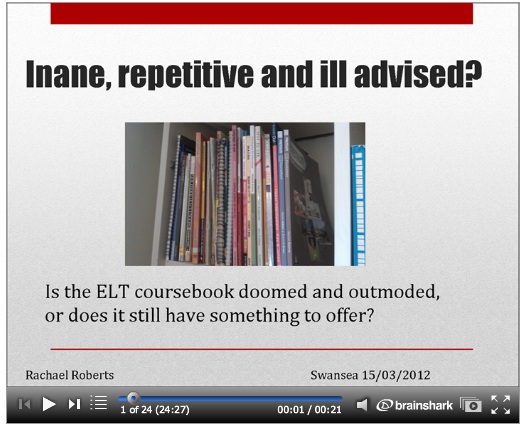
Inane, repetitive and illadvised? Is the ELT coursebook doomed and outmoded, or does it still have something to offer?

Inane-repetitive-and-ill-advised-Is-the-ELT-coursebook-outmoded-or-does-it-still-have-something-to-o-883693503

This is a version of a talk I gave at Swansea University in March 2012. It’s about 25 minutes, plus time to read some of the slides, so get a cup of coffee first!

Some of the questions I try to answer:

  • How is the methodology behind a coursebook decided on?
  • Are we now in an era of ‘textbook defined practice’?
  • Should we be using coursebooks at all, and if so how should we be using them?

9 Comments

Filed under Different ways to use a coursebook, Teaching methodology

#ELTChat summary on Multiple Intelligences 07/03/12

This is a summary of the first ELT Chat on Wednesday 7th March 2012 about Multiple Intelligences.
#ELTChat takes place on Twitter every Wednesday at 12pm and 9pm BST www.eltchat.com
Shaun Wilden kicked off by giving us a link to the Wikipedia page on Multiple Intelligences. The link is below, but basically, it’s a theory proposed by Howard Gardner in the 1980s, which says that rather than there being just one kind of intelligence, there are different kinds of intelligence:
• Spatial
• Linguistic
• Logical-mathematical
• Bodily-kinesthetic
• Musical
• Interpersonal
• Intrapersonal
• Naturalistic
• Existential
(The last two were added at a later date)
The first part of the discussion mostly centred around whether MI theory had now been discredited, to what extent people believed in it and to what extent it was practised.
The overall view seemed to be that people were little sceptical about the scientific basis, but agreed that it was important to recognise that people learn in different ways, and to provide a variety of activities:

@louisealix68: think it’s good as T to know we all learn diff.(I’m visual) in order 2 help kids with learning strats best 2 them
@rliberni: yes agreed I think the idea of varying activities etc is imp and MI would help to highlight that
@breathyvowel: Yup but for me the varying comes first, and the relevance to MI is more or less incidental

@esolcourses also suggested that it might be impractical or unnecessary to devote too much time to individual differences when students actually had a lot in common. And other people suggested some drawbacks to focusing on MI:

@OUPELTGlobal: I think tchers should be careful of labelling their sts – different sts can use
different ints at different times.
@michaelegriffin: Just sort of the cultiness of MI puts me off. I am with @Marisa_C about
much of it just being sensible
@kevchanwow: agree that a wide range of activities is necessary to keep students involved. But does MI offer the right framework?

Several people felt that, irrespective of whether the science actually stood up, there was a benefit in discussing multiple intelligences with students so that they would be aware of different ways of learning and able to ‘play to their strengths’ (@OUPELTGlobal)

@kevchanwow: MI as a means for students to discuss how they learn. An exercise in empathy and to realize that there are many ways to learn and that it is OK to be (learn) different
@samshep: we cn be interested in how ss learn w/out labelling them. Also shd encourage thm to try diff things & expand capabilities
@kevchanwow recognizing what brings our students joy and how where they excel is key for rapport. But does MI help us do that?

There was also seen to be a benefit in teachers at least considering MI, so that they would not assume that all learners learnt the same way (or the same way the teachers did)

It was questioned whether MIs needed to be formally assessed, but @Marisa_C suggested a possible test for anyone who wanted to do so, the Barsch Learning Styles Inventory, available online. @worldteacher also provided a short MI quiz (see below)
@ louisealix68 mentioned Thomas Armstrong (link below) as a good place to go for more information on MI.

People started to discuss other systems of learning styles:
@samshep surely multiple intelligences is just learning styles dressed in different clothes w same pitfalls and questions.
@shaunwilden: @samshep I agree and there are far too many learning styles models out there, can get very confusing 🙂
@teflerinha asked whether people felt that multisensory learning (link below), which has some crossover with MI, was particularly suitable for YLs. It was generally agreed that it was, though the point was made by @worldteacher that it could also apply to adults.
@louisealix68 raised the question of whether males had different learning styles to females. @breathyvowel commented: I definitely find that the atmosphere changes with gender balance, so perhaps unconsciously yes and @teflerinha commented: Thnk gender cn affct way class interacts. Once had all male CELTA & all activities finished superfast.

A little later there was also discussion of naturalist and existential intelligences and how these might be accommodated. @teflerinha made the point that existential or spiritual intelligence was becoming a big thing in coaching and business training(essentially about connecting with your inner wisdom and with others) and @leoselivan suggested that naturalist intelligence lent itself well to categorising and ordering tasks.

@cherrymp commented that perhaps Emotional Intelligence was more important to cultivate than MI (“the ability to identify, assess, and control the emotions of oneself, of others, and of groups”.)

@Marisa_C asked for examples of MI based activities which had been used successfully:
@teflerinha: Extended project type work tends to be good for MI I think as there are a variety of tasks
@louisealix68: e.g. use running dictation for kinsaesthetic. Dictogloss = linguistic/math
@esolcourses: Online drag and drop picture quizzes on my website 4 spacial intel. – work well as ind. or group activities. http://t.co/DwwK3BTV
@louisealix68: learn vocab=rote (music); organise alphabetically – math; read/cover = ling
@rliberni: used to do dictation in teams with paper up on wall 1st grp to complete with all correct won
@teflerinha: And giving ss the opportunity to work alone as well as in pairs or groups- for intrapersonal learners
@michaelegriffin: Drawin’, movin’, clappin’ actin’, connectin’, solvin’ (puzzles),
@OUPELTGlobal : Asking sts whon learn visually to find their own images for texts, adds to their understanding/learning of the text

There was a questions from @SueAnnan as to whether MI meant more planning. Some comments:
@leoselivan: no but it does require thinking on your feet sometimes. I think if a T is aware u
don’t need to spend MORE time planning
@teflerinha: Not so much a lot of prep as bearing it in mind when choosing activity types I
think
@shaunwilden: No cos it is everyday teaching anyway 🙂
@OUPELTGlobal: I don’t think so. Once I was aware of them, and my sts too, we sort of
helped each other. Awareness is very important!
But @SueAnnan made the point that, while she agreed to an extent, she had seen ss turned off by non traditional activities. @michaelegriffin agreed, ‘I think that is a very good point and quite common… Like “why are we drawing in English class???!?!” “Give me verbs!”’
@SophiaKhan4suggested that it was ‘sometimes hard to go out of your own comfort zone when choosing activities tho’ and @NikkiFortova agreed ‘@SophiaKhan4 so so true, but if we don;t go out of our comfort zone from time to time, we don’ t learn @shaunWilden said that ‘thats only natural isn’t it, if we have a class we need to cater to all which might mean some are happy when others aren’t.’

Perhaps a good conclusion would be @shiftparadigm’s comment,’ In practice, might a good place to start be recognizing and accommodating a student’s strengths?’

List of useful links (please let me know if any don’t work)

Link to Wikipedia page on MI http://en.wikipedia.org/wiki/Theory_of_multiple_intelligences (@ShaunWilden)
Link to Thomas Armstrong’s webpage http://www.thomasarmstrong.com/multiple_intelligences.php
Link to Barsch Learning styles inventory http://t.co/2W7ckOep (@Marisa_C)
Link to MI Quiz http://t.co/zqOgEMKN (@worldteacher)
Link to Howard Gardner’s book on Googlebooks http://t.co/0TagR8U6 (@Marisa_C)
Link to info on multisensory learning (VAK) http://tlp.excellencegateway.org.uk/tlp/pedagogy/assets/documents/qs_multi_sensory_learning.pdf (@teflerinha)
Link to VARK learning styles http://t.co/ct36VJSi @rliberni)
Link to Bonnie Tsai, interesting speaker on MI http://t.co/ly1oLHQb (louisealix68)
Whole set of links on MI http://cybraryman.com/multipleintel.html (@cybraryman1)
Googlebooks link to Multiple Intelligences in the Classroom http://t.co/oBKyBZlc (@marisa_C)
Link to page on Multiple Intelligences http://t.co/AcfXd99B (@cherrymp)
Link to Multiple Intelligences lesson plans http://t.co/CKyTfbx7 (@cherrymp)
Link to a whole list of learning styles resources, diigo by @carldowse http://www.diigo.com/list/carldowse/learning-styles (@SueAnnan)
Link to article on Integrating MI in ESL/EFL classrooms http://t.co/vrtkdLon (@worldteacher)
Link to MI lesson plan http://t.co/ae3xEz66 (@shaunWilden)
Link to Howard Gardner, Multiple Intelligences and Education http://t.co/tpleDJxb (@cherrymp)
Link to an interactive version of Blooms Taxonomy, revised for 21st Century http://t.co/q2IApHij (@nikkiFortova)

2 Comments

Filed under Differentiation, ELT Chat summaries

Ideas for taking an ’emergent’ approach to using a coursebook

Most coursebooks have an essentially structural syllabus. Each unit has a handful of language points, what Scott Thornbury refers to as ‘Grammar McNuggets’, and the assumption is that these points will be presented, practised and learnt.

As a coursebook writer, I understand why the syllabus is presented in this way. Most teachers, institutions, parents, students like to have a sense of the way ahead as a series of steps. I don’t think there’s anything wrong with this so long as:

–       We remember that what we are teaching is not necessarily what the student is learning.

–       We aim to teach the students rather than the material.

I believe that the material in a coursebook should be seen as a resource, pure and simple. It can and should be used and abused to best meet the needs of the class.

There are certain key elements we need to provide students to give them the opportunity to develop.

Input or language in context (this needs to be motivating and relevant)

Opportunity to ‘notice’ language

Clarification/consciousness raising- whether after noticing or after using (feedback)

Opportunity to use language (this also needs to be motivating and relevant and ideally personalised)

If all these elements aren’t in the coursebook (and they might be), there is no reason why we can’t adapt it to provide them.

‘Noticing’

Many coursebooks do now ask students to notice the language in a text. There are two possible problems with this. Firstly, the text may have been specially written to include these examples, and not in a very natural way. Secondly, if the text is authentic, there may only be a couple of examples.

One way of dealing with this (and it could be used for any text you want to use, not just coursebook texts) is to also use a concordance. For example, there is a text in a coursebook I’m familiar with which has some examples of the different meanings of the word ‘like’ (as a verb and as a preposition). Students are asked to find examples and decide on the meaning. This could then be extended by looking at a concordance (or a simplified version at lower levels) and deciding on the meaning of these examples before returning to the personalised practice in the coursebook. In this example, students write each other questions using both meanings and then answer each other’s questions before going on to write about a place they like and what it’s like.

‘Interlanguage’

Another example from a well known coursebook has a short text. Students are asked to underline all the examples of articles and then find examples of the rules given. An alternative might be to do the text as a dictogloss. The teacher reads the text aloud, at fairly normal speed (not slowly) and the students try to write down what they can. They then work together to recreate the text. Inevitably, if articles are a problem area, they will miss some out or use the wrong ones. They can then compare their version with the original and identify the gap in their own interlanguage.

Alternatively, or even as a follow up task, students could translate the text into their L1 and then, a few days or a week later, try to translate it back. Again, this will highlight any individual difficulties.

Task repetition

Another way to get students to ‘notice the gap’ using a coursebook activity works well with a more traditional kind of activity where students listen to a dialogue which exemplifies a particular language point.

Fans of emergent grammar might avoid these kinds of recordings like the plague, but it can work well in a kind of task based approach. This way, you begin by getting the students to improvise a similar kind of dialogue (obviously this works best if the topic is something they might actually want to talk about). You could even record these conversations if you have the technology. Then you listen to the coursebook dialogue and encourage students to notice any language in there that they could have used. Incidentally, this might not be the language the coursebook writers intended. Finally, the students carry out the dialogue again, perhaps this time with a different partner. If you have recorded the first version, you could record this too, and students could then listen to the recordings at home and note any improvements in the second version.

Task repetition has been shown to have a very positive effect on what Thornbury refers to as ‘grammaring’

I am very far from believing that everyone should be using published materials all the time. However, always starting from scratch can be very labour intensive and, I believe, requires a good deal of experience and understanding. Why not use everything that’s available, just tweaking and adapting as you go?

Incidentally, there are some fabulous ideas, perfectly applicable to published materials, in Grammar and Uncovering Grammar, both by Scott Thornbury.

Here are a few links I have found since writing the post, related to using a coursebook in a more unplugged style.

3 Comments

Filed under Different ways to use a coursebook

Some thoughts on teaching and learning

Taking part in this weeks’ ELTChat (www.eltchat.com) on the future of coursebooks, has got me thinking, once again, about the seeming stand off between those that like and use coursebooks and those that hate them.

At the risk of sounding like Tony Blair ;), I’m sure there must be a third way. I’d like to explore this a bit further in subsequent posts, but to kick off I just wanted to share this set of images:

Imagine, if you will, that this first picture represents a teacher’s lesson plan. The steps could, perhaps represent the ‘target language’, the boulders and plants, other elements of the lesson that he or she intends to weave in.

This second picture could represent the experience of the lesson from one student’s point of view. They get so far up the steps, but not as far as the teacher anticipated, and one of the steps is partly missing. On the other hand, there’s a nice little collection of boulders and plants in there!

For another student, the lesson might be all about the language explicitly taught. They’ve doggedly marched up those steps- and haven’t even noticed that they’re in a garden.

And this student is enjoying the garden, but hasn’t noticed the steps. And maybe he (or she) doesn’t need to if they’re getting something out of that part of the garden…..

 Now, this metaphor has been couched in terms of a more traditional language lesson, where the teacher imagines (and I use that word advisedly) that they can decide in advance what the learners are going to learn. They can’t of course, because there is no way to stop the learners from wandering where they will in the garden, or even curling up in a sunny corner and going to sleep.

But, I would argue, even if a lesson is completely unplanned, organic and student led, it’s still going to be a different experience for every student in the class.

I wonder therefore if the key issue isn’t less about whether we’re using pre-prepared material or not, and more about what we are doing with it, or how we are helping the students to explore the material and take from it what they individually need?

Equally, teachers are all different and work in different ways and need varying levels of support. For some, I believe it will be very helpful for the coursebook to suggest what language could be highlighted in a text and provide clarification and practice. I know I learnt an awful lot about how to exploit texts from using coursebooks. But the coursebook certainly shouldn’t be used as a bible; at least I would hope any material I have written is not used this way. It’s a resource, pure and simple, just like any other resource, such as a newspaper or a recording. The only real difference is that someone has already thought about ways that you could choose to work with the material and, if you find it helpful, you could benefit from their experience and knowledge.

Use it, don’t use it, use part of it, use it in a different way… whatever you do the learners will undoubtedly be learning what they are ready to learn and what they choose to learn.

11 Comments

Filed under Different ways to use a coursebook

Assessment for Learning: a new way to meet individual learner needs?

They say that there is nothing new under the sun (especially not in teaching?) but the notion of Assessment for Learning (as opposed to assessment of learning)is a big buzzword in mainstream education in the UK and there are plenty of ideas which we can apply to ESOL and ELT.

The idea of AfL originated from a booklet by Dylan Wiliam and Paul Black, Inside the Black Box: Raising Standards through Classroom Assessment. In this, and subsequent books and papers, they focus on four main ways of helping students to become more independent learners and to individualise learning:

  •  Questioning techniques
  • Feedback methods
  • Sharing criteria
  • Self  and peer assessment

Questioning techniques

I suspect that questioning is something which the average ESOL/ELT teacher already knows more about than Wiliam and Black assume. In my experience, a lot of teaching in our field(s) takes place through asking the right questions, whereas they seem to think that most teachers are asking closed questions to check knowledge. Having said that, I think it is still an area where further development may be useful.

Some approaches/activities you could try:

  • Opening up ideas by asking other students to comment on what has been said, rather than commenting on it yourself.
  • Bouncing questions around, so you nominate one student to answer another’s question.
  • Get students to put up their hands to ask a question, rather than to answer one.
  • Ask students to write down questions at the end of a lesson about what still confuses them. These could go into a box for you to look at when planning the next lesson, or they could be redistributed for small groups to answer.
  • Ask why rather than just accepting an answer. This is particularly important, I think, when going through the answers to, say, a reading comprehension or a gapfill.

And my personal long time favourite: increasing wait time after you have asked a question. In Assessment for Learning: Putting it into practice, Black et al report that teachers who increased wait time found that:

–          Answers were longer

–          Failure to respond decreased

–          Responses were more confident

–          Students challenged and/or improved the answers of other students

–          More alternative explanations were offered.

Feedback methods

This refers to both giving students feedback on their work and on getting feedback as to how well each student is doing.

In terms of the first category, one of the big points made by AfL is that writing comments on students’ work is much more effective than grades. In fact, their research showed that a group of students given only comments improved noticeably, whereas the other two groups given either grades only or both comments and grades, did not.  Of course, the comments have to be helpful and specific about exactly what the student has to do to improve.

In terms of getting feedback on how each student is doing, there are two basic themes. One, which will be familiar I am sure, is getting students to work in pairs and groups so that the teacher can monitor and assess. The other may be less familiar and involves a few nice little techniques:

  • Using miniwhiteboards for students to write answers on and then hold up. If everyone is facing the front, peers will not be able to see who has written what, but the teacher can.
  • Giving each student laminated A,B and C cards, so that they can hold up the answers to multiple choice questions in the same way.
  • Using signals to indicate to the teacher how well they feel they have understood. These could be  ‘traffic light’ red, amber or green cards (green for I am sure I have got this to red I haven’t a clue what you’re on about

Sharing criteria

In the ELT/ESOL context, the idea of sharing the criteria you use may not be that new. As a reminder though, some of the ideas in AfL may be useful:

  • Using models of what you want students to achieve. This obviously applies to writing, but could also apply to speaking, with recordings of native speakers or more proficient students doing the same task. These models can be analysed by the students, using the criteria.
  • Letting students decide on what they think the criteria for assessment should be, or negotiating it with them.

Self and peer assessment

Again, this is something which I think is quite common in ESOL/ELT classrooms, but it is given a lot of emphasis in AfL. Possible ideas:

  •  Two stars and a wish (may be better for Yls). Students peer assess using two stars to say two good things about the work and a wish to identify something which could be improved (further)
  • Students identify what they think is their best piece of work, and say why.
  • Using learning journals to set targets and self evaluate.

If you wish to find out more about AfL, either of the publications mentioned above would be a good place to start. I’d be very interested to hear any comments on any of these approaches, and whether this kind of approach is popular in your context (and of course why or why not 😉 )

5 Comments

Filed under Differentiation

Simple ways to differentiate materials for mixed level classes

I love this picture..they’re all eggs, but just look at the variety. And it’s the same in any class.

Differentiation can be defined as:

“….identifying and addressing the different needs, interests and abilities of all learners to give them the best possible chance of achieving their learning goals.”

(Standards Unit, Improving differentiation in business education, DfES 2004)

Differentiation is a key issue in ESOL, or teaching English to students who now live in an English speaking country. This is because, in the UK at least, classes are often extremely mixed in terms of level, and students often have what is known as a ‘spiky’ profile  (they may be pretty proficient at speaking and listening, for example, but struggle with reading and writing).

In ELT, differentiation is more often referred to as ‘teaching mixed ability’ or ‘mixed levels’. But, whatever, we call, it, the fact is that no class is ever completely homogeneous, and we all need to be thinking as much as we can about how to meet the individual needs of the students.

That said, I don’t believe in providing different worksheets for all the students and getting them to work on these individually or even in pairs. Unless the class is very small, this just stretches the teacher too thin, and it is often pretty uninspiring for the students as well.

Let’s look at some ways in which we can differentiate without having to spend hours on preparation.

1 Differentiation by outcome

Some people use differentiated outcomes on their lesson plans. For example:

By the end of the lesson all students will be able to.. most will be able to..some will be able to..

This seems quite popular in ESOL, but I personally am not hugely keen on this. It is a reminder that what you are teaching is not what it being learnt. However, it is basically a deficit model.

I would argue that it is more effective (and encouraging) to help students to assess themselves against their personal standard. One way of achieving this is to move away where possible from summative assessment towards more formative assessment. This is a big talking point in British schools at the moment. Basically, this challenges the idea that the best way to test students is by comparing them with each other. This sets up an atmosphere of competition and leads lower achieving students to conclude that they are failing. It also encourages stronger students to rigidly produce only what will get them the highest mark.

Better, surely to encourage students to self assess and to set their own targets or checklists of competencies together with the teacher?

Having promised you less preparation, I have to admit that setting individual targets, does take time and effort but, provided, that a sensible approach is taken (i.e. not asking learners who barely speak English to fill in a 6 page Individual Learning Plan), it can, I think, be well worth it.

2. Differentiation by teaching method

The activities we choose to use can also differentiate well. An activity which involves active learning and group or pair work is likely to differentiate more effectively because

–          Students can work at their own level.

–          Students can support each other and learn from each other.

Most of us have experimented with putting stronger students with weaker ones and, it has to be said, the results can vary quite a bit. Sometimes it works really well. The stronger student consolidates their knowledge by explaining to the weaker student and the weaker student feels supported.

Sometimes, however, the stronger student dominates or resents the role and/or the weaker student feels embarrassed or says nothing.

Mixing things up so that the same pairings aren’t used all the time certainly helps, but there are also some techniques you can use, such as Scribe, which I first saw in Jill Hadfield’s excellent book, Classroom Dynamics. When carrying out a small group discussion, appoint a scribe, or note taker for the group. They should only listen and take notes. After the discussion, they will feed back to the whole class.

If the strongest student is the scribe, this will prevent them from dominating, but still give them an important role and a chance to shine at the end. If a weaker student takes this role, the pressure is taken off them to produce language spontaneously, but they can prepare something to say at the end, which will provide a sense of achievement.

Questioning techniques can also be modified to provide better differentiation. Give students enough time and space to answer and nominate, by asking the question before you name the student, so it doesn’t always fall back to stronger students. Consider how easy the question is and don’t choose students who can’t answer. Use monitoring while students are working in pairs or groups to identify who can answer which question.

Ask different types of questions. A useful model is Bloom’s mastery and developmental tasks (Bloom’s taxonomy) Mastery tasks can be mastered by all learners, they are straightforward- you might ask a learner to describe something or define something. A developmental task is more stretching and requires a deep understanding. These kinds of questions might ask the students to judge or critically appraise for example.

3 Differentiation by task.

And finally, most tasks can be designed to provide either extra support, or extension to challenge more able students. This doesn’t have to mean completely new activities, just a tweak here and there.

The table below gives some examples:

Activity Type Extension activities Support strategies
Reading Select 3 new items of vocabulary, look them up in their dictionaries and write them up on the board, with definitions.Write 3 questions about the text. These can then be given to another early finisher to answer and then passed back to the original student for marking. Pre-teach vocabulary students will need to do the task and leave it on the board.Activate their previous knowledge of the topic before reading.Give students the answers in a jumbled order, with a few distractors.Make open questions multiple choice.

Break the text into sections with questions after each section and give the option of only reading 1 or 2 sections.


Listening When students listen for the second time to confirm their answers, give some optional extra questions as well.When taking answers on a true/false activity, ask why/why not? Pre-teach vocabulary and activate knowledge as above.Give students a chance to discuss answers before feeding back to the class. Monitor and play again if necessary.Give students the tapescript on second listening.In a gap-fill, provide some of the words needed.


Writing Make use of creative tasks that students can do at their own level.Use a correction code to give students a chance to self correct.Increase the word limit. Give a model or example before they start writing.Correct the draft with the student or in pairs before rewriting.Reduce the word limit.
Speaking Ask students to justify their opinionsPair higher level students together so they can really stretch themselves. Give students time to rehearse or plan their ideas.Pair weak and strong together.Elicit and practise the language they will be using beforehand

And, going back to the second point,  we can also aid differentiation by providing tasks with more open outcomes, so that students can do the same task, but each at their own level of ability.

Obviously none of these ideas is going to provide every student in the class with a 1-2-1 tailor-made course. However, I do think they can go some way towards helping to address the different needs, interests and abilities of the learners.

Please feel free to comment and add your own ideas. All gratefully received!

If you found this post useful, why not check out my e-book, The CELTA Teaching Compendium, a quick easy reference to all the teaching skills required for CELTA. 

http://the-round.com/resource/the-celta-compendium/

24 Comments

Filed under Differentiation