Category Archives: Teaching methodology

The Language Experience Approach: a person centred, materials light approach to literacy

In a previous post, I talked about some criteria for selecting suitable reading texts to use with learners. Two key points are that texts need to be at the right level and that they need to be intrinsically interesting for the students.

Clearly, one way of achieving both these points is for the learners to produce the texts themselves. The Language Experience Approach (LEA) is a way of doing this, which has its roots in early literacy teaching. It dates back to the sixties and is fairly well known in ESOL circles, but not, I think in general ELT.

Overview of the LEA

1 Working together, the teacher and students choose a topic or activity which can be written up later. This might mean watching a video, taking a field trip or simply bringing in some pictures.

2 Carry out the activity or discuss the topic.

3 Discuss the experience or discussion and write some key words and phrases on the board.

4 The class works together to develop a written account. Typically the students dictate to the teacher, who writes it down. I say typically, because this is at root a literacy activity, so doesn’t assume that the students can write in English. In classic LEA, the teacher does not correct any mistakes or even elicit any corrections. However, I personally feel that for students’ whose first language isn’t English, providing or eliciting a correct model is vital at some stage in the process.

Of course, there is no reason why students who are able to write in English couldn’t work together in groups to write a text.

5 The teacher or a learner or all the learners read the text aloud to the class, and then everyone reads it again silently. This is another stage at which linguistic revisions might be made.

6 Extension activities.  Because the students have written the text themselves, they should be quite familiar with the meaning, even if they do not recognise all the words. At lower levels of literacy, students could:

–          Copy the story.

–          Word or sentence matching (match strips with words or sentences from the text with the text on the board)

–          Write down the story as the teacher dictates it.

–          Complete missing words which the teacher (or one of the students) has rubbed out.

–          Unscramble the sentences from the story (previously scrambled by the teacher)

At higher levels :

–          Students revise and edit the text themselves.

–          Use this text as a basis for writing their own personalised accounts

–          Use the vocabulary from this text to write a new text.

Of course if you have both more and less proficient readers/writers in your class (very common in ESOL), the students could do different tasks with the same text.

The beauty of the LEA is that it is firmly learner centred, using the students’ own experiences as the basis of the work,  and can provide a sense or achievement for every student in the class, at very mixed levels. It is also very materials light, and requires little preparation.

I am sure that there is plenty of room for variations on the LEA and would be interested to hear your ideas.

4 Comments

Filed under Differentiation, Teaching methodology

Developing meaning-building skills in reading

The default position with regard to exploiting reading texts seems to be comprehension questions. I should start by saying that I am not against comprehension questions as such.  In a previous post,  I looked at a selection of quite traditional tasks and how to write them in such a way that they help guide the learner through the text. As Nuttall (1982) says,

‘The questions that help you to understand are the ones that make you work at the text. They force you to contribute accurately to the process of making sense of it, rather than expecting understanding just to happen.”

However, it is also undeniable that these kinds of tasks are ultimately more about testing than teaching.

Meaning-building is something which happens by interacting with a text, and it is highly personalised. No-one will understand a text in exactly the same way because we all bring our own experience, knowledge, attitudes and so on to everything we read.

As we read, we use our background knowledge, contextual clues and knowledge of the language to build meaning.  It used to be assumed that using contextual information, or information from the co-text (what goes before or after what we are reading) was something that only more confident or capable learners could do. However,  there is some evidence that in fact learners who are struggling to decode a text will also try to use meaning building skills. The difference is that more capable readers will use them to add meaning, less capable or confident readers will use them as a compensatory strategy.

(If you are interested in this last point, have a look at some of the reams of stuff which has been written about Stanovich’s Interactive Compensatory Hypothesis)

Think aloud

One way to find out more about what kinds of interactive processing your learners are doing while reading is to ask them to use a think aloud protocol. This can work very well in small groups. Basically, you get students to read a paragraph, and then discuss with the rest of the group what they think they have understood so far. Tony Lynch, in Communication in the Language Classroom (1996:126), says of this process, ‘My experience is that think aloud tasks make some learners aware of textual clues which other learners in the group have recognised, which would pass unnoticed in individual reading.’

He also suggests following up this task with a round-up where each learner notes something they felt they learnt from the discussion.

Another way of doing this is something called ‘reciprocal teaching’, again mentioned by Tony Lynch. In this version, a different person is chosen to lead the discussion after each paragraph, using four main points:

  • Clarifying any problems
  •  Stating the main idea
  •  Summarizing the content of the paragraph
  • Predicting the likely content of the next paragraph

(Cotterall, S, 1990)

SQ3R

This is a technique which was originally developed for university study, but it works just as well with any slightly longer or more complex text, which needs detailed understanding.

The acronym stands for:

  • Survey: Scan the whole text, looking at any clues in the introduction, titles, layout etc.
  • Question: Decide what questions you would like to be answered by reading the text. Make a note of them.
  • Read: Read the text, trying to answer your questions and note down any other questions that come up.
  • Recite: After each section, stop and see if you can remember the answers to our questions. If not, read through the section again.
  • Review: Once you’ve finished, go back over all the questions and check you still know the answers. Re-read as necessary.

Summarising

This is an old-fashioned technique, but is actually one of the very best ways of seeing whether students have really understood the salient points of a text. Below is an example from New Total English Intermediate Writing Bank (click to enlarge). It uses an adapted authentic text, but you could easily carry out the same kind of processes on any text you choose.

Alternatively, students could be asked to summarise a text for different audiences. For example, to make it suitable for a child, someone from a very different culture and so on. This angle on summarising means that the students have to think about what background knowledge the reader would need to understand the text- which is a good way into thinking about how they themselves use their background knowledge to build meaning.

13 Comments

Filed under Different ways to use a coursebook, Exploiting authentic reading materials, Teaching methodology

Is 1-2-1 teaching intrinsically better for students than being in a group?

Background to the question

This is a summary of the lively ELTChat on this subject, on 6th June 2012, moderated as well as ever by @Marisa_C and @ShaunWilden. See http://www.eltchat.com if you’re not familiar with this great institution!

I volunteered to write the summary, as I had proposed the question (so it was my fault!;) ). What sparked the question for me was an interesting post by @ukteachers on his blog http://www.ukteachersonline.co.uk/blog_files/lack_person_centred_ELT.html. An example quote:

The fact that teachers work with groups is part of the problem. The individual needs of each person simply cannot be met in a classroom environment. So teachers have to pitch things at the lowest common denominator in the classroom who is the student who more or less understands what’s going on. A great deal of what happens in classrooms is an exercise in training yourself to put your own needs last and the needs of the group and its consensus first. You don’t understand something? Tough – the teacher doesn’t have time for that.

The chat began by discussing 1-2-1 teaching in general.

Advantages of 1-2-1

Lessons can be tailor-made

@theteacherjames suggested that ‘An obvious benefit of 1-2-1 is that the lessons should be focused on exactly what the st needs to learn’ and, similarly, @Shaunwilden added the benefits of ‘personally selected material, run at sts pace, easier to monitor class.’ @Kevchanwow also pointed out that, ‘1 on 1 allows for all (2) participants to focus in on a clear set of goals.’

And @andivwhite made the point that ‘More than 1 student immediately means multilevel in terms of personality, interest, language, etc.  ‘

Some students will prefer this way of learning

@hartle and @RichmondELT mentioned the need to meet individual learning styles as well as goals and @Elawassell said, ‘Learning with a group may be frustrating 4 some Ss. The ones that get things quickly or for those who are slow…’

Several participants (such as @TutorMe_Online) also mentioned that students would need to participate more in a 1-2-1 setting, which might be good for shyer or less confident students.

Benefits in terms of accelerated learning

@TheteacherJames, ‘The st gets a lot of time to speak & listen to a high level language user. More demanding in that respect.’ And @rliberni felt that ‘It is tiring but very rewarding as you can see the student develop & improve before your eyes.’ @Elawassel referred to a student who was very clear that they found 1-2-1 much more effective.

@TutorMe_Online: Think 1-2-1 has the edge in terms of productivity & how much improvement a single student can make in 1 lesson

Disadvantages of 1-2-1

Difficult for the teacher?

Not everyone agreed that 1-2-1 was any more difficult for the teacher, but this was certainly the majority opinion. For example, @Marisa_C talked about being ‘on’ all the time, and AlexandraKouk said she found preparing and teaching ‘intensive’. @JoHart mentioned the difficulty with a shy or uninterested learner. @rliberni added ‘it can be tiring, also need to address issues as they arise which means you have to be on your toes always!’

On the other hand @theteacherjames felt that with experience, it was not necessary to do a lot of preparation, and @shaunwilden felt that there were ‘ways of taking a back seat’.

Not always best for the learner?

@esolcourses suggested that 1-2-1 could be isolating for the student and @teflerinha added that it could also not be the best preparation for the outside world. @worldteacher added that ‘many students gain confidence from a group setting’.

@kevchanwow made an interesting point, that ‘the power of peer modeling can’t be overestimated. The closer the peer is socially, the greater the impact.’ @worldteacher also mentioned the benefits of a group: less pressure, peer teaching, moral support, sharing, etc and @RichmondELT said ‘In groups independent learning is encouraged, students can help each other rather than always depending on the teacher.’

@teflerinha mentioned the fact that if we learn by negotiating meaning, that having to do so with a variety of people, some of whom might struggle to understand more than a ‘helpful’ teacher, could only be a good thing. Similarly, e_clements suggested a problem with 1-2-1 was that there was only 1 teacher voice and that ‘In a group Ss can interact with other NN/lower level speakers – probably more realistic for what they’ll need to do in real life.’ And @kevchanwow said, ‘Groups allow exposure to wider array of truly learnable structures, not structures teachers think should be learned.’

That said, @theteacherjames said he encouraged learners to listen to different voices outside the class, and a couple of people said that 1-2-1 classes in their context involved different teachers on different days.

Points about teaching 1-2-1 in general

 The conversation turned to how people actually teach 1-2-1. A lot of people pointed out the danger of 1-2-1 simply turning into a ‘chat’. This provoked a lot of discussion, as several people pointed out that a chat was a great basis for learning- provided that students were enabled to ‘notice’ language and learn and develop. For example, @theteacherjames said, ‘I always start conversation led, then introduce relevant activities based on the conversation. Chat is priceless!’ or @andivwhite,’If the chat is structured with feedback and error correction, it’s perfect.’ Dogme was mentioned at this stage, but not really picked up on. (Incidentally I think 1-2-1 is perfect for a dogme approach, even IS a dogme approach..certainly that’s what I was doing 20 years ago teaching 1-2-1)

@ukteachers pointed out that ‘If u approach 121 as if you’re in a classroom and barricade yourself behind materials then sure – it’s dull as dishwater.’

@esolcourses reminded us of the danger of the teacher dominating, which point was taken up by several others. For example, @kevchanwow, ‘In 1:1 it’s hard to remember that silence is often necessary for production and consolidation.’

@Ukteachers said’I think of 121 as a specialised form of pairwork rather than being a TEACHER vs STUDENT situation.’

Horses for courses

At this point the talk moved on to whether groups were better. Many of the points had already been made when talking about 1-2-1, and the general consensus was that they were different things (not better or worse).

Essentially, most people seemed to agree that 1-2-1 was best for learners with very specific needs, but that groups had advantages too. Many of these are outlined above, but added were:

@hartle in 121 you can’t use grp activities that allow students time to repeat and consolidate new language etc. @teflerinha seconded the importance of task repetition.

@RichmondELT In groups independent learning is encouraged, students can help each other rather than always depending on the teacher

@MrChrisJWilson: #eltchat a teacher only has a set number of experiences, stories, input. Having other students increase the knowledge/stories in the room. Also allowing development of group skills as well as knowledge of grammar vocab and lexis

@ukteachers asked the question as to what we, personally would prefer. Obviously the answer varied according to the individual. Some preferred the intensive nature of 1-2-1, others the group experience- bringing up the intriguing notion that this might, like learning styles, be something that teachers had preferences for- and were thus in danger of assuming that everyone felt the same way as themselves.

Cost

 Next there was some discussion about cost, and whether students expected more ‘spoonfeeding’ for paying more (@MrChrisJWilson), or whether the extra benefit was worth the extra cost (@Michaelegriffin. The question was asked about usual rate in UK- and this seemed to be between £9 and £50 an hour.

Conclusion

@esolcourses brought up the fact that many classes she taught had a combination of 1-2-1 and group work (This is/was common in the ESOL context, but disappearing with funding cuts). Many people agreed that a combination of 1-2-1 and group would perhaps be the perfect scenario.

Perhaps the last word should go to @hartle ‘Lots of good points here about both contexts, but a good teacher should be able to manage both and the challenge is to adapt your skills.’

4 Comments

Filed under ELT Chat summaries, Teaching methodology

The power of groups

I recently read an interesting post, entitled The lack of person-centredness in ELT on Jonathan’s English Blog, at ukteachersonline.  It caught my attention because, as an ELT teacher and trainer, I like to think that I work in a person-centred way.

In Freedom to Learn, Rogers lists five hypotheses (paraphrased):

1 No-one can teach anyone anything; they can only facilitate learning. Everyone will process what they learn in their own way and in their own time.

2 A person only learns what is personally meaningful to them.

3 People naturally resist change, but being open to consider new and different concepts is vital to learning.

4 If people feel threatened, they become less receptive and more rigid.

5 The educational situation in which people learn best is where threat is reduced to a minimum and the ability to look at things in different ways is maximised.

It seemed to me that there were two main points in the post I mention. Firstly, that teacher training does not give nearly enough attention to the psychological aspects of learning. Secondly, that ELT teaching fails because it is usually carried out in groups.

In relation to the first point, Jonathan says, that in most teacher training courses, there is nothing whatsoever from educational psychology or adult pedagogy and not a whiff of a mention of inter-personal skills, group dynamics and so on. How can this be? These are human beings in the classroom and yet nobody seems to think it’s worth training teachers to think for a second about how people interact together in classrooms and how this might relate to learning.’

I couldn’t agree more. Jonathan also says that A different pedagogy could be developed in the classroom which recognises the social nature of language and constructivist learning principles but which is also based on a person-centred concept of language teaching.’ Obviously on a four week CELTA, for example, there is a limited amount of time to go into depth on these areas. However, it should be something which runs through every element of the course, like a stick of rock.

However, when it comes to the second point, I can’t agree. Jonathan says, ‘The fact that teachers work with groups is part of the problem. The individual needs of each person simply cannot be met in a classroom environment. So teachers have to pitch things at the lowest common denominator in the classroom who is the student who more or less understands what’s going on. A great deal of what happens in classrooms is an exercise in training yourself to put your own needs last and the needs of the group and its consensus first. You don’t understand something? Tough – the teacher doesn’t have time for that.’

This may be true of some (even many) classrooms, but I don’t think that it is an essential drawback of teaching in a group. In fact, I think that working in groups can be much more powerful a learning process than working 1-2-1.

Whether we want to admit it or not, there are strong parallels between the processes of therapy and classroom or educational processes (which is why, I guess, Carl Rogers was so interested in learning). Both are about growth. Look at this quote I found through a quick google about group therapy:

Group therapy is a powerful venue for growth and change. Not only do students receive tremendous understanding, support, and encouragement from others facing similar issues, but they also gain different perspectives, ideas, and viewpoints on those issues. Most students, though somewhat apprehensive at first, report that the group experience was helpful far beyond their expectations.

I would argue that pretty much the same thing is true of the group experience in teaching and learning English. Rogers talks about minimising threat and maximising opportunities to see different perspectives: what better way to do that than in a supportive group? And,  it is a group experience, not about the teacher on one side and the learners on the other. The teacher doesn’t need to spread themselves thinly between 20 (or more) students, because they are not the only person in that room who can facilitate learning. What about the other students? What about the student him or herself?

2 Comments

Filed under Teaching methodology

Repeated reading: some activities to build reading fluency

 repeated reading[Thanks to @mkofab at ELTpics for the photo.]

In my last post, I looked at reading while listening, and how it might help learners both to read more fluently, and to acquire more language. Reading while listening is a form of something known as ‘repeated reading’, a strategy whereby a student reads a passage several times, either silently or aloud. The idea, as discussed in the previous entry, is to develop greater fluency or automaticity, and there is evidence to suggest that it works, and, moreover, that it has a positive effect on the student’s language development as a whole.

But isn’t it terribly boring to just read the same passage again and again? Not according to Gorsuch and Arnold , who claim that students were ‘delighted to see such powerful and immediate increases in reading speed and comprehension.’ I’m sure that’s it’s true that students can be motivated simply by seeing progress. The typical way that this kind of motivation is built on in schools is by overtly measuring this progress. For example, Tomkins (2003)* suggests the following procedure:

1 Conduct a pre-test. The student reads a passage aloud while the teacher records the reading time and any mistakes. The teacher then clarifies any problems.

2 The student practises reading the passage again on their own, out loud or silently, several times.

3 The teacher records the student again and makes a note of reading time and any mistakes.

4 Teacher and student discuss the improved time (pretty much inevitable) and whether there were fewer mistakes.

I can see this working very well in some contexts, and being disastrous in others. Your call, I think.

If you don’t want to take such an overt approach, you could try thinking about real reasons why a student might need to read aloud in English, and build activities around these. For example, the class might enjoy reading a one-act play, repeatedly reading it in order to prepare for a recording. Or, many ESOL classes are made up of parents of young children, just learning to read in English at school. These parents could definitely benefit from practising reading aloud their children’s favourite books.

Or try some activities where there is a goal or outcome, other than simply improving your reading fluency. For example, a dictogloss in pairs. Student A reads the text out loud, at a natural speed, while B tries to write down as much as possible. This is repeated until B feels confident that they have the whole text. B can then read the text back to A, for checking. This works best if the more fluent reader in the pair is A, the one who initially reads the text, as this way A is able to give a good model. The activity could be extended by changing the pairs, so that B then takes away the text to dictate to a new (A) partner. This way, B also gets the repeated reading practice, but only after they have heard the next a number of times from the original A.

Choral reading, as a class, has also been shown to be very effective, but in its unadulterated form seems rather dull and childish. You could try putting a text on the board or smartboard, getting students to read it aloud as a class, and then rubbing out random words, so that they have to remember what was there. Of course, this is as much about memory as reading, but it does provide a powerful motivation. It is also a good opportunity to work on weak forms and linking- demonstrating how these occur in the text which is being read.

And, of course, repeated reading does not have to mean reading aloud. A nice activity which can be done with absolutely no preparation is to ask all the students to read the same passage silently. After one minute exactly, stop them, whether they have finished or not, and ask them note how far they got. Tell them to start the passage again, from the beginning. Stop them again after one minute and ask them if they read any further this time (they almost certainly will have done). The beauty of this activity is that it is completely differentiated, as each student is working at his or her own level, and under no obligation to expose their reading level to anyone else.

Tompkins, G. (2003). Literacy for the 21st Century: Teaching reading and writing in pre-kindergarten through grade 4. New Jersey: Merrill Prentice Hall.

12 Comments

Filed under Different ways to use a coursebook, Teaching methodology

Listening while reading: can it actually help develop reading skills?

[Thanks to @Sarah_WG on ELT Pics for the photo]

A little while ago I went to the recording of the listening component of my new coursebook- Real Life Global Advanced. I was surprised to discover (because nobody had ever actually mentioned it) that all the reading passages were also being recorded.

‘But how will listening to a reading passage help them develop reading skills?’ I wondered. In fact, as I have discovered by reading up on the area since, it just might.

We are increasingly aware that reading is an excellent way of developing language, as learners are exposed to language in context. However, many students read very slowly and laboriously in English, slowly decoding every word.  At this speed, it is very difficult for them to actually understand the meaning of the text because they are constantly dealing with isolated words and phrases.

When reading in our native language most of us carry out this decoding with a good degree of automaticity, leaving us free to focus on higher order comprehension processes. Think of this like learning to drive a car. When we first start learning, it seems impossible that we will ever be able to manage the gears, clutch, accelerator as well as actually look where we are going. But an experienced driver can do all these things with such automaticity that he or she can also carry on a conversation or listen to the radio, while keeping focused on changing conditions on the road.

But how can we help our learners to get to this kind of automaticity when reading? One way is, of course, by encouraging extensive reading outside of the classroom. But there is another strategy: repeated reading.

The idea behind repeated reading, which was originally developed by Samuels in 1979, is to help non fluent readers develop automaticity in their decoding. Students read and re-read a passage either aloud or silently. Think of it as drilling for readers!

Now, my first thought was that this would help with reading that particular passage, but that it would not necessarily be transferred to anything else the students might read. But research shows that I was probably wrong in that assumption.

According to Taguchi and Gorsuch (2002), for example, the ‘effects of re-reading a passage for L1 readers are carried over to a new unpracticed passage with regard to reading rate and accuracy’ and they cite Carver & Hoffman, 1981; Dowhower, 1989; Faulkner & Levy, 1994; Herman, 1985; Rashotte & Torgesen, 1985 and Samuels, 1979). It also helps with comprehension (Dowhower, 1989; Morgan & Lyon, 1979; Young et al., 1996). And finally, ‘repeated reading enables L1 readers to read in larger and more meaningful phrases’ (Dowhower, 1989).’

Now these studies all looked at L1 readers, and Taguchi and Gorsuch’s 2002 finding with L2 readers was inconclusive, for various reasons. However, it seems from a later article by Gorsuch in Language magazine.com  that there is evidence that it can work for L2 learners too. I say seems, because for some reason the end of the article is missing from the PDF!

There are lots of different ways (more fun that it might sound at first) of carrying out repeated reading, which I will look at in a follow up post, but one of the key ways is known as assisted repeated reading, and often involves using a recording of the passage being read.

The student, who will have already read the passage silently at least once, reads the passage again, possibly several times, while listening to the recording. This helps him or her to build the connections between the way the word is written, the word itself, and what it sounds like. It also exposes him or her to all the meaning inherent in the pronunciation: the pitch, tone and emphasis.

Seeing words repeatedly in context has been found to help L1 learners transfer their word recognition to other contexts much better than lists of isolated words. Grabe (1991) suggests that this may apply to L2 learners as well. I haven’t yet come across any research which proves this, but it makes perfect sense to me. After all, isn’t this just another way of getting students to ‘notice’ language in context, which most people agree helps with acquisition.

So, in the end, I concluded that having the reading texts on audio may actually be providing teachers with the opportunity to try out a different way of helping their learners both to read more fluently and to acquire language.

And this kind of practice may also help learners to read more extensively outside the classroom because if they can read more automatically, they will enjoy it more and make more sense of it.


12 Comments

Filed under Different ways to use a coursebook, Exploiting authentic reading materials, Teaching methodology

The wonder of wait time!

  How would you like it if your students:
  
– Gave longer answers?
  – Answered more often?
  – Gave more confident answers?
  – Weren’t afraid to challenge or add to   o
ther students’ answers?  – Were willing to discuss and offer alternative answers?
For all these benefits, why not try new and improved
‘Wait Time’TM?

Actually, I doubt any teacher would need a heavy sales technique to be persuaded to ‘buy’ this idea. These are the benefits which Rowe (1974) found to increasing the amount of time teachers wait after asking the class a question. Typically, she found, teachers wait no more than 1.5 seconds after asking a question before they jump in and rephrase it, or even answer it themselves. By waiting at least 3 seconds, she concluded, all the above benefits ensued.
Her research wasn’t in a language classroom, but Nunan (1991) came to similar conclusions, as did Scott Thornbury in 1996.

Of course, the questions asked need to be those which warrant giving the extra time to think. In other words, more open and higher level questions, rather than very closed or display questions. This is important, because when teachers lengthened wait time when asking lower level questions (Riley 1986), student achievement and motivation actually went down. No doubt they just thought the teacher was half asleep!

But, there is also evidence (Swift & Gooding, 1983; Tobin 1986) that when teachers started consciously giving more wait time, their own skills improved. They tend to ask fewer questions, but make them higher quality- asking for more thought and higher level thinking skills.

As well as wait time after asking a question, there have also been found to be benefits in pausing briefly after a student offers an answer. This gives them time to add any further thoughts, or even for another student to add something or contradict.

And why stop there? As Stahl (1990) points out, there are plenty of other moment in the classroom when silence can be golden. He refers to ‘think time’ rather than ‘wait time’, as he feels this better describes the purpose of such times (for both teacher and students) Stahl lists eight categories of periods of silence:

1 Post teacher question wait time (this is discussed above)
2 Within students’ response pause time (not jumping in when a student hesitates- and/or not allowing other students to do so)
3 Post students’ response wait time (allowing a few seconds when a student has finished giving an answer will enable them to add something if they want to, and allow other students the chance to consider what has been said and respond to it.)
4 and 5 Student and teacher pause time (that there should generally be a culture where it is acceptable to stop for a moment and consider what you are going to say)
6 Within teacher presentation pause time (That while a teacher is presenting some information, they stop for a short time, just to let the information sink in and give time for students to absorb it).
7 Student task completion wait time (This seems obvious, but I have a tendency to ask students to work in pairs almost automatically. Here the suggestion is to set a specific amount of time for students to work in silence, individually)
8 Impact pause time (Using a short pause to grab attention; making students wait in anticipation for the next piece of information)

Of course, especially at first, it can feel really uncomfortable to leave any silence in the classroom. In my experience, however, it is worth a bit of initial discomfort to experiment with this idea.
Alternatively (or additionally), rather than simply waiting, you could of course, give students something concrete to do with the wait time:

• Try getting students to write down an answer first. If it’s a closed question, they could write the answer on a miniwhiteboard (or piece of paper) and hold it up when they time has finished. You could then nominate a learner to explain the reasons for their answer.

• Let the students discuss the answer in pairs before nominating a student (or pair) to give their answer to the class.

• Before carrying out a feedback slot on, say, a reading comprehension task, allocate different questions to different students and ask them to spend a little time thinking about why they chose the answer that they did, so that they are ready to explain their reasoning to the class.

At different times in my teaching life, I have been recorded teaching. While it has never failed to be a gruesome experience watching (or even listening to) myself, it has to be said that there is no better way of really examining what is actually happening in your classroom. Why not try it, and see what kind of wait time you are giving and the impact of it when you do give more?

References
Nunan, D (1991) Language Teaching Methodology. Prentice Hall

Rowe, M.B. (1974). Wait-time and rewards as instructional variables, their influence on language, logic and fate control: Parts I and II. Journal of Research in Science Teaching, 11, 81-84 and 291-308.

Stahl, R. J. (1994). Using ‘Think-time’ and ‘Wait-time’ Skilfully in the Classroom. ERIC Abstracts, report number EDO-SO-94-3

Swift, J. N., & Gooding, C. T. (1983). Interaction of wait time feedback and questioning
instruction on middle school science teaching. Journal of Research in Science Teaching,
20(8), 721-730.

Thornbury, S (1996) Teachers research teacher talk. ELT J, 50 (4): 279-289.

Tobin, K. (1987) The Role of Wait Time in Higher Cognitive Level Learning. Review of Educational Research, 57 (1), 69-95.

5 Comments

Filed under Teaching methodology

Getting students to notice language in reading texts

To start with, why not try this little awareness test:

How successful were you in noticing? Whatever we are doing, we don’t tend to notice everything- and we can miss some quite important elements!

We tend to notice things which are either frequent or salient. So, when I first went to live in Portual, I quickly noticed the word ‘puxe’, which was written on a lot of doors. It was something I saw frequently. It was also salient, or meaningful for me because the pronunciation is ‘push’..but it means ‘pull’!

Schmidt, who first coined the term ‘noticing’(I think), carried out a study of his own language learning in Brazil (where they use ’empurre’ rather than ‘puxe’ btw). He concluded that he was more likely to actually use language himself when his attention had been drawn to it in some way.

Or as Scott Thornbury puts it:

‘1. Learners must attend to linguistic features of the input that they are exposed to, without which input cannot become ‘intake’.

2. Learners must ‘notice the gap’, i.e. make comparisons between the current state of their developing linguistic system, as realised in their output, and the target language system, available as input.’

(Thornbury 1996)

A reading text is full of language that we can draw students’ attention to in this way, and thus, hopefully, help them in the process of acquiring this language into their ‘store’.

Before we can start to focus on language though, it is important to focus on the actual text as a whole (see previous blog posts), and then we have to consider which aspects of language to focus on or we risk not seeing the wood for the trees (or the monkey for the basketball players).

Activities which help students to ‘notice’ vocabulary

Many texts will have a clear topic, so this is a good place to start (especially if the topic is one which is relevant to students’ needs and interests- and if it isn’t why are you using it? 😉 ). You can simply ask the students to find words and phrases in the text connected with the topic of X, or ask them to categorise the words and phrases they find into subsections of the topic (example here from IELTS Foundation 2nd ed-click to enlarge).

You can help to expand students’ vocabulary by asking them to find synonyms of words you give them, in the text. This is particularly useful for those taking exams, where questions are usually paraphrased.

You can help students to see how texts are put together by asking them to find lexical links and chains in the text (example here from IELTS Foundation 2nd ed-click to enlarge)

Students can also develop their awareness of chunks and collocation by asking them to find chunks of words that go together, or asking them to search the text to find what collocates with a list of words from the text which you have given them.

Activities which help students to notice grammar or discourse

The most obvious task is to ask students to look at the examples of the language focus in the text and use them to complete rules about its use. Or they could try writing their own rules and then comparing them with a grammar reference.

An alternative is to remove those examples (or parts of them) and get students to complete the text, comparing their versions with the original. This is something which works very well for articles and for discourse markers.

Or you could give students another version of the text with deliberate errors, and ask them to find a ccertain numbers of mistakes and correct them- before, again, checking against the original.

Try a dictogloss (read a short section aloud, which contains the language you are focusing on) and ask students to write down as much as they can before reconstructing the text together. This works well for structures which are very frequent, such as reference links or articles.

Having thus drawn the students’ attention to language, I believe that it is important to give them some opportunity to use the language. Opinion varies as to whether practising the language per se helps students to acquire it, but at the very least it is another opportunity to notice it, which does seem to help with acquisition.

5 Comments

Filed under Exploiting authentic reading materials, IELTS, Teaching methodology

‘Pushing’ student output: one way to Demand High Teaching?

Having taken part in the ELTChat discussion last week on Demand High Teaching (see Jim Scrivener and Adrian Underhill’s slides from their IATEFL talk here), I was reminded of a session I taught for in-service teachers on the Output Hypothesis. Back in 1985, Merrill Swain studied children learning French in an immersion context in Canada and discovered that while their comprehension was good, their productive skills were not very strong. They had been given lots of what Krashen calls ‘comprehensible input’, but, she concluded, they had not been given enough opportunity to use the language themselves. Output is important because:

  1. While attempting to produce the target language, learners may notice their linguistic short-comings, ‘notice the gap’
  2. Output is a way of trying out language and testing hypotheses that are forming.
  3. Speech (and writing) can offer a way of reflecting on language itself in interaction with other students, helping to clarify ideas and iron out problems.

 Swain also came up with the idea of ‘push’ (see here for Thornbury’s excellent blog post on the idea of ‘push’), saying:

‘Comprehensible output refers to the need for a learner to be pushed toward the delivery of a message that is not only conveyed but that is conveyed precisely, coherently and appropriately.’

Just how helpful this ‘push’ can be is illustrated in the following example from a piece of research by Alison Mackey (2002). She recorded ESL learners interacting with other learners, teachers and native speakers and then asked them to watch the videos and reflect on what had been happening for them at the time.

This is a transcript of one of these interactions:

NNS: And hand- in hand have a bigger glass to see.

NS: It’s errr. You mean something in his hand?

NNS: Like spectacle. For older person.

NS: Mmm. Sorry, I don’t follow. It’s what?

NNS: In hand have- he have- has- a glass for looking through for make the print bigger to see, to see the print, for magnify.

NS: He has some glasses?

NNS: Magnify glasses. He has magnifying glass.

NS: Oh, aha, I see, a magnifying glass. Right, that’s a good one. Ok.

And this is what the student said about the interaction:

In this example I see I have to manage my err err expression because he does not understand me and I cannot think of exact word right then. I am thinking, thinking, it is nearly in my mind, thinking bigger and magnificate and eventually magnify. I know I see this word before but he is forcing me to think harder, think harder for the correct word to give him so he can understand and so I was trying. I carry on talking until finally I get it and when I say it then he understand it, me.

So, we can see that being ‘unhelpful’ to a learner can actually lead to much more learning than jumping in and giving them the word they’re looking for straightaway.

Image


3 Comments

Filed under Teaching methodology

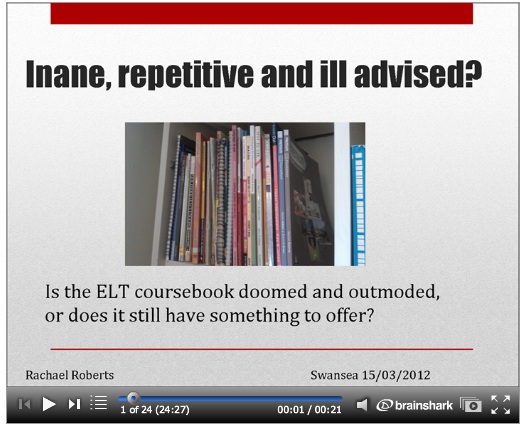
Inane, repetitive and illadvised? Is the ELT coursebook doomed and outmoded, or does it still have something to offer?

Inane-repetitive-and-ill-advised-Is-the-ELT-coursebook-outmoded-or-does-it-still-have-something-to-o-883693503

This is a version of a talk I gave at Swansea University in March 2012. It’s about 25 minutes, plus time to read some of the slides, so get a cup of coffee first!

Some of the questions I try to answer:

  • How is the methodology behind a coursebook decided on?
  • Are we now in an era of ‘textbook defined practice’?
  • Should we be using coursebooks at all, and if so how should we be using them?

9 Comments

Filed under Different ways to use a coursebook, Teaching methodology